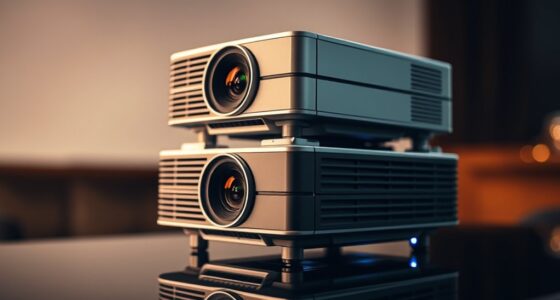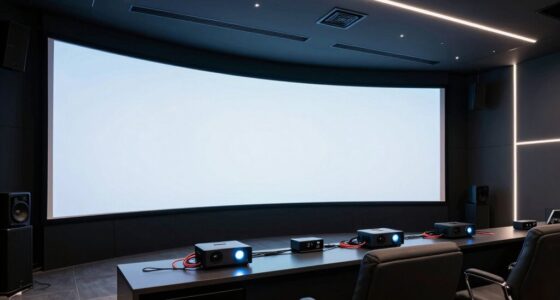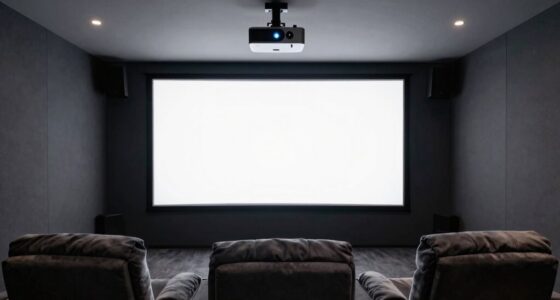
The throw ratio directly influences how you plan your room layout from the start. It determines the projector’s placement relative to your screen, affecting where you can position seating, furniture, and even ceiling height. Choosing the right throw ratio helps you avoid space issues like tiny images or awkward distances. Getting this right early on saves you time and money, and sets the stage for ideal image quality. Keep going to discover more tips for perfect room setup.

Get business pricing on your home office setup
- Business-only prices and quantity discounts
- Tax-exempt purchasing
- Multiple users, one account, clear invoices
Key Takeaways
- The throw ratio determines optimal projector placement for desired screen size, guiding initial room layout decisions.
- It influences room dimensions, ceiling height, and mounting options to ensure proper projection setup.
- Selecting the right throw ratio early prevents space issues, such as images being too small or too distant.
- It helps plan seating arrangements and viewer distances for optimal image clarity and comfort.
- Considering throw ratio from the start ensures seamless integration with room design and reduces future adjustments.
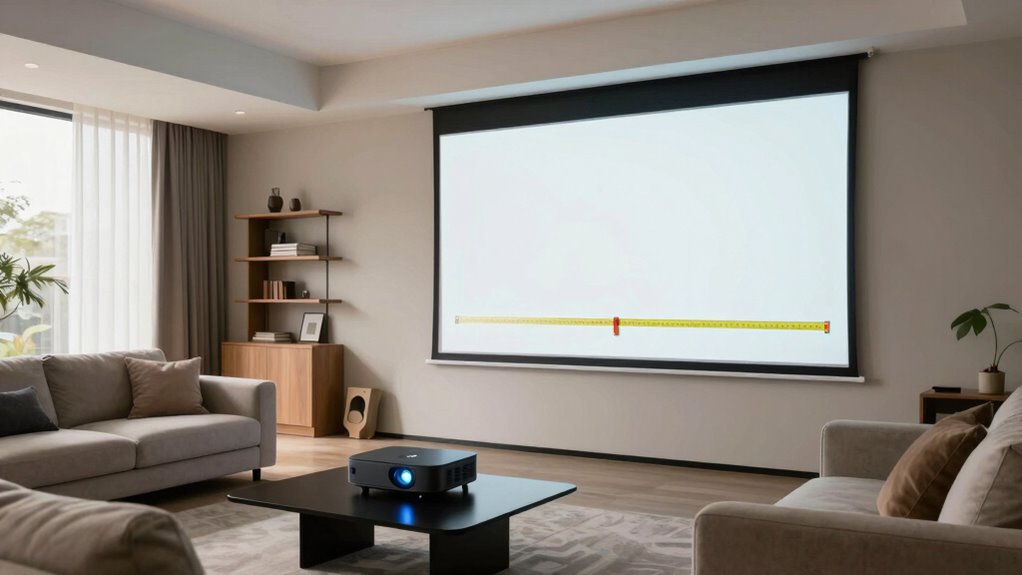
Have you ever wondered how to choose the right projector for your space? One of the most important factors to take into account is the throw ratio, which directly impacts how you plan your room from the very beginning. Throw ratio determines the relationship between the projector’s distance from the screen and the width of the image it produces. Basically, it helps you decide how far back you need to place the projector to get the desired screen size. If you’re working with limited space, understanding throw ratio guarantees you won’t end up with a tiny image or an overly distant projector that’s hard to integrate into your room’s layout.
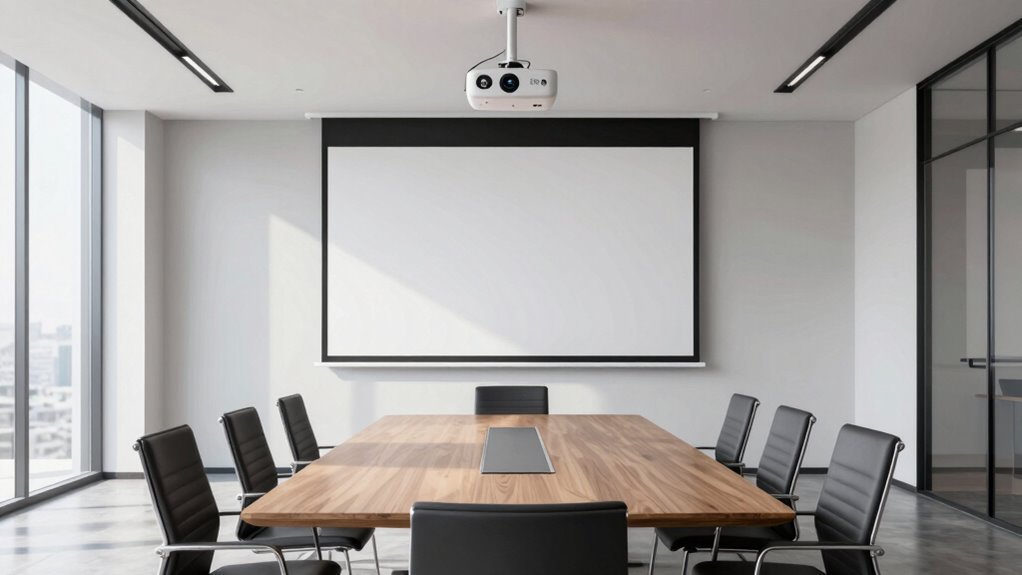
Projection flexibility is a key benefit influenced by throw ratio. A projector with a short throw ratio allows you to place it closer to the screen, making it ideal for small rooms or spaces where mounting options are limited. Conversely, long-throw projectors require more distance but can cover larger areas, which is perfect for big auditoriums or conference rooms. By taking into account the throw ratio early on, you can select a projector that offers the right projection flexibility for your environment, avoiding the need for extensive room modifications later. This foresight simplifies planning and guarantees your setup is both functional and aesthetically pleasing. Additionally, understanding the projection environment helps ensure compatibility with your room’s design and architecture.
Viewing distance is another critical aspect affected by throw ratio. It’s tempting to think about image size alone, but how far the projector sits from the screen impacts image clarity and overall viewing experience. A projector with an appropriate throw ratio allows you to maximize viewing distance, ensuring the picture is sharp and bright without straining viewers’ eyes. If you choose a projector with a mismatched throw ratio, you might find yourself with a screen that’s either too small from a long distance or too large and distorted when placed too close. Planning with throw ratio in mind helps you find the right balance, providing an immersive viewing experience without the hassle of repositioning or recalibrating the setup.
From day one, taking into account throw ratio influences every element of room planning — from seating arrangements to ceiling height and mounting options. It guarantees your projector fits seamlessly into your space, provides the right image size, and offers the projection flexibility you need. Ignoring this detail can lead to awkward placements, poor image quality, and frustration down the line. By understanding how throw ratio shapes your setup, you’re empowered to make smarter choices that save time, money, and effort, creating an optimal projection environment from the start. Additionally, understanding projector placement helps optimize your overall room design, ensuring a cohesive and functional setup.
short throw projector for small rooms
As an affiliate, we earn on qualifying purchases.
As an affiliate, we earn on qualifying purchases.
Frequently Asked Questions
How Do I Measure My Room’s Dimensions Accurately?
To measure your room’s dimensions accurately, start by measuring the ceiling height using a tape measure from floor to ceiling. Next, measure the length and width of the room. Don’t forget to note window placement, as it can affect projector setup and throw ratio considerations. Use a level or laser measure for precision, ensuring all measurements are clear and consistent to plan your space effectively.
What Are Common Mistakes When Planning With Throw Ratio?
Think of planning your projector setup like tuning a musical instrument—you need precise calibration. A common mistake is neglecting ambient light considerations, which can wash out the image, or misjudging the throw ratio, resulting in a distorted picture. Failing to account for these factors leads to poor image quality. Always calibrate your projector correctly and consider room lighting to avoid these pitfalls and guarantee a stunning viewing experience.
How Can I Optimize Sound Quality Alongside Throw Ratio?
To enhance sound quality alongside throw ratio, focus on strategic speaker placement and acoustic treatments. Position speakers to minimize reflections and dead spots, ensuring clear audio. Use acoustic panels or diffusers to control sound reflections and improve clarity. Balancing these elements with your throw ratio helps create a harmonious space, delivering both ideal image size and superior sound quality without compromise. Regularly test and adjust to fine-tune your setup.
Does Room Shape Impact Optimal Throw Ratio Choice?
Think of your room as a canvas; its shape defines how your projector paints the picture. Room shape considerably impacts the ideal throw ratio choice because it influences the projection angle needed to fill the screen. Narrow or irregular rooms may require a different throw ratio to avoid distortions or shadows, ensuring your image is crisp and properly aligned. Adjusting the throw ratio based on room shape helps create a seamless visual experience.
Are There Specific Projectors Better for Small Rooms?
For small rooms, you should choose projectors with higher brightness and a suitable throw ratio to comfortably fill your screen size without overwhelming the space. Compact projectors with short-throw lenses are ideal, as they can project large images from a short distance. Look for models that balance brightness and throw ratio, ensuring clear, vivid images without creating clutter or shadows, making your small room setup seamless and effective.
long throw projector for large spaces
As an affiliate, we earn on qualifying purchases.
As an affiliate, we earn on qualifying purchases.
Conclusion
Understanding throw ratio is like having a secret weapon in room planning—you get clarity from the start. Without it, you risk a space where the projector’s image is either lost in the room or overwhelming your area. It’s the difference between a seamless setup and constant adjustments. So, embrace the throw ratio, and design with confidence. After all, precision today means a perfect viewing experience tomorrow—because in room planning, foresight truly pays off.
projector ceiling mount adjustable
As an affiliate, we earn on qualifying purchases.
As an affiliate, we earn on qualifying purchases.
projector screen size calculator
As an affiliate, we earn on qualifying purchases.
As an affiliate, we earn on qualifying purchases.
Columbus Day / Indigenous Peoples' Day Picks
long weekend sales
As an affiliate, we earn on qualifying purchases.