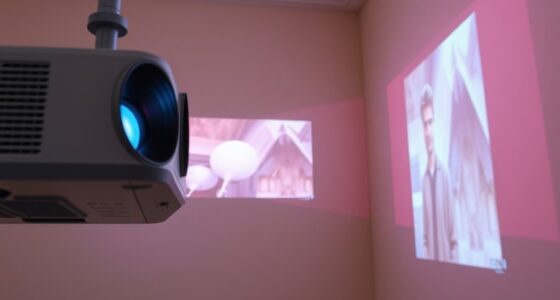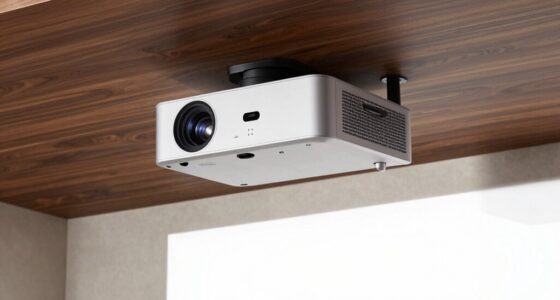
To determine the best mounting height for your projector, consider your room ceiling height, screen size, and project angle. Mount it too low, and you risk shadows or glare; too high, and the image may become distorted or need adjustment. Ideally, position the projector about 3 to 4 feet from the ceiling when possible, aiming for a downward tilt of 20-30 degrees. For more detailed guidance, continue exploring to guarantee your setup is both safe and ideal.

Get business pricing on your home office setup
- Business-only prices and quantity discounts
- Tax-exempt purchasing
- Multiple users, one account, clear invoices
Key Takeaways
- Mount your projector 7 to 12 feet above the floor for optimal image size and clarity, depending on room size.
- Aim for a ceiling angle of about 20 to 30 degrees downward to minimize distortion and keystone effects.
- Consider ceiling height: higher ceilings allow more flexibility, while low ceilings require careful height adjustments.
- Balance mounting height to prevent glare, shadows, or obstructions while maintaining easy access for maintenance.
- Adjust the projector’s height to achieve a proper projection angle that aligns with the screen for a sharp, distortion-free image.
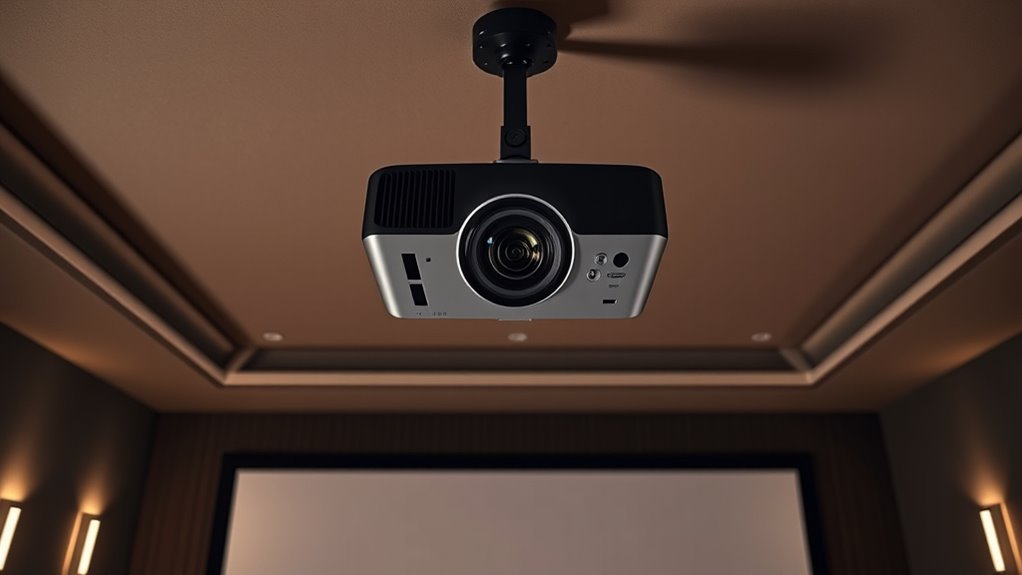
Have you ever wondered how the height at which you mount a device or fixture can impact its performance and safety? When it comes to projectors, the mounting height is vital for achieving ideal image quality and guaranteeing safe, reliable operation. One key factor to consider is the projection angle, which directly relates to where you position your projector. If you mount it too high or too low, you risk skewed images, distorted proportions, or uneven focus. Ideally, you want the projector to be positioned so that the projection angle minimizes keystone distortion and produces a clear, square image.
Choosing the right ceiling mount is essential because it provides a stable, secure platform for your projector. A ceiling mount allows you to position the projector at the perfect height, often near the ceiling, ensuring it’s out of the way and less prone to accidental bumps or damage. When selecting a ceiling mount, consider the projector’s throw distance and lens shift capabilities. These features help determine the appropriate mounting height and distance from the screen, making sure the image fits perfectly without needing excessive adjustments later.
Choosing the right ceiling mount ensures stability, proper height, and optimal image fit for your projector.
Mounting your projector too low might have the advantage of easy access for maintenance, but it can introduce issues with glare, shadows, or obstructions. Conversely, mounting it too high might improve aesthetics and reduce accidental contact, but it can also make adjustments more difficult and may affect the projection angle. Striking the right balance is key. The goal is to install the projector at a height that allows for a comfortable projection angle—usually around a 20 to 30-degree downward tilt from the ceiling—so that the image lands accurately on the screen without distortion.
Another consideration is the room’s layout and size. High ceilings can give you more flexibility in positioning, but they also demand a sturdy ceiling mount capable of supporting the weight. If your ceiling is low, you’ll need to ensure the projector’s height doesn’t cause the image to be too steep or difficult to align. Properly adjusting the projection angle through the ceiling mount setup ensures a seamless viewing experience while maintaining safety standards. Additionally, understanding the contrast ratio of your projector can help you fine-tune its placement for optimal image quality in different lighting conditions.
As an affiliate, we earn on qualifying purchases.
Frequently Asked Questions
How Does Ceiling Height Affect Projector Mounting Options?
Ceiling height directly impacts your projector mounting options by influencing ceiling compatibility and room acoustics. If your ceiling is too high, you may need an extension or a specialized mount to guarantee proper projection alignment. Low ceilings can limit placement choices and affect acoustics, possibly causing sound reflections. Consider your room’s height to select the right mount, optimize image quality, and improve overall acoustics for a better viewing experience.
Can Projector Mounting Height Impact Image Quality?
You might be surprised, but your projector’s mounting height can definitely influence image quality. If positioned too high or low, projection distortion can occur, leading to skewed visuals and reduced image clarity. By choosing the right mounting height, you ensure a crisp, accurate display. Proper placement minimizes distortion and keeps your visuals sharp, making your viewing experience more immersive and enjoyable.
What Tools Are Needed to Measure Optimal Mounting Height?
To measure ideal mounting height, you need a tape measure or ruler for precise distance, a laser level to guarantee accurate projection alignment, and a pencil or marker to mark mounting spots. Additionally, use a stud finder to locate secure mounting hardware points. These tools help you position your projector correctly, ensuring the image aligns properly and maintains quality. Proper measurement prevents image distortion and ensures a seamless viewing experience.
How Do Different Mounting Heights Influence Projector Maintenance Access?
Think of your projector’s mounting height as a delicate dance—each step affects ceiling aesthetics and installation complexity. When mounted higher, maintenance access becomes trickier, often requiring ladders or special tools, disrupting the sleek look. Lower mounts offer easier access but can clutter your space. You’ll want a height that balances aesthetic appeal with maintenance ease, ensuring your setup remains both beautiful and functional, without turning maintenance into a climb.
Is There a Recommended Mounting Height for Specific Projector Types?
For specific projector types, a recommended mounting height depends on your projection angle and ceiling compatibility. You should position your projector so it creates a proper projection angle for clear images without distortion. Generally, ceiling compatibility guides the height, ensuring the projector fits well and maintains ideal image quality. Check your projector’s manual for recommended mounting heights tailored to your model, and adjust accordingly to avoid strain on maintenance or adjustments later.
As an affiliate, we earn on qualifying purchases.
Conclusion
When it comes to mounting your projector, finding the perfect height is like tuning a fine instrument—you want everything to harmonize just right. While there’s no one-size-fits-all answer, paying attention to your room’s details can make a subtle difference. With a little patience and care, you’ll create an inviting space that feels just right, inviting everyone to enjoy the show without a hitch. After all, a well-placed projector sets the stage for memorable moments.
As an affiliate, we earn on qualifying purchases.
As an affiliate, we earn on qualifying purchases.
Halloween Picks
halloween
As an affiliate, we earn on qualifying purchases.