
Your speaker placement plays a bigger role in sound quality than many realize. Proper positioning affects how sound waves travel, reflect, and interact with your room’s acoustics, which impacts clarity and bass response. If your speakers are misplaced, you might experience echoes, dead spots, or muddy sound that ruins your listening experience. By understanding how placement influences sound, you can dramatically improve your setup and enjoy richer, clearer audio — if you keep exploring, you’ll discover how to optimize your space even further.

Get business pricing on your home office setup
- Business-only prices and quantity discounts
- Tax-exempt purchasing
- Multiple users, one account, clear invoices
Key Takeaways
- Proper placement ensures balanced sound distribution and avoids dead spots or echoes in the room.
- Speaker positioning directly influences sound clarity, imaging, and bass response.
- Incorrect placement can cause sound reflections and resonances, reducing audio quality.
- Optimal positioning maximizes the effectiveness of room acoustics and minimizes unwanted reflections.
- Even high-quality speakers perform best when properly aligned with room acoustics and furniture.
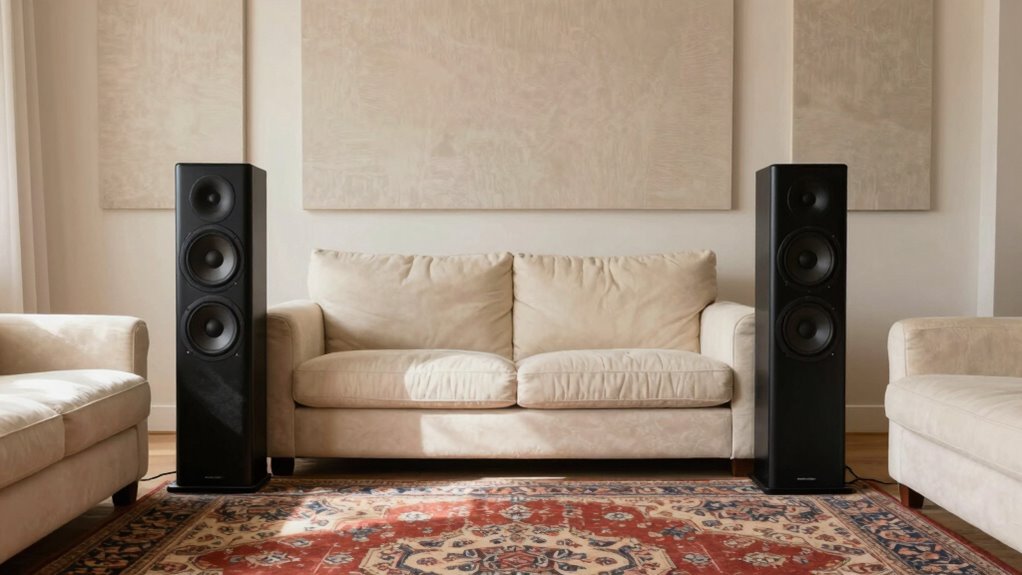
Have you ever wondered why your audio sounds off despite having good speakers? The answer often lies in the way your space interacts with sound, making room acoustics a fundamental factor. Even the most expensive speakers can underperform if placed improperly. Your room’s size, shape, and furnishings influence how sound waves travel and reflect, creating echoes or dead spots that distort audio clarity. This is why understanding room acoustics is essential for peak sound quality. When you position your speakers without considering these factors, you risk muddled sound, uneven bass, and diminished clarity, regardless of your speaker’s quality.
Room interactions shape sound quality; proper placement and acoustics optimize your listening experience.
Another key aspect is speaker calibration, which involves adjusting your system to account for room characteristics. Proper calibration ensures that your speakers deliver balanced sound across the frequency spectrum, compensating for room-induced anomalies. If you ignore calibration, you might notice that certain sounds are too loud or too soft, and your audio might lack the depth and precision it should have. Calibration tools and techniques can help you fine-tune your setup, aligning the sound output with your room’s unique acoustics. This process is especially important if you move your speakers or rearrange your furniture, as even small changes can impact sound quality. Additionally, room acoustics play a crucial role in how your sound system performs and should be carefully considered during setup. Paying attention to sound reflection and absorption properties can further improve your listening environment. Incorporating sound treatment options can help manage unwanted reflections and resonances, creating a cleaner sound. Recognizing the importance of acoustic treatment can make a significant difference in achieving optimal audio performance. Moreover, understanding how furnishings and room materials influence sound reflection can help you make better decisions for your space.
speaker placement calibration tools
As an affiliate, we earn on qualifying purchases.
As an affiliate, we earn on qualifying purchases.
Frequently Asked Questions
How Do Room Acoustics Influence Speaker Placement Choices?
Room acoustics greatly influence your speaker placement choices because factors like room symmetry and furniture reflectivity affect sound quality. You should position speakers where they face open, symmetrical spaces to avoid uneven sound distribution. Keep furniture reflectivity in mind, avoiding placing speakers near reflective surfaces that can cause echo or distortion. Adjusting your setup based on these acoustic elements guarantees clearer, more balanced audio for a suitable listening experience.
What Are Common Mistakes to Avoid When Positioning Speakers?
Avoid common mistakes like neglecting speaker symmetry and furniture interference. You might think placing speakers randomly improves sound, but uneven positioning creates imbalances. Keep speakers at ear level, equidistant from the listening spot, and guarantee furniture doesn’t block sound waves. Don’t ignore room acoustics—uneven symmetry or obstructions can distort audio. Proper placement enhances clarity, while poor positioning dulls the listening experience. Mind these details for maximum sound quality.
Does Speaker Height Impact Sound Quality Significantly?
Yes, speaker height considerably impacts sound quality because it affects sound elevation and how sound waves reach your ears. If speakers are too high or low, you might miss out on balanced audio and clear dialogue. Properly positioning your speakers at ear level ensures ideal sound clarity and imaging. Adjusting speaker height can improve the overall listening experience, making sure you hear every detail with accuracy and depth.
How Can I Test if My Speaker Placement Is Optimal?
You can test if your speaker placement is ideal by listening for balanced sound and clear bass localization. Make sure your speakers are symmetrically positioned relative to your listening area for even sound distribution. Adjust their angles and distances, then sit in your usual listening spot to evaluate clarity and bass response. Use your ears to detect any imbalance or muddiness, fine-tuning until you achieve a natural, immersive sound.
Are There Differences in Placement for Different Types of Speakers?
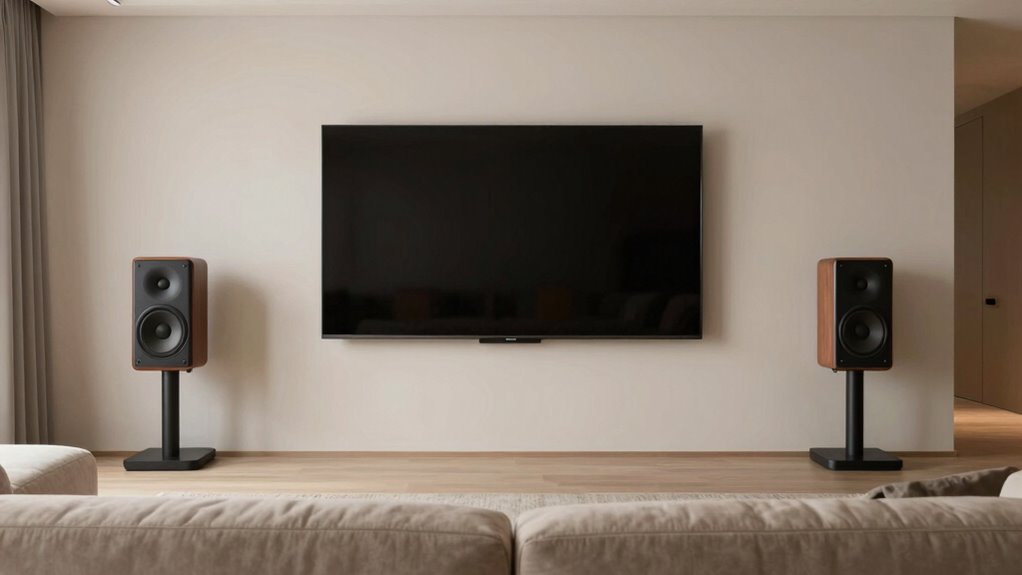
Yes, different speakers require varied placement. For example, bookshelf speakers benefit from symmetrical placement and avoiding furniture interference to prevent sound distortion. Floor-standing speakers often need more space around them for ideal bass and clarity, while center channels should be aligned with your TV for proper imaging. Always consider speaker symmetry and furniture interference when positioning each type to guarantee the best sound experience.
As an affiliate, we earn on qualifying purchases.
Conclusion
Remember, the way you position your speakers can make or break your listening experience. It’s easy to think placement isn’t essential, but even small adjustments can dramatically improve sound quality. Don’t assume you’ll get perfect sound without effort—your ears will thank you for taking the time. Investing a bit of patience now guarantees you enjoy richer, clearer audio every time you press play, proving that speaker placement truly matters more than many buyers realize.
sound reflection absorption panels for speakers
As an affiliate, we earn on qualifying purchases.
As an affiliate, we earn on qualifying purchases.
speaker stands for optimal positioning
As an affiliate, we earn on qualifying purchases.
As an affiliate, we earn on qualifying purchases.
Fall Picks
fall essentials
As an affiliate, we earn on qualifying purchases.