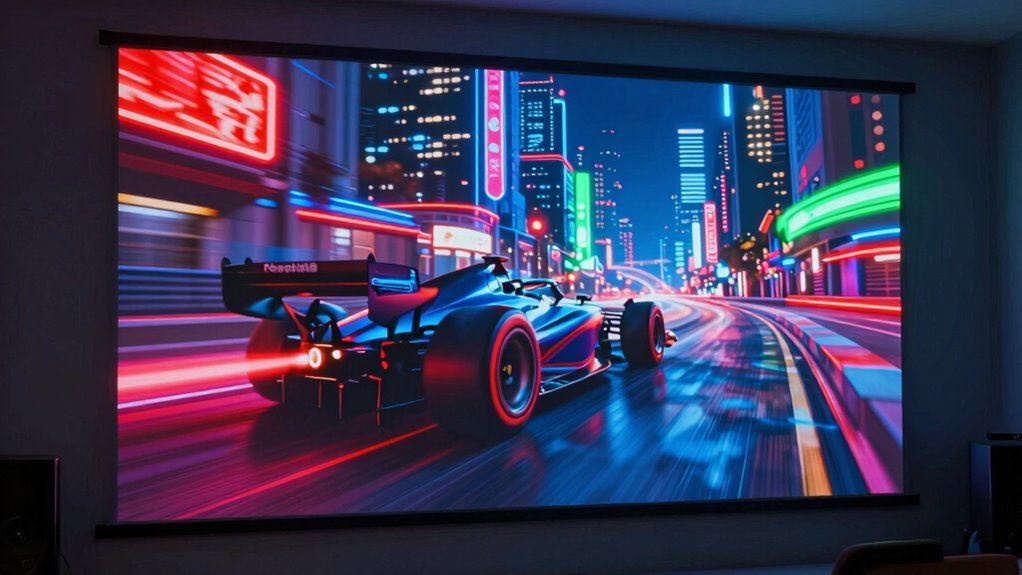

For racing games, a projector has to make track detail easy to read without letting control response, room lighting, or placement get in the way. My strongest all-round pick is the Optoma GT2400HDR: its 4,200 lumens, short-throw design, and laser light source suit a bright, space-conscious gaming room. The Optoma GT3900UHD is the resolution choice for buyers who want native 4K as well as a short throw, while the BenQ TK700 offers another route to 4K gaming when there is room to position a standard-throw projector.

Get your home office setup delivered free — and shop member deals
- Fast, free delivery on millions of items
- Access to Prime Big Deal Days deals on October 6–7
- Prime Video, Amazon Music and more included
The tradeoff is clear: the Optoma short-throw models are easier to fit close to a wall and generally brighter on paper, but most are native 1080p; the BenQ and GT3900UHD provide native 4K, but their brightness, placement, or cost of setup may make them a less straightforward fit. I ranked these five around racing-game priorities—input response, image clarity, usable brightness, and placement—rather than treating any one specification as a guarantee of a better drive.
Complete the kit


Key Takeaways
- GT2400HDR leads for a bright room and close placement, with 4,200 lumens and a laser source, but its native resolution is 1080p.
- GT3900UHD is the short-throw 4K choice, combining native 3840 × 2160 resolution with 4,000 lumens.
- BenQ TK700 pairs native 4K with a stated 16 ms input lag; its 3,200-lumen rating is lower than the brightest Optoma picks.
- GT1080HDR is the lamp-based short-throw option for buyers who value bright 1080p play over laser longevity or native 4K.
- GT2300HDR offers short-throw laser convenience and a 30,000-hour stated life, but its 1080p resolution and 3,600-lumen rating trail the leading options.
| Optoma GT2400HDR |  | Best Overall for Bright, Close-Range Racing | Native resolution: 1920 × 1080 | Maximum listed resolution: 3840 × 2160 | Brightness: 4,200 lumens | VIEW ON AMAZON | See Our Full Breakdown |
| Optoma GT3900UHD | | Best Short-Throw Native 4K Pick | Native resolution: 3840 × 2160 | Brightness: 4,000 lumens | Throw ratio: 0.496:1 | VIEW ON AMAZON | See Our Full Breakdown |
| BenQ TK700 |  | Best for Native 4K Gaming with a Standard Throw | Native resolution: 3840 × 2160 | Brightness: 3,200 lumens | Input lag: 16 ms listed | VIEW ON AMAZON | See Our Full Breakdown |
| Optoma GT1080HDR |  | Best Lamp-Based Short-Throw Value | Native resolution: 1920 × 1080 | Brightness: 3,800 lumens | Contrast ratio: 50,000:1 | VIEW ON AMAZON | See Our Full Breakdown |
| Optoma GT2300HDR | | Best for Long-Life Laser 1080p Setups | Native resolution: 1920 × 1080 | Brightness: 3,600 lumens | Display type: Laser | VIEW ON AMAZON | See Our Full Breakdown |
| projectors for racing game | Native resolution | Brightness | Connectivity | Throw distance |
|---|---|---|---|---|
| Optoma GT2400HDR | 1920 × 1080 | 4,200 lumens | HDMI, Ethernet, USB, VGA | 2.6–3.7 feet |
| Optoma GT3900UHD | 3840 × 2160 | 4,000 lumens | HDMI | — |
| BenQ TK700 | 3840 × 2160 | 3,200 lumens | HDMI, USB 2.0 Type A | — |
| Optoma GT1080HDR | 1920 × 1080 | 3,800 lumens | HDMI, VGA, USB | 1.3–11.5 feet |
| Optoma GT2300HDR | 1920 × 1080 | 3,600 lumens | HDMI | 2.6–3.7 feet |
More Details on Our Top Picks
Optoma GT2400HDR
I put the GT2400HDR first because it brings together the most useful features for a broad range of racing-game rooms: a short-throw lens, 4,200 lumens, native 1080p, and a 30,000-hour DuraCore laser light source. It can sit about 2.6 to 3.7 feet from the image surface, making a large view more feasible when a couch, wheel stand, or room layout leaves little space behind the player. The high stated brightness is also a practical advantage if the room is not fully dark.
Its main compromise is resolution. The projector is native 1080p, though it accepts a maximum 3840 × 2160 display resolution, so buyers should not mistake compatibility for native 4K detail. The GT3900UHD is the better match if crisp 4K track textures matter more than brightness, while the GT2400HDR makes a stronger case when ambient light and placement are bigger concerns. Its long-life laser also sidesteps the lamp replacement consideration that applies to the GT1080HDR.
The available information calls out low input lag for gaming but does not provide a specific measurement. I would check the response and refresh-rate modes against the console or PC being used rather than assume every input mode performs alike. The GT2400HDR is a compelling practical pick, not a substitute for a purpose-built high-refresh monitor or a dark-room native-4K setup.
Pros:- 4,200-lumen rating is the highest listed here.
- Short-throw range supports close placement in compact rooms.
- Laser light source is specified for up to 30,000 hours.
- Gaming-focused low input lag is listed.
Cons:- Native resolution is 1920 × 1080, not 4K.
- No exact input-lag measurement is supplied in the product details.
- Short-throw installation still needs careful alignment to avoid image distortion.
Best for: Racing players who need a bright short-throw image, use a compact room, and prefer a laser light source over native 4K resolution.
Not ideal for: Buyers who want native 4K detail or need a published input-lag figure before choosing a projector.
- Native resolution:1920 × 1080
- Maximum listed resolution:3840 × 2160
- Brightness:4,200 lumens
- Light source:DuraCore laser
- Stated light-source life:Up to 30,000 hours
- Throw distance:2.6–3.7 feet
- Connectivity:HDMI, Ethernet, USB, VGA
Our verdict“I recommend the GT2400HDR for players who prioritize bright, space-efficient 1080p racing over native 4K.”
Optoma GT3900UHD
For buyers who want genuine 4K detail without giving up short-throw placement, the GT3900UHD is the standout. Its 3840 × 2160 native resolution gives fine track markings, distant scenery, and interface elements more detail than the 1080p GT2400HDR or GT2300HDR can display natively. The 0.496:1 throw ratio is especially relevant in a racing setup: the projector can create a large image from close range, reducing the chance that the player or wheel blocks the beam.
It is also rated at 4,000 lumens and supports HDR, making it more flexible than a dimmer projector when the room cannot be completely dark. Gaming modes are described as low-lag, with support for 1080p at 240 Hz and 4K at 60 Hz. Those modes address different priorities: high refresh at 1080p can suit players chasing smoother motion, while 4K at 60 Hz favors image detail. Buyers should check which signal modes their source and game support.
Compared with the GT2400HDR, the GT3900UHD trades a little listed brightness for native 4K. It is also more demanding as a purchase decision because its provided details do not quantify input lag, and the unusually short listed minimum distance and installation geometry need checking against the actual room and screen. This is my pick for a small room where native 4K and short throw both matter, not the automatic choice for anyone focused solely on brightness or a measured response time.
Pros:- Native 3840 × 2160 resolution displays 4K detail.
- 0.496:1 short-throw design suits space-limited setups.
- 4,000-lumen rating and HDR compatibility support flexible viewing.
- Lists 1080p at 240 Hz and 4K at 60 Hz gaming support.
Cons:- Lower listed brightness than the GT2400HDR.
- No exact input-lag figure is provided.
- Placement and screen fit need close checking because throw geometry is specialized.
Best for: Racing-game players who want native 4K, a short-throw installation, and a stated choice between high-refresh 1080p and 4K/60 Hz modes.
Not ideal for: Buyers who mainly want the highest listed brightness or require a precise input-lag measurement before purchase.
- Native resolution:3840 × 2160
- Brightness:4,000 lumens
- Throw ratio:0.496:1
- Minimum throw distance:1.08 feet
- Maximum throw distance:10.8 feet
- Gaming modes listed:1080p at 240 Hz; 4K at 60 Hz
- Light-source life:Up to 30,000 hours
- Connectivity:HDMI
Our verdict“I would choose the GT3900UHD when a compact room needs native 4K and short-throw flexibility in the same projector.”
BenQ TK700
The BenQ TK700 is the natural alternative for players who want native 4K but do not need the short-throw placement of the Optoma GT3900UHD. It pairs 3840 × 2160 resolution with a stated 16 ms input lag, giving buyers a concrete response figure to compare with their gaming needs. For racing games, that published number is more useful than a general low-lag claim, although performance can vary by input mode and source.
At 3,200 lumens, it has a lower brightness rating than the four Optoma options here, especially the GT2400HDR and GT1080HDR. That makes room lighting and screen size more important to the setup. Its listed maximum throw distance is five meters, but no short-throw ratio is supplied, so I would confirm the projector-to-screen distance before planning a wide image. If the projector must sit close to the wall, the GT3900UHD is a more suitable 4K candidate.
The TK700’s native 4K image and gaming-oriented specification make it appealing for a dedicated setup, but the listing’s lamp-life figure is only 4,000 hours, well below the 30,000-hour laser figures on the GT2400HDR, GT2300HDR, and GT3900UHD. I rank it below those options for flexibility and long-term light-source convenience, not because 4K is unimportant. Choose it when native 4K and a stated lag figure take priority over short throw and laser longevity.
Pros:- Native 3840 × 2160 resolution supports detailed racing visuals.
- A 16 ms input-lag figure is provided.
- HDMI and USB connectivity support common gaming and media sources.
- Three-year warranty is listed.
Cons:- 3,200-lumen rating is below all four Optoma picks.
- Listed light-source life is 4,000 hours, shorter than the laser alternatives.
- No short-throw ratio is supplied, so room fit needs verification.
Best for: Players with room for standard-throw placement who want native 4K and a stated 16 ms input-lag figure.
Not ideal for: Buyers with a very small room, a bright viewing environment, or a preference for a long-life laser light source.
- Native resolution:3840 × 2160
- Brightness:3,200 lumens
- Input lag:16 ms listed
- Contrast ratio:10,000:1
- Light-source life:4,000 hours listed
- Maximum throw distance:5 meters
- Connectivity:HDMI, USB 2.0 Type A
- Warranty:3 years
Our verdict“I recommend the TK700 for a room with suitable throw distance where native 4K and a stated response figure outweigh brightness and lamp longevity.”
Optoma GT1080HDR
The GT1080HDR is aimed at players who want a bright, large 1080p image from close to the screen and do not need native 4K. It is rated at 3,800 lumens and can project a 100-inch image from just over three feet, which makes it easier to fit around a racing seat or wheel rig than a conventional longer-throw projector. That short-throw convenience is the key reason to consider it over the BenQ TK700 if room depth is limited.
It supports 4K HDR input, but its native resolution remains 1920 × 1080. For a racing game, 1080p can still deliver a large, readable view, but buyers seeking fine 4K detail should look at the GT3900UHD or BenQ TK700. It also uses a lamp rather than the long-life laser source found in the GT2400HDR and GT2300HDR. The listed lamp life is 15,000 hours, so it sits between those laser options and the BenQ’s stated 4,000-hour figure.
The product information describes low input lag without giving a number, and it does not provide detailed speaker or mounting information. I would treat it as a display choice for a dedicated gaming setup and plan on external audio if sound quality matters. It is more straightforward than a 4K projector for buyers who simply want a big, bright 1080p image, but the GT2400HDR offers higher stated brightness and laser operation.
Pros:- 3,800-lumen rating suits a range of room-light conditions.
- Can project a 100-inch image from just over three feet.
- 4K HDR input compatibility is listed.
- Lamp life is specified at up to 15,000 hours.
Cons:- Native resolution is 1080p despite 4K HDR input support.
- Lamp replacement is a maintenance consideration compared with laser models.
- No exact input-lag measurement is provided.
Best for: Racing players who need a bright 1080p short-throw projector and are comfortable with a lamp-based light source.
Not ideal for: Buyers who want native 4K, a laser light source, or a published numerical input-lag result.
- Native resolution:1920 × 1080
- Brightness:3,800 lumens
- Contrast ratio:50,000:1
- Lamp life:Up to 15,000 hours
- Throw distance:1.3–11.5 feet
- Projection size:Up to 307 inches listed
- Connectivity:HDMI, VGA, USB
Our verdict“I would pick the GT1080HDR for a bright, close-placement 1080p setup when native 4K and laser operation are not priorities.”
Optoma GT2300HDR
The GT2300HDR makes sense for a player who wants the practical benefits of short throw and a long-life laser but does not need native 4K. Its native 1080p resolution is paired with a 3,600-lumen rating and a listed 30,000-hour laser life. In regular gaming use, avoiding routine lamp changes can be a meaningful convenience, especially if the projector will also handle movies or sports.
Its specified throw range is 2.6 to 3.7 feet, similar to the GT2400HDR, though the latter is rated brighter at 4,200 lumens. That difference puts the GT2300HDR in a narrower role: it is a short-throw laser option for users who value the light source and installation format, while the GT2400HDR has the stronger brightness case. If 4K detail is the priority, the GT3900UHD offers native 4K and a similarly long stated light-source life.
The GT2300HDR weighs 9.6 pounds, making its mounting support worth checking before installation. Its available details also do not provide a numerical input-lag result, despite describing responsive gaming. I would not choose it on a claim of faster controls than its rivals; its appeal is the combination of laser longevity and compact-room placement. The relatively modest brightness and 1080p ceiling explain why it ranks below the more capable all-round and 4K options.
Pros:- Laser light source is listed for up to 30,000 hours.
- Short-throw range suits a compact room.
- 3,600-lumen rating supports more flexible viewing than a dim home-theater model.
- Gaming-focused low input lag is described.
Cons:- Native resolution is limited to 1920 × 1080.
- Heavier than the GT3900UHD at 9.6 pounds.
- No exact input-lag measurement is listed.
Best for: Players who want short-throw 1080p gaming with a long-life laser source and can use a sturdy tabletop or mount.
Not ideal for: Buyers who want native 4K, the highest brightness in this group, or the lightest projector to mount.
- Native resolution:1920 × 1080
- Brightness:3,600 lumens
- Display type:Laser
- Light-source life:Up to 30,000 hours
- Throw distance:2.6–3.7 feet
- Weight:9.6 pounds
- Connectivity:HDMI
- Mounting:Tabletop, wall, floor
Our verdict“I recommend the GT2300HDR when laser longevity and short-throw placement matter more than native 4K or maximum brightness.”

How We Picked
I ranked these projectors for the demands of racing games, not as general-purpose home theater picks. A wide racing view can make track position, braking points, and dashboard information easier to follow, but only if the image is clear at the chosen screen size and the projector can be installed at a practical distance. I gave weight to native resolution, stated brightness, short-throw flexibility, light-source life, and any supplied input-lag information. I also separated native resolution from accepted input: a projector that accepts a 4K signal does not thereby display a native 4K image.
Where product details specify a gaming response figure, I use it carefully rather than treating it as a direct, universal comparison. The GT3900UHD lists support for 1080p at 240 Hz and 4K at 60 Hz with low input lag, while the BenQ listing gives a 16 ms figure. The other descriptions call out low input lag without providing a number, so I do not invent one or claim that their response is faster. Console, PC, refresh rate, and selected resolution can all affect the practical experience.
Brightness and placement matter because racing sessions often use a large image, sometimes with room lights on. I favored short-throw options for compact rooms, while still recognizing that a bright projector cannot fully compensate for a poor screen or strong light falling on the image. I also treated laser life as a convenience advantage, not proof of better color or gaming response. My order puts the GT2400HDR first for its unusually strong mix of brightness, short throw, laser operation, and gaming focus; the 4K GT3900UHD follows for buyers who put detail first. The remaining placements reflect their more specific tradeoffs.
| projectors for racing game | Connectivity |
|---|---|
| Optoma GT2400HDR | HDMI, Ethernet, USB, VGA |
| Optoma GT3900UHD | HDMI |
| BenQ TK700 | HDMI, USB 2.0 Type A |
| Optoma GT1080HDR | HDMI, VGA, USB |
| Optoma GT2300HDR | HDMI |
Factors to Consider When Choosing Projectors For Racing Games
I would choose a racing-game projector by starting with the room and the signal the system can actually deliver. A large image is only useful if its placement works, its motion remains comfortable, and the detail suits the screen size.Decide whether native 4K is worth prioritizing
Native resolution is a straightforward way to separate these five options. The GT3900UHD and BenQ TK700 display native 3840 × 2160; the GT2400HDR, GT1080HDR, and GT2300HDR are native 1920 × 1080 models. A 4K input label on a 1080p projector means it can accept that signal, not that it displays all 4K pixels. On a very large racing image, 4K can help keep distant scenery and small interface details crisp. If you sit farther back or prioritize brightness and room fit, 1080p may be a more reasonable tradeoff.
Match throw distance to the racing setup
Measure from the projector’s lens position to the intended screen before choosing. A short-throw model can create a large picture close to the wall, which helps when a wheel stand or seat leaves little space behind the player. The GT3900UHD also advertises a 0.496:1 throw ratio. Do not plan from screen size alone: confirm the model’s projection calculator or manual against your room, mounting position, and image dimensions. A short throw reduces placement problems but does not remove them; poor alignment can still distort the image.
Treat brightness as a room-and-screen question
The listed brightness ratings range from 3,200 lumens on the BenQ TK700 to 4,200 on the GT2400HDR. A higher figure can help an image remain visible with some ambient light, but it cannot make a screen immune to daylight or bright lamps. Screen material, image size, wall color, and light falling directly on the viewing area all matter. For evening play in a controlled room, native detail may matter more than the difference between these ratings; for lights-on play, the brighter Optomas have the stronger paper case.
Check input lag and supported refresh modes
Racing depends on predictable steering and braking response, so I would look for a measured input-lag figure and the resolution and refresh rate at which it applies. The TK700 listing specifies 16 ms; the GT3900UHD lists 1080p at 240 Hz and 4K at 60 Hz with low input lag, but no exact latency figure. Other entries make low-lag claims without a number. Confirm the chosen mode with the console or PC and game, since a headline refresh rate does not guarantee that every resolution, port, or setting supports it.
Compare lamp upkeep with laser life
The GT2400HDR, GT2300HDR, and GT3900UHD list laser life of up to 30,000 hours, while the GT1080HDR lists a 15,000-hour lamp life and the BenQ lists 4,000 hours. These figures are not a direct measure of picture quality, and actual life can depend on use and operating mode. They do help describe upkeep: a laser model may avoid routine lamp replacement, while a lamp-based projector can be a sensible choice if its placement, image, and gaming features suit the setup better.
Plan audio and installation separately
A racing game can benefit from engine and track sound, but these product details do not give enough consistent speaker information to rank built-in audio. I would budget for a separate sound system if sound quality matters. Check weight, mounting method, cable reach, ventilation, and access to controls before fixing the projector in place. The 9.6-pound GT2300HDR is the heaviest option with a supplied weight, while the GT3900UHD is listed at 6.4 pounds. Leave room for airflow and make sure cables do not cross a driving path.
Frequently Asked Questions
Is 1080p enough for racing games on a projector?
For many players, yes. A large 1080p image can make a racing game feel more immersive, and the GT2400HDR, GT1080HDR, and GT2300HDR pair that resolution with short-throw placement. Native 4K can preserve finer scenery and small interface details, particularly on a very large screen or when sitting close. I would choose based on image size, viewing distance, and what the gaming system outputs rather than treating 4K as mandatory.
Which projector here is best for a small room?
The short-throw Optoma models are the most relevant starting point. The GT2400HDR and GT2300HDR list a 2.6-to-3.7-foot throw range, while the GT3900UHD uses a 0.496:1 short-throw lens and offers native 4K. The best fit depends on the exact screen dimensions and projector position, so I would verify the model’s throw calculation before buying. A short throw can reduce distance needs, but it does not remove the need for careful alignment.
Does 4K input support mean a projector is native 4K?
No. The GT2400HDR and GT1080HDR accept 4K input, but their native resolution is 1920 × 1080. The GT3900UHD and BenQ TK700 list native 3840 × 2160 resolution. If native pixel detail matters for your large racing image, compare the native-resolution specification rather than relying only on HDR or maximum-input claims.
What input lag should I look for in a racing-game projector?
There is no single figure that suits every player, but lower measured latency can make steering and braking feel more immediate. Compare figures only when they refer to similar resolution, refresh rate, and picture mode. The BenQ TK700 lists 16 ms, while the other product details use low-lag language without a numerical result; the GT3900UHD also identifies supported refresh and resolution combinations. I would confirm the mode supported by the intended console or PC before deciding.
Can I use a projector for racing games with the lights on?
You can, but room light reduces perceived contrast and can wash out track detail. The GT2400HDR has the highest listed brightness here at 4,200 lumens, followed by the GT3900UHD at 4,000 and GT1080HDR at 3,800. Those specifications give a useful comparison, not a guarantee of a clear image in direct daylight. A controlled-light room and a suitable screen can matter as much as the projector’s stated brightness.
Conclusion
For the widest range of racing setups, I would start with the Optoma GT2400HDR: its 4,200-lumen rating, short throw, and laser source make it the most balanced choice for bright, compact rooms, provided native 1080p is enough. If your priority is a large image with native 4K and close placement, choose the GT3900UHD. The BenQ TK700 is the better fit when you have standard-throw space and value native 4K with a stated 16 ms lag figure.
For a more focused 1080p short-throw setup, the GT1080HDR suits buyers who accept lamp upkeep, while the GT2300HDR is for those who favor long-life laser operation over higher brightness or 4K. Before choosing, I would verify throw distance, image size, and the exact gaming mode supported by the source. Those checks will tell you more about how well a projector fits your racing rig than any single headline specification.
Fall Picks
fall essentials
As an affiliate, we earn on qualifying purchases.