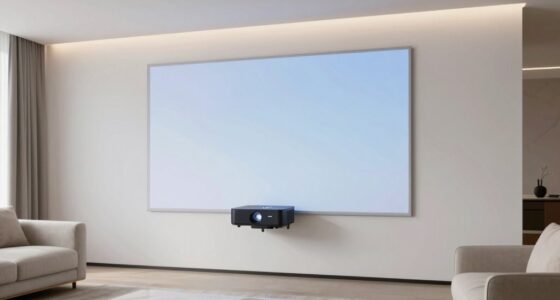
Your projector’s brightness, measured in lumens, doesn’t tell the full story without considering your environment. Factors like room size, ambient light, and whether the space is dark or bright all impact how visible and sharp your images will be. A high lumen projector may still struggle in a well-lit room, while a lower one can work fine in a dark space. Keep exploring to discover how these elements influence your ideal setup.

Get business pricing on your home office setup
- Business-only prices and quantity discounts
- Tax-exempt purchasing
- Multiple users, one account, clear invoices
Key Takeaways
- Brightness perception depends on ambient lighting and room conditions, not just lumen ratings.
- Larger or brighter rooms require higher lumen projectors for clear images.
- Dark environments allow lower lumen projectors to produce vivid images effectively.
- Proper context ensures projector brightness matches room size and lighting for optimal viewing.
- Without considering environment, lumen ratings alone can lead to inadequate or overpowered projector choices.
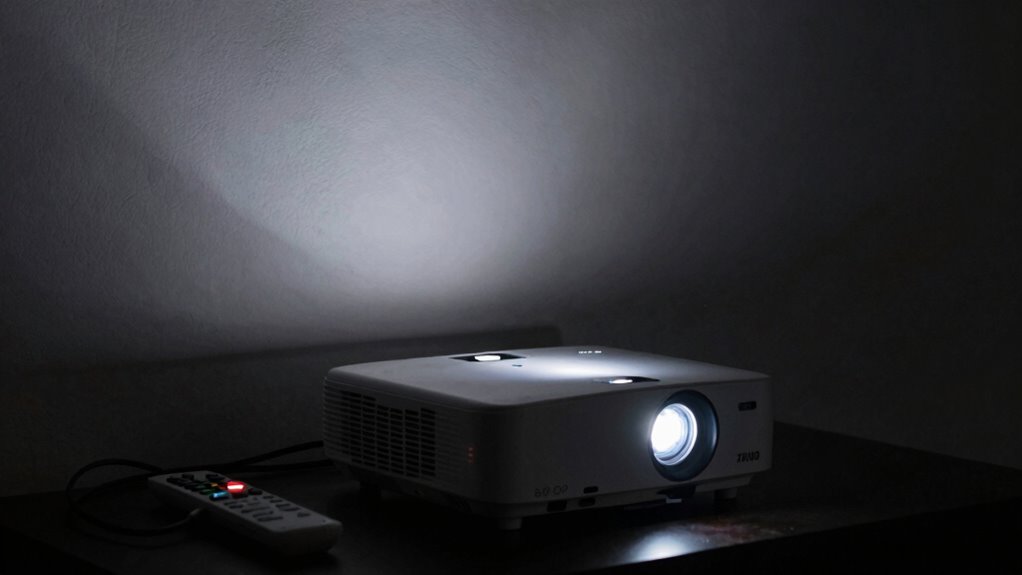
Have you ever wondered how the brightness of a projector impacts your viewing experience? The truth is, without considering the environment where you’ll use it, the numbers on a projector’s lumen rating can be pretty meaningless. Brightness isn’t just a number; it’s a factor that interacts with ambient lighting and room size to determine how well you see your images. For example, if you’re setting up in a small, dark room, a lower-lumen projector might do just fine because there’s minimal ambient light competing with the projected image. But if your room is large and filled with ambient lighting, that same projector might struggle to produce a clear, vibrant picture. Additionally, understanding how Color Temperature concepts influence projector performance can help you select the right device for your needs.
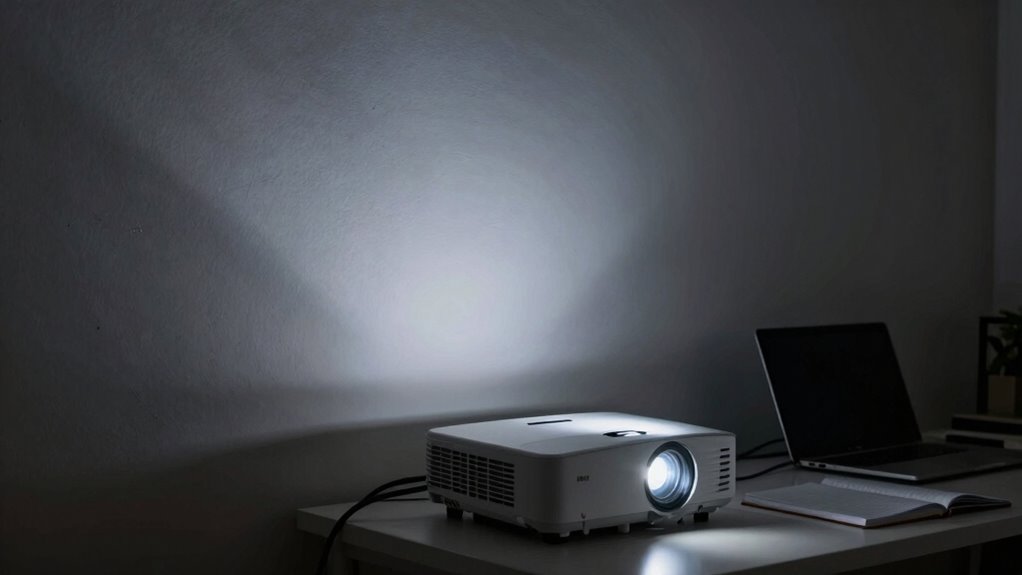
Ambient lighting plays a huge role in how bright your projector’s image appears. Even a high-lumen projector can look dull if there’s a lot of natural or artificial light bouncing around the room. Conversely, in a dim or controlled environment, you don’t need as much brightness to get a sharp picture. That’s why understanding the ambient lighting conditions in your space is key before you buy. If you’re watching movies during the daytime or in a room with big windows, you’ll want a projector with a higher lumen rating to combat the extra light. Conversely, if your movie nights happen in a darkened basement or a room with blackout curtains, a lower lumen projector will serve you just fine and might even save you some money.
Room size also influences how much brightness you need. In larger rooms, the image has to cover more surface area, which means you need more lumens to keep the picture vivid and clear. Otherwise, the image can appear washed out or faint, no matter how powerful the projector’s specs say it is. Smaller rooms or spaces with minimal ambient light allow you to get away with a lower lumen rating, which can be more cost-effective and easier to set up. It’s all about matching the projector’s brightness with the size of your room and how much light is in it.
In the end, the key to understanding projector brightness isn’t just about looking at lumen numbers. It’s about putting those numbers into the context of your specific environment—room size, ambient lighting, and how you plan to use your projector. When you consider all these factors together, you’ll make a smarter choice that results in a better viewing experience, no matter where or when you watch.
As an affiliate, we earn on qualifying purchases.
Frequently Asked Questions
How Is Projector Brightness Measured in Lumens?
You measure projector brightness in lumens by evaluating the total light output, but it’s vital to take into account projector calibration for accurate readings. Proper calibration ensures lumen consistency across different devices, so you get reliable brightness levels. When reviewing a projector, look for lumens specified under standard testing conditions. Keep in mind that actual brightness can vary based on screen size, ambient light, and calibration, making context essential for meaningful comparisons.
Does Room Size Affect the Ideal Projector Brightness?
Yes, room size affects the ideal projector brightness. In larger rooms, you need a brighter projector to guarantee the image is visible and clear, especially if ambient light is present. Proper projector placement also plays a role; positioning it correctly can enhance brightness and image quality. So, consider both room size and projector placement when choosing a projector, making sure it can produce enough lumens for your space.
Can a Brighter Projector Compensate for Ambient Light?
Yes, a brighter projector can help compensate for ambient light, making images more visible. However, higher brightness levels can sometimes reduce color accuracy, especially in brightly lit environments. You might notice washed-out colors or less vibrant images if the projector isn’t balanced well. To get the best picture, consider both brightness and environmental factors like ambient light, and choose a projector that maintains color accuracy even at higher brightness settings.
What Types of Content Require Higher Brightness Levels?
Imagine watching a vibrant movie scene or a detailed business presentation; these require higher brightness levels. You need this extra power to guarantee content clarity, so images stay sharp and colors pop, even in well-lit rooms. Higher brightness improves viewing comfort by reducing eye strain and glare, making it easier to focus on intricate details. Fundamentally, bright content demands a projector with enough lumen output to keep visuals vivid and comfortable.
How Does Screen Material Influence Brightness Perception?
Screen material plays a vital role in how you perceive brightness. If your screen has high reflectivity, it reflects more ambient light, making images appear dimmer even with a bright projector. Conversely, matte or low-reflectivity surfaces help maintain brightness. Material durability also matters, as durable screens often resist scratches and wear, preserving their reflective qualities and ensuring consistent brightness perception over time.
low lumen projector for dark rooms
As an affiliate, we earn on qualifying purchases.
As an affiliate, we earn on qualifying purchases.
Conclusion
So, when you judge projector brightness, remember it’s not just a number. It’s about the environment, the screen size, and your viewing needs. It’s about understanding the context, considering the space, and matching the projector to your expectations. Because brightness isn’t absolute; it’s flexible. It’s relative. It’s about what works for you. So, don’t just look at the specs—look at the bigger picture, and make your choice accordingly.
projector with adjustable brightness
As an affiliate, we earn on qualifying purchases.
As an affiliate, we earn on qualifying purchases.
home theater projector for ambient light
As an affiliate, we earn on qualifying purchases.
As an affiliate, we earn on qualifying purchases.
Halloween Picks
halloween
As an affiliate, we earn on qualifying purchases.