
Shopping for home cinema 4K projectors models in 2026 means sorting through two very different worlds: affordable smart minis with built-in streaming apps, and true home-theater machines like the Epson LS11000 that deliver genuine 4K laser imaging. The Epson Home Cinema LS11000 stands out as the best overall pick for a dedicated theater room thanks to its laser light source, HDR10+, and 3LCD color accuracy that no compact model can match. If budget and portability matter more, the Epson Home Cinema 2350 strikes the best balance of 4K picture quality and built-in streaming, while the AuKing 5000 ANSI model is the brightest option for living rooms with ambient light. The main tradeoff you’ll face: most budget “4K” projectors only accept a 4K signal and display it at 1080p, while Epson’s PRO-UHD models get far closer to real 4K detail. Keep reading for the full breakdown of all 15 models and which one fits your room, budget, and viewing habits.

Get business pricing on your home office setup
- Business-only prices and quantity discounts
- Tax-exempt purchasing
- Multiple users, one account, clear invoices
Key Takeaways
- True 4K capability separates the lineup: only the Epson LS11000, 3800, and 2350 use pixel-shifting PRO-UHD technology that produces near-native 4K detail, while every mini model under $300 decodes 4K but displays native 1080p.
- ANSI brightness claims vary wildly in honesty — Epson‘s 3000-lumens-plus output outperforms budget models claiming similar numbers, so brightness ratings should only be compared within the same brand family.
- Built-in smart platforms (Google TV, Android TV, VIDAA) eliminate the need for external streaming sticks, which is where budget models like the VOPLLS G3 and Philoent genuinely beat dumb-but-brighter projectors.
- The Epson 3800 lacks built-in streaming entirely — a meaningful drawback for casual viewers, even though its 3-chip 3LCD color beats every smart mini in this lineup.
- Laser light source versus lamp versus LED is the hidden cost divider: the LS11000’s laser lasts far longer and holds brightness better over time, justifying its premium over lamp-based Epson models.
| HAPPRUN 2000 ANSI 4K Decoding Projector with WiFi and Bluetooth, Auto Focus |  | Best Brightness-Per-Dollar Performer | Native Resolution: 1920 x 1080 (4K decoding supported) | Brightness: 2000 ANSI lumens | Contrast Ratio: 20000:1 | VIEW ON AMAZON | See Our Full Breakdown |
| Philoent Mini Projector with WiFi 6 and Bluetooth 5.4, Built-in Apps (2026 Upgraded) |  | Best Ultra-Portable Pick | Native Resolution: 1280 x 720 | Max Display Resolution: 1920 x 1080 | Brightness: 200 ANSI lumens | VIEW ON AMAZON | See Our Full Breakdown |
| Epson Home Cinema 3800 4K PRO-UHD 3-Chip 3LCD Projector with HDR Technology |  | Best Image Quality / Premium Choice | Projection Technology: 3-Chip 3LCD, 4K PRO-UHD pixel-shifting | Brightness: 3000 lumens (color and white) | Contrast Ratio: Up to 100,000:1 | VIEW ON AMAZON | See Our Full Breakdown |
| Magcubic HY300PRO Mini Projector with WiFi & Bluetooth, 4K Support, Auto Keystone, 180° Rotation |  | Best Budget Starter Pick | Native Resolution: 1280 x 720 (4K input supported) | Brightness: 200 ANSI lumens | Contrast Ratio: 8000:1 | VIEW ON AMAZON | See Our Full Breakdown |
| Magcubic HY350Max Smart Projector with WiFi 6 & Bluetooth 5.4, Native 1080P, 600 ANSI, Auto Focus & Obstacle Avoidance |  | Best Mid-Range All-Rounder | Native Resolution: 1920 x 1080 (4K/8K decoding) | Brightness: 600 ANSI lumens | Display Type: LCD | VIEW ON AMAZON | See Our Full Breakdown |
| VOPLLS G7 4K Outdoor Projector with WiFi and Bluetooth, Google TV, High Brightness |  | Best Smart Streaming Experience | Resolution: 4K | Throw Ratio: 1.24:1 | 100-inch Image Distance: 9.0 ft | VIEW ON AMAZON | See Our Full Breakdown |
| Mini Projector with Wi-Fi 6 & Bluetooth 5.4, 1080P 4K Support, Auto Keystone, Portable Smart Projector X1 |  | Best Ultra-Portable Pick | Native Resolution: 720P (4K support) | Brightness: 300 ANSI lumens | Contrast: 15,00:1 dynamic | VIEW ON AMAZON | See Our Full Breakdown |
| Epson Home Cinema 2350 4K PRO-UHD Smart Streaming Projector with Android TV |  | Best Bright-Room Performer | Resolution: 4K PRO-UHD processing | Brightness: 2,800 lumens (color and white) | Display Technology: 3-Chip 3LCD | VIEW ON AMAZON | See Our Full Breakdown |
| Mini Projector with Wifi and Bluetooth, Built-in Apps, Movie Projector (YGSKK) |  | Best Budget Flexibility | Native Resolution: 1080P (4K compatible via HDMI) | Brightness: 300 ANSI lumens | Image Size: 50–200 inches | VIEW ON AMAZON | See Our Full Breakdown |
| Smart Projector 4K with WiFi Bluetooth, VIDAA OS, Dolby Audio, AI Auto Focus Movie Projector |  | Best TV-Style Interface | Native Resolution: 1920 x 1080 (4K decoding, max 3840 x 2160) | Brightness: 550 ANSI lumens | HDR Support: HDR10+, MEMC | VIEW ON AMAZON | See Our Full Breakdown |
| AuKing 5000 ANSI & 70W Dolby 4K Outdoor Projector with Auto Focus |  | Best for Backyard Movie Nights | Resolution: Native 1080p, accepts 4K input with HDR10+ | Brightness: 5000 ANSI lumens | Smart Platform: Linux OS with officially licensed Prime Video, YouTube and more | VIEW ON AMAZON | See Our Full Breakdown |
| Mini Projector, Portable Smart Projector 4K WiFi 6 BT 5.4 [Built-in App] | ” image=”https://m.media-amazon.com/images/I/71U0ezDt70L._AC_SY300_SX300_QL70_FMwebp_.jpg” link=”0″] | Best Budget Starter Pick | Smart Platform: Android 11.0 with built-in Netflix | Resolution: 4K support with 1080p-class display | Connectivity: WiFi 6, Bluetooth 5.4 (per listing: BT 5.0 for audio) | VIEW ON AMAZON | See Our Full Breakdown |
| Epson Home Cinema LS11000 4K PRO-UHD Laser Projector with HDR10+ |  | Best Premium Home Theater | Resolution: 4K PRO-UHD, 3840 x 2160 (8.29M pixels) via pixel-shifting | Light Source: Multi-array laser diodes | Brightness: 2,500 lumens color / 2,500 lumens white | VIEW ON AMAZON | See Our Full Breakdown |
| VOPLLS G3 Official Licensed Google TV 4K Smart Projector with WiFi and Bluetooth, Dolby Audio, Auto Focus, Portable Outdoor/Home Projector |  | Best Smart Experience | Resolution: Native 1080p, supports 4K input | Smart Platform: Officially licensed Google TV | Streaming: Netflix, Disney+, Prime Video, Hulu, 10,000+ Google Play apps, 800+ free live channels | VIEW ON AMAZON | See Our Full Breakdown |
| KOGATA Smart 4K-Supported Projector with WiFi 6 & Bluetooth, AI Auto Focus, 6D Keystone, Dolby Audio, HDR10+ |  | Best Value All-Rounder | Resolution: Native 1920 x 1080; decodes up to 4K (3840 x 2160) | Brightness: 550 lm | Chipset / Memory: MTK9660, 2GB RAM + 8GB storage | VIEW ON AMAZON | See Our Full Breakdown |
| home cinema 4k projectors model | Brightness | Connectivity |
|---|---|---|
| HAPPRUN 2000 ANSI 4K Decoding | 2000 ANSI lumens | WiFi 6, Bluetooth 5.2, 2x HDMI, 2x USB, AV, 3.5mm |
| Philoent Mini Projector with W | 200 ANSI lumens | WiFi 6, Bluetooth 5.4, HDMI, USB |
| Epson Home Cinema 3800 4K PRO- | 3000 lumens (color and white) | — |
| Magcubic HY300PRO Mini Project | 200 ANSI lumens | WiFi, Bluetooth, HDMI, USB |
| Magcubic HY350Max Smart Projec | 600 ANSI lumens | WiFi 6, Bluetooth 5.4, HDMI, USB |
| VOPLLS G7 4K Outdoor Projector | — | — |
| Mini Projector with Wi-Fi 6 & | 300 ANSI lumens | — |
| Epson Home Cinema 2350 4K PRO- | 2,800 lumens (color and white) | — |
| Mini Projector with Wifi and B | 300 ANSI lumens | — |
| Smart Projector 4K with WiFi B | 550 ANSI lumens | — |
| AuKing 5000 ANSI & 70W Dolby 4 | 5000 ANSI lumens | WiFi 6, Bluetooth 5.2, AirPlay/Miracast/DLNA |
| Mini Projector | — | WiFi 6, Bluetooth 5.4 (per listing: BT 5.0 for audio) |
| Epson Home Cinema LS11000 4K P | 2,500 lumens color / 2,500 lumens white | — |
| VOPLLS G3 Official Licensed Go | — | WiFi 6, Bluetooth 5.2, HDMI, USB; AirPlay/Miracast/Chromecast |
| KOGATA Smart 4K-Supported Proj | 550 lm | Wi-Fi 6, dual Bluetooth channels |
More Details on Our Top Picks
HAPPRUN 2000 ANSI 4K Decoding Projector with WiFi and Bluetooth, Auto Focus
This model stands out for pairing 2000 ANSI lumens of brightness with fully automatic setup, a combination that most portable projectors in this roundup simply can’t match. Where the Magcubic HY350Max tops out at 600 ANSI and struggles outside a dark room, the HAPPRUN holds a watchable image even with some ambient light — which is what makes outdoor movie nights realistic rather than aspirational. The AI auto focus, 6D keystone, obstacle avoidance, and screen alignment mean it settles into a rectangular, sharp picture within seconds of startup, unlike the manually focused Magcubic HY300PRO. The tradeoff: native resolution is 1080p, not true 4K — 4K content is decoded down — and streaming apps like Disney+ still require a TV stick or Chromecast due to copyright restrictions. Compared with the Epson Home Cinema 3800, it trades image refinement for convenience and portability.
Pros:- 2000 ANSI lumens stays watchable with ambient light, rare at this tier
- Full auto setup: focus, keystone, obstacle avoidance, and screen alignment in seconds
- WiFi 6 mirroring keeps wireless streaming stable with minimal latency
- Doubles as a Bluetooth speaker thanks to bidirectional Bluetooth 5.2
Cons:- Native 1080p panel — 4K is decoded, not displayed
- Major streaming apps require an external TV stick or Chromecast
Best for: Buyers who want a bright, fuss-free projector for mixed indoor and backyard use without a permanent theater setup
Not ideal for: Dedicated home theater enthusiasts who want native 4K panels and reference-grade color — the 1080p LCD engine and processing fall short of Epson’s 3-chip image quality
- Native Resolution:1920 x 1080 (4K decoding supported)
- Brightness:2000 ANSI lumens
- Contrast Ratio:20000:1
- Image Size:50–300 inches
- Connectivity:WiFi 6, Bluetooth 5.2, 2x HDMI, 2x USB, AV, 3.5mm
- Setup Features:Auto focus, 6D auto keystone, obstacle avoidance, auto screen alignment
- Speaker:8W HiFi built-in
Our verdict“The strongest pick here for buyers who prioritize brightness and effortless setup over true 4K fidelity.”
Philoent Mini Projector with WiFi 6 and Bluetooth 5.4, Built-in Apps (2026 Upgraded)
At 0.85 lb, this is the projector you actually carry — the Magcubic HY300PRO is backpack-friendly too, but the Philoent goes further with a 0.8:1 short-throw ratio, meaning it produces a large image from under a meter away. That single spec changes where you can use it: cramped bedrooms, dorm rooms, and small apartments suddenly support a big screen. Built-in Prime Video and YouTube apps spare you from carrying a streaming stick, and the 180° rotation lets you project onto the ceiling from bed. The compromises are real and worth stating plainly: the native panel is 720p, and 200 ANSI lumens means this is a lights-off-only machine. Anyone comparing it against the HAPPRUN’s 2000 ANSI output should understand the gap — this is a convenience-first product, not a home theater centerpiece.
Pros:- 0.8:1 short throw delivers a large image in very small rooms
- Built-in streaming apps remove the need for a TV stick
- Whisper-quiet at roughly 25 dB for bedroom use
- Featherweight at 0.85 lb with a 2-year warranty
Cons:- Native resolution is only 720p — 1080P/4K input is downscaled
- 200 ANSI lumens is dim even among budget portables
Best for: Travelers, dorm dwellers, and casual viewers who want a big image in tight spaces with zero external gear
Not ideal for: Anyone expecting sharp 4K detail or daytime viewing — the 720p panel and 200 ANSI brightness demand a dark room and modest size expectations
- Native Resolution:1280 x 720
- Max Display Resolution:1920 x 1080
- Brightness:200 ANSI lumens
- Throw Ratio:0.8:1 (0.6–3.5 m)
- Connectivity:WiFi 6, Bluetooth 5.4, HDMI, USB
- Weight:0.85 lb (387 g)
- Noise Level:~25 dB
- Warranty:2 years
Our verdict“The pick for mobility and small-space flexibility, as long as you accept dim, 720p output in exchange.”
Epson Home Cinema 3800 4K PRO-UHD 3-Chip 3LCD Projector with HDR Technology
This is the pick where picture fidelity outranks convenience. The 3-chip 3LCD design delivers 100% of the RGB signal per frame with zero rainbow effect — a real differentiator against the single-chip DLP and LCD portables elsewhere in this list, like the HAPPRUN or Magcubic HY350Max. Full 10-bit HDR with 12-bit video processing smooths tonal banding in ways budget decoders can’t, and 3000 lumens of equal color and white brightness means colors don’t wash out the way they do on cheaper LCD projectors. Add lens shift and a precision glass lens, and you get installation flexibility that no portable in this roundup offers. The tradeoffs: it’s a lamp-based, non-portable unit with no built-in smart platform — you’ll need an external streaming device — and fans run louder than the ~25 dB Philoent. Compared with the Epson LS11000, you give up laser light source and deeper contrast, but at a far friendlier cost.
Pros:- 3-chip 3LCD eliminates rainbow artifacts and preserves full color brightness
- Full 10-bit HDR and 12-bit processing for smooth, artifact-free gradients
- Lens shift and glass optics allow precise, distortion-free installation
- Active 3D support plus 18 Gbps HDMI 2.0 for 4K HDR at 60 Hz
Cons:- No built-in streaming platform — external source required
- Lamp-based rather than laser, with shorter light source life than LED portables
Best for: Home theater buyers with a dedicated dark room who want accurate color, HDR depth, and proper installation adjustments
Not ideal for: Casual or portable users — no smart apps, no battery, and a bulkier fixed installation make it wrong for bedroom or backyard setups
- Projection Technology:3-Chip 3LCD, 4K PRO-UHD pixel-shifting
- Brightness:3000 lumens (color and white)
- Contrast Ratio:Up to 100,000:1
- HDR Support:Full 10-bit HDR
- HDMI:Full 18 Gbps HDMI 2.0 (4K HDR at 60 Hz)
- Lens:Multi-element glass with vertical/horizontal lens shift
- Audio:Dual 10W stereo speakers, apt Bluetooth
- 3D Support:Active 3D compatible
Our verdict“The image-quality benchmark of this batch, built for a permanent theater rather than a flexible lifestyle setup.”
Magcubic HY300PRO Mini Projector with WiFi & Bluetooth, 4K Support, Auto Keystone, 180° Rotation
For a first projector or a gift, the HY300PRO makes sense because it removes nearly every barrier: built-in streaming apps mean no TV stick to buy, and the 180° rotating stand handles awkward placements that would defeat a fixed unit. It sits a rung below the Philoent mini on placement flexibility — no short throw here — but matches its 200 ANSI brightness and 720p native panel while often costing less. Where the Magcubic HY350Max adds autofocus and triples the brightness, the HY300PRO asks you to focus manually and live with a dark-room-only image. Frame it honestly: this is a low-commitment way to test whether a projector fits your life before spending on something like the HAPPRUN or Epson 3800. The 30-130 inch image range is generous, but expect visible softness at the top end of that scale.
Pros:- Built-in apps stream without any external device
- Compact and 30% smaller than its predecessor, genuinely backpack-ready
- Flexible positioning with the 180° rotating stand
- Broad connectivity: WiFi, Bluetooth, HDMI, and USB
Cons:- 200 ANSI lumens restricts viewing to dark rooms
- Manual focus instead of the autofocus common on rivals
- 720p native resolution looks soft on large images
Best for: First-time projector buyers and kids’ rooms where low cost and built-in streaming matter more than image quality
Not ideal for: Anyone who has already owned a projector — the 200 ANSI brightness and 720p panel will feel like a downgrade, and manual focus gets tedious
- Native Resolution:1280 x 720 (4K input supported)
- Brightness:200 ANSI lumens
- Contrast Ratio:8000:1
- Image Size:30–130 inches
- Throw Distance:0.6–2.6 m
- Connectivity:WiFi, Bluetooth, HDMI, USB
- Mounting:Tripod, ceiling, tabletop with 180° rotating stand
Our verdict“A low-risk entry point into projection, best treated as a trial run rather than a home theater purchase.”
Magcubic HY350Max Smart Projector with WiFi 6 & Bluetooth 5.4, Native 1080P, 600 ANSI, Auto Focus & Obstacle Avoidance
The HY350Max lands in the sensible middle of this lineup: native 1080p rather than the 720p panels of the HY300PRO and Philoent, and 600 ANSI lumens — triple those budget minis — so the picture survives a lamp being on. It doesn’t reach the HAPPRUN’s 2000 ANSI daylight capability, but it matches the auto focus, 6D keystone, obstacle avoidance, and screen alignment suite, so setup is equally hands-off. The 15W stereo speakers and air mouse remote round it into a genuine one-box solution, where the Epson 3800 asks you to build a system around it. Two honest limits: LCD contrast can’t match DLP blacks, and 600 ANSI still means curtains drawn for afternoon viewing. With 4K/8K decoding on tap and a 40-140 inch range, this is the balanced default for buyers who want sharp, automated projection without paying for home theater excess.
Pros:- Native 1080p panel produces genuinely sharp images, not just 4K decoding claims
- Full automatic setup suite rivals more expensive models
- 15W HiFi speakers and air mouse remote remove accessory purchases
- WiFi 6 and Bluetooth 5.4 keep wireless streaming and audio stable
Cons:- LCD panel delivers weaker contrast than DLP alternatives
- 600 ANSI lumens still limits daytime and outdoor use
Best for: Living-room viewers who want native 1080p sharpness, automatic setup, and decent ambient-light performance in one box
Not ideal for: Bright-room daytime viewers and contrast purists — 600 ANSI and LCD blacks fall well short of the HAPPRUN’s brightness or Epson’s dynamic range
- Native Resolution:1920 x 1080 (4K/8K decoding)
- Brightness:600 ANSI lumens
- Display Type:LCD
- Image Size:40–140 inches
- Throw Distance:0.9–3.1 m
- Connectivity:WiFi 6, Bluetooth 5.4, HDMI, USB
- Setup Features:Auto focus, 6D keystone, obstacle avoidance, auto screen alignment
- Speaker:15W HiFi stereo
Our verdict“The best-balanced choice here for everyday living-room projection, provided your room gets reasonably dark.”
VOPLLS G7 4K Outdoor Projector with WiFi and Bluetooth, Google TV, High Brightness
The VOPLLS G7 stands out for being one of the few projectors in this lineup with officially licensed Google TV, meaning Netflix, Disney+, and Prime Video run natively without the workarounds common on budget models like the Magcubic HY350Max, where sideloading apps is often the norm. Its 1.24:1 short throw ratio is the other headline: a 100-inch image from just 9 feet makes it far friendlier to apartments and smaller rooms than standard-throw competitors. Setup is nearly hands-free, with AI autofocus, 6D keystone, and screen fit completing in about three seconds. The tradeoff is transparency — no certified lumen rating is published, so buyers who need guaranteed daytime brightness outdoors may prefer the HAPPRUN 2000 ANSI model instead. HDR10+ support and Dolby Audio speakers round out a package that behaves more like a smart TV than a projector.
Pros:- Officially licensed Google TV with native Netflix, Disney+, and Prime Video apps
- Short throw ratio produces a 100-inch image from just 9 feet
- AI auto setup with focus, keystone, and screen fit finishes in about 3 seconds
- Broad connectivity including Bluetooth 5.2, AirPlay, Chromecast, HDMI, and USB-C
Cons:- No certified lumen rating stated, making real brightness hard to verify
- Daytime or outdoor viewing in ambient light may still fall short
Best for: Stream-first buyers in smaller rooms who want native Netflix and Disney+ apps without a streaming stick
Not ideal for: Daytime outdoor movie hosts — without a certified lumen figure, brightness in ambient light is a gamble
- Resolution:4K
- Throw Ratio:1.24:1
- 100-inch Image Distance:9.0 ft
- HDR Support:HDR10+
- Keystone Correction:6D
- Streaming:Google TV (Netflix, Disney+, Prime Video, Hulu, YouTube)
- Bluetooth:5.2
- Audio:Dolby Audio, dual-diaphragm speakers with DSP chip
- Warranty:3-year warranty, lifetime support
Our verdict“This pick makes the most sense for streamers in tight spaces who want a true smart TV experience projected large, provided most viewing happens after dark.”
Mini Projector with Wi-Fi 6 & Bluetooth 5.4, 1080P 4K Support, Auto Keystone, Portable Smart Projector X1
Weighing 0.8 lbs and roughly the size of a tall water bottle, this mini projector is the most genuinely portable option in this batch — the VOPLLS G7 and Epson Home Cinema 2350 simply cannot compete on grab-and-go convenience. It pairs that portability with Android TV built in, over 10,000 apps, and Wi-Fi 6 for smoother casting with less buffering. The compromise is fundamental: native 720P resolution and 300 ANSI lumens put it well below native 1080P models like the YGSKK mini projector, and the 3W stereo speakers are a placeholder rather than a sound solution. Compared with the similarly compact Magcubic HY300PRO, the X1 counters with a cleaner app ecosystem and newer Bluetooth 5.4. This model is better suited to casual, after-dark use — kids’ sleepovers, camping, dorm rooms — than any serious home cinema build.
Pros:- Ultra-light 0.8 lb body with tripod, tabletop, and ceiling mounting options
- Android TV built in with 10,000+ apps and 800+ free channels
- Wi-Fi 6 and Bluetooth 5.4 keep streaming and pairing stable
- 30,000-hour LED light source with low-noise cooling
Cons:- Native 720P resolution falls short of full HD, let alone 4K
- 300 ANSI lumens limit it to dim or dark rooms
- 3W speakers are too weak for anything beyond near-field listening
Best for: Travelers, campers, and dorm-dwellers who prioritize size and built-in streaming over image fidelity
Not ideal for: Home cinema enthusiasts — 720P native resolution and modest brightness can’t deliver a true 4K theater image
- Native Resolution:720P (4K support)
- Brightness:300 ANSI lumens
- Contrast:15,00:1 dynamic
- Smart Platform:Android TV with 10,000+ apps
- Wireless:Wi-Fi 6, Bluetooth 5.4
- Size / Weight:L6″ x 3″ diameter, 0.8 lbs
- Light Source Life:30,000 hours LED
- Audio:3W RMS stereo speakers
Our verdict“Buy this if portability and built-in apps matter more than picture quality; skip it if you’re building a real theater room.”
Epson Home Cinema 2350 4K PRO-UHD Smart Streaming Projector with Android TV
The Epson Home Cinema 2350 earns its place on one strength the budget models here can’t fake: 2,800 lumens of color and white brightness. Where the X1 mini or the VIDAA smart projector wash out with a lamp on, the 2350 holds a watchable picture in living rooms that aren’t pitch black. Its 3-chip 3LCD design also eliminates the rainbow artifacts single-chip projectors can show, and Epson’s 4K PRO-UHD processing delivers detail that outclasses native 1080P units even if it isn’t pixel-true 4K like the Epson LS11000. Android TV with voice search handles streaming duties natively. The tradeoffs: this is a bigger, heavier chassis than any mini here, the built-in speakers are basic, and the lens lacks the auto keystone polish of newer smart models — placement still takes some patience.
Pros:- 2,800 lumens of color and white brightness for vivid images in varied lighting
- True 3-chip 3LCD technology with 100% RGB color signal and no rainbowing
- Input lag under 20 ms for responsive console gaming
- Android TV with voice search and all major streaming apps built in
Cons:- Bulky chassis compared with mini and portable competitors
- HDR10 support without HDR10+ trails newer models like the VOPLLS G7
- Auto setup and keystone automation lag behind current smart projectors
Best for: Families with bright, multi-use living rooms who need a picture that survives ambient light
Not ideal for: Portable or outdoor-only users — the size and weight make it a poor camping companion
- Resolution:4K PRO-UHD processing
- Brightness:2,800 lumens (color and white)
- Display Technology:3-Chip 3LCD
- HDR Support:HDR10, HLG
- Input Lag:Under 20 ms
- Smart Platform:Android TV with Google Assistant voice search
- Streaming:Netflix, Prime Video, Hulu, Disney+, HBO Max, YouTube, YouTube TV
Our verdict“This option stands out for buyers whose rooms aren’t light-controlled — its brightness and color accuracy justify the extra bulk over flashier smart minis.”
Mini Projector with Wifi and Bluetooth, Built-in Apps, Movie Projector (YGSKK)
This YGSKK model occupies a middle ground the ultra-cheap minis don’t: native 1080P resolution with 4K input compatibility, built-in streaming apps, and a genuinely clever 210° rotating base that lets you aim the image at a wall or the ceiling without a tripod. Compared with the 720P X1, the sharper native panel is immediately visible on large screens, and the electric focus via remote beats the manual focus rings common at this price — and even rivals pricier units like the Magcubic HY300PRO’s approach. The 300 ANSI lumen rating matches the X1, so dark-room viewing remains the requirement. Two quirks matter: Bluetooth connects only to audio devices, not phones, and true 4K playback requires an external 4K source over HDMI rather than built-in apps. For a bedroom or casual movie night setup under $200-ish expectations, the flexibility on offer is hard to beat.
Pros:- Native 1080P resolution with 4K input support via HDMI
- 210° rotating base enables wall, tabletop, and ceiling projection without extra mounts
- Electric focus adjustable from the remote in about 3 seconds
- Built-in apps including Prime Video, YouTube, and Hulu with app store
Cons:- Bluetooth is audio-only and will not pair with smartphones
- 300 ANSI lumens restrict viewing to dim environments
- 4K playback requires external devices, not the built-in apps
Best for: Bedroom and casual movie-night viewers who want ceiling projection and native 1080P on a tight budget
Not ideal for: Buyers wanting phone audio streaming over Bluetooth or built-in 4K playback — neither is supported
- Native Resolution:1080P (4K compatible via HDMI)
- Brightness:300 ANSI lumens
- Image Size:50–200 inches
- Wireless:Wi-Fi 6, Bluetooth 5.3 (audio devices only)
- Focus:Electric focus via remote
- Rotation:210° rotating base
- Ports:HDMI, USB, 3.5mm audio (HDMI cable included)
- Warranty:3-year warranty, 24/7 support
Our verdict“This pick makes the most sense for budget buyers who want sharp 1080P and ceiling-friendly mounting flexibility without paying for smart-platform polish.”
Smart Projector 4K with WiFi Bluetooth, VIDAA OS, Dolby Audio, AI Auto Focus Movie Projector
What separates this VIDAA-powered projector from every Google TV or generic Android model in this roundup is that its interface was built for television viewing first — 1,200+ apps and 1,000+ live channels sit behind a clean, responsive menu that feels closer to a smart TV than a gadget. Compared with the VOPLLS G7’s Google TV, VIDAA leans harder into live content, which suits households that still watch sports and news rather than streaming-only households. Hardware-wise, the native 1080P panel with 4K decoding, HDR10+, and MEMC motion smoothing puts it a step above the YGSKK for fast action, and the 60W Dolby Audio system embarrasses the 3W speakers on the X1 mini. The catch: 550 ANSI lumens means it’s bright for a smart projector but still short of the Epson 2350’s 2,800-lumen output, and digital keystone correction can soften the image at extreme angles.
Pros:- VIDAA OS with 1,200+ apps and 1,000+ live TV channels in a clean, TV-style interface
- MEMC motion smoothing keeps sports and action scenes smooth
- 60W Dolby Audio system delivers room-filling sound without external speakers
- AI auto focus, 6D keystone, obstacle avoidance, and auto screen alignment
Cons:- 550 ANSI lumens limit daytime and outdoor performance
- Native panel is 1080P — 4K is decoding only, not true 4K output
- Keystone correction at large angles can degrade sharpness
Best for: Cord-cutter households that watch live TV and sports and want a TV-like interface with big built-in sound
Not ideal for: Daytime sports watchers in bright rooms — 550 ANSI lumens can’t match the Epson 2350’s brightness
- Native Resolution:1920 x 1080 (4K decoding, max 3840 x 2160)
- Brightness:550 ANSI lumens
- HDR Support:HDR10+, MEMC
- Smart Platform:VIDAA OS, 1,200+ apps, 1,000+ live channels
- Audio:60W Dolby Audio, DTS
- Wireless:Wi-Fi 6, two-way Bluetooth 5.4
- Ports:HDMI 2.1 CEC/ARC, 3.5mm audio
- Image Size:Up to 300 inches
- Noise Level:As low as 28 dB
Our verdict“This model is better suited to households replacing a living room TV with projection — especially live-TV watchers — than to enthusiasts chasing true 4K fidelity.”
AuKing 5000 ANSI & 70W Dolby 4K Outdoor Projector with Auto Focus
This pick makes the most sense for buyers whose movie nights happen outdoors or in bright rooms, where cheaper options like the Magcubic HY350Max simply wash out. The 5000 ANSI brightness claim and 70W Dolby Audio chamber mean you get a punchy image and real bass without hauling out external speakers — a genuine advantage over the VOPLLS G3, which relies on smaller built-ins. Officially licensed Prime Video and YouTube apps, TOF autofocus in 0.2 seconds, and a foldable 360° stand make setup nearly effortless.
The tradeoff is honest and repeated across this price tier: this is a native 1080p panel that downscales 4K input, not a true 4K display. If genuine 4K resolution matters more than brightness, the Epson LS11000 is the better target — at a much higher cost.
Pros:- Exceptional brightness that holds up outdoors and in ambient light
- 70W Dolby Audio with a tuned chamber rivals a small soundbar
- Officially licensed streaming apps with no sideloading or dongles
- TOF autofocus and auto keystone make setup nearly instant
Cons:- Native 1080p panel — 4K input is downscaled, not displayed natively
- Linux OS offers fewer apps and less flexibility than Android or Google TV platforms
Best for: Backyard movie hosts and bright-living-room viewers who need maximum brightness and loud, tuned audio without external gear
Not ideal for: Buyers chasing true 4K resolution — the panel is native 1080p, so detail enthusiasts should look at the Epson options instead
- Resolution:Native 1080p, accepts 4K input with HDR10+
- Brightness:5000 ANSI lumens
- Smart Platform:Linux OS with officially licensed Prime Video, YouTube and more
- Focus/Correction:TOF laser autofocus (0.2s), auto keystone
- Audio:70W Dolby Audio with tuned acoustic chamber
- Connectivity:WiFi 6, Bluetooth 5.2, AirPlay/Miracast/DLNA
- Stand:Foldable, removable; 360° rotation, 180° tilt
- Warranty:2-year protection, lifetime customer service
Our verdict“If your priority is a big, loud, bright picture on a patio rather than pixel-perfect 4K, this delivers more usable performance per dollar than anything else in the lineup.”
Mini Projector, Portable Smart Projector 4K WiFi 6 BT 5.4 [Built-in App]
” image=”https://m.media-amazon.com/images/I/71U0ezDt70L._AC_SY300_SX300_QL70_FMwebp_.jpg” link=”0″]Best Budget Starter Pick
View on AmazonFor a first projector under modest budgets, this model stands out for keeping things simple: Android 11 with Netflix built in, WiFi 6, auto keystone, and a 180° rotating body for ceiling projection. Compared with the KOGATA GC357, it trades raw specs for portability and a lower barrier to entry — there’s less setup friction and no firmware-update ceremony on day one.
The compromises are real, though. Brightness is modest, so it behaves best in a dark bedroom or dorm rather than a family living room, and the built-in speakers are basic enough that Bluetooth 5.4 pairing with a speaker is close to mandatory. Buyers who want official Google TV licensing with native app support should step up to the VOPLLS G3 instead.
Pros:- Built-in Netflix on Android 11 with no streaming stick required
- 180° rotation enables easy ceiling and angled projection
- WiFi 6 keeps streaming and mirroring stable
- Compact and light enough to move between rooms daily
Cons:- Modest brightness limits it to dark rooms
- Basic built-in audio — external speaker recommended
- Auto keystone is digital, which softens image edges at extreme angles
Best for: Students, kids’ rooms, and first-time buyers who want Netflix on the ceiling for minimal money and minimal setup
Not ideal for: Living-room or daytime viewers — low brightness and basic speakers can’t compete with dedicated home cinema units like the Epson 3800
- Smart Platform:Android 11.0 with built-in Netflix
- Resolution:4K support with 1080p-class display
- Connectivity:WiFi 6, Bluetooth 5.4 (per listing: BT 5.0 for audio)
- Correction:Automatic keystone correction
- Mounting Flexibility:180° rotation for wall, ceiling, or inclined surfaces
- Mirroring:Direct projection from iPhone/Android
Our verdict“A low-commitment entry point for casual, lights-off viewing where convenience matters more than image fidelity.”
Epson Home Cinema LS11000 4K PRO-UHD Laser Projector with HDR10+
This is the pick for buyers building a serious dedicated theater room, and it plays in a different league from the value options here. The 3-chip 3LCD engine eliminates the rainbow artifacts single-chip projectors can show, while the laser light source delivers 2,500 lumens of both color and white brightness — meaning colors don’t dim the way they do on budget LCD units like the AuKing when things get bright. A dynamic contrast ratio above 1,200,000:1 and 10-bit HDR10+ processing with 16-step curve adjustment give it genuine shadow detail the sub-$500 models can’t touch.
The tradeoffs: no smart platform is built in, so you’ll need an external streaming source, and there’s no battery, rotation gimmicks, or auto-focus party tricks — this is a fixed-installation machine. It also costs several times more than the VOPLLS G3, so it only makes sense if image quality is the whole point.
Pros:- True 3-chip 3LCD design with zero rainbow artifacts and full RGB brightness
- Laser light source with dynamic contrast exceeding 1,200,000:1
- Full 10-bit HDR10+/HLG processing with real-time 16-step HDR curve adjustment
- 120Hz refresh rate support for gaming and smooth motion
Cons:- No built-in smart platform — external streaming device required
- Premium price far above the portable models in this roundup
- Best performance demands a dark, dedicated room
Best for: Home theater enthusiasts with a light-controlled room who want reference-grade color, contrast, and laser longevity
Not ideal for: Casual or portable users — no built-in streaming apps, no battery, and a price that’s wasted on occasional backyard use
- Resolution:4K PRO-UHD, 3840 x 2160 (8.29M pixels) via pixel-shifting
- Light Source:Multi-array laser diodes
- Brightness:2,500 lumens color / 2,500 lumens white
- Engine:True 3-chip 3LCD
- HDR:10-bit HDR, HDR10+, HLG with 16-step real-time curve adjustment
- Contrast:Dynamic contrast ratio over 1,200,000:1
- Refresh Rate:Up to 120 Hz with frame interpolation
- Lens:Epson Cinema Lens, multi-element precision glass
Our verdict“If you’re furnishing a true theater space and image fidelity outranks convenience, this is the ceiling of the lineup — everyone else should spend less.”
VOPLLS G3 Official Licensed Google TV 4K Smart Projector with WiFi and Bluetooth, Dolby Audio, Auto Focus, Portable Outdoor/Home Projector
Where most budget projectors treat streaming as an afterthought, the G3 makes it the headline: officially licensed Google TV with native Netflix, Disney+, Prime Video, and Hulu — no sideloading, no dongle, no app crashes. That’s a cleaner experience than the KOGATA GC357’s app set and far more polished than the bare-bones Linux interface on the AuKing. Setup intelligence is a step up too: auto focus, auto keystone, smart obstacle avoidance, and screen fit mean the image sorts itself out wherever you place it, and the 360° rotating body handles ceiling projection without a mount.
The honest limitation: this is a native 1080p display accepting 4K input, so sharpness trails a true 4K unit like the Epson LS11000. Dolby Atmos dual speakers are better than average for the size but won’t replace a soundbar for serious movie nights.
Pros:- Officially licensed Google TV with native Netflix, Disney+, Prime Video, and Hulu
- Full automation suite: auto focus, auto keystone, obstacle avoidance, screen fit
- 360° rotating body enables ceiling projection without hardware
- Doubles as a Bluetooth speaker; 30dB whisper-quiet cooling
Cons:- Native 1080p panel — 4K input is accepted but not displayed at full resolution
- Kid-Safe Mode and AI features require Google account setup
Best for: Stream-first households who want every major app licensed, native, and remote-controlled from day one
Not ideal for: Resolution purists and very large-screen enthusiasts — 1080p native output at 150+ inches will look softer than a pixel-shifted 4K projector
- Resolution:Native 1080p, supports 4K input
- Smart Platform:Officially licensed Google TV
- Streaming:Netflix, Disney+, Prime Video, Hulu, 10,000+ Google Play apps, 800+ free live channels
- HDR / Color:HDR10, 98% NTSC color coverage
- Audio:Dolby Atmos dual speakers, Bluetooth speaker mode
- Connectivity:WiFi 6, Bluetooth 5.2, HDMI, USB; AirPlay/Miracast/Chromecast
- Adjustment:Auto focus, auto keystone, obstacle avoidance, screen fit, 50–100% digital zoom
- Light Source:LED rated up to 100,000 hours
Our verdict“The strongest choice in this roundup if smart-platform polish and app legitimacy matter more than native 4K sharpness.”
KOGATA Smart 4K-Supported Projector with WiFi 6 & Bluetooth, AI Auto Focus, 6D Keystone, Dolby Audio, HDR10+
The KOGATA GC357 occupies the practical middle ground: pre-installed Netflix, YouTube, and Prime Video, a capable MTK9660 chipset, and the most flexible correction in the budget tier — 6D keystone plus 50–100% zoom means awkward shelf placements still produce a straight image. Compared with the Magcubic HY350Max, it offers a more mature smart platform and certified Dolby/DTS audio; compared with the VOPLLS G3, you give up the Google TV ecosystem but gain a giant 300-inch maximum image for the money.
The catch is brightness: at roughly 550 lumens, this is strictly a dark-room projector, whereas the AuKing’s output holds up in ambient light. And like everything at this price, 4K is decoded and downscaled to a native 1080p panel — the Epson Home Cinema 3800 remains the reference if you want real 4K pixels.
Pros:- Netflix, YouTube, and Prime Video pre-installed with no TV stick needed
- 6D keystone plus 50–100% zoom suits off-angle shelf placement
- Dolby Audio and DTS certified sound with Bluetooth speaker mode
- MTK9660 chipset with Wi-Fi 6 keeps streaming and mirroring smooth
Cons:- Only about 550 lumens — dark-room use only
- Native 1080p panel; 4K is decoded and downscaled
- Initial system update on setup must not be interrupted
Best for: Budget-conscious movie watchers in dark rooms who want built-in apps, flexible placement, and certified audio without buying extras
Not ideal for: Daytime or lamp-lit viewers — 550 lumens washes out quickly in any ambient light
- Resolution:Native 1920 x 1080; decodes up to 4K (3840 x 2160)
- Brightness:550 lm
- Chipset / Memory:MTK9660, 2GB RAM + 8GB storage
- Streaming:Netflix, YouTube, Prime Video built in
- Correction:AI auto focus, 6D keystone, 50–100% zoom
- HDR / Audio:HDR10+ / Dolby Vision support; Dolby Audio & DTS certified
- Connectivity:Wi-Fi 6, dual Bluetooth channels
- Max Screen Size:300 inches
Our verdict“A well-rounded dark-room value pick that trades brightness for smart features and placement flexibility — pick it over brighter rivals only if your viewing happens after sundown.”
How We Picked
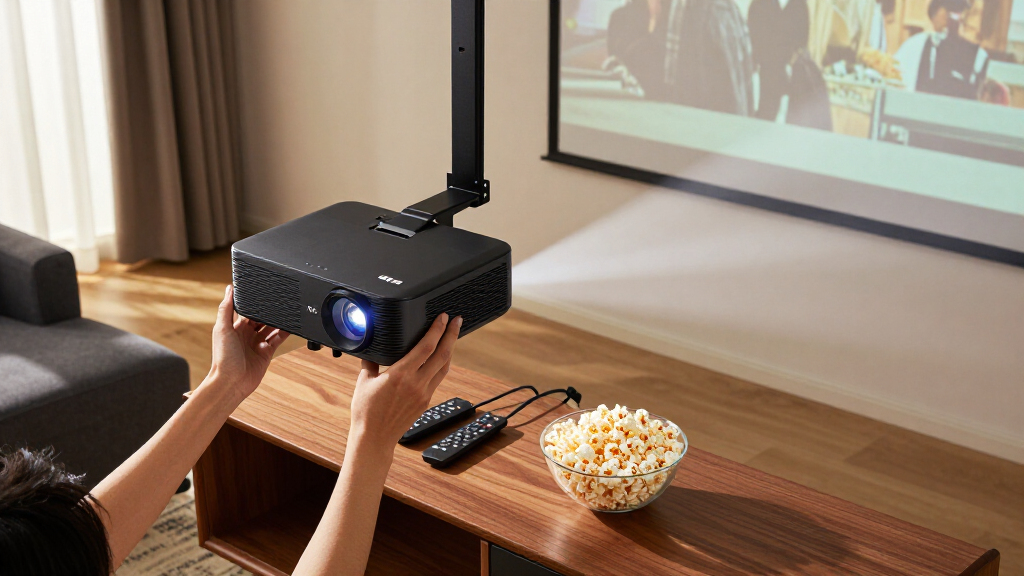
I ranked these fifteen models around three questions a home cinema buyer actually asks: how good does the picture look in my room, how easy is it to live with day to day, and what am I really paying for at each price tier. Image quality came first — native resolution versus 4K decoding, light source type (laser, lamp, or LED), color technology like Epson’s 3-chip 3LCD design, and honest brightness output measured in ANSI lumens rather than marketing numbers. A projector claiming “4K support” at 1080p native resolution ranked below one that genuinely pixel-shifts toward 4K detail.
Usability and versatility formed the second filter: auto focus, auto keystone, obstacle avoidance, built-in streaming platforms, WiFi and Bluetooth versions, and installation flexibility like ceiling mode or 180-degree rotation. Finally, I weighed long-term ownership — lamp replacement costs, light source lifespan, and whether features like HDR10+ or Dolby Audio actually translate into a better movie night. Models were then assigned distinct roles: dedicated theater performance, living-room brightness, budget smart portability, or beginner-friendly simplicity, so the ranking reflects fit rather than raw specs alone.
Factors to Consider When Choosing Home Cinema 4k Projectors Models
Before picking a specific model, it helps to understand what actually drives picture quality and long-term satisfaction with a home cinema projector — because the spec sheet rarely tells the whole story.Native 4K vs. 4K Decoding: The Most Misunderstood Spec
The single most common mistake buyers make is assuming “4K support” means a 4K picture. Most compact projectors accept a 4K signal from a streaming stick or Blu-ray player, then downscale it to a native 1080P imaging chip — you get 4K convenience but 1080P sharpness. Epson’s PRO-UHD models take a different route, using fast pixel-shifting to place each pixel in multiple positions per frame, producing detail dramatically closer to true 4K. If you sit close to a 100-inch or larger screen, the difference is visible; on a 60-inch image in a bedroom, it matters far less. Decide your screen size and seating distance before paying extra for genuine 4K detail you may never perceive.
Brightness Claims and Your Room’s Light Control
Brightness ratings are the least trustworthy numbers in this category. Some brands measure LED output rather than ANSI lumens, producing inflated figures that a calibrated Epson can triple in real-world performance. Beyond the numbers, your room dictates how much brightness you actually need: a blackout home theater works beautifully at modest output, while a family living room with afternoon sun demands the highest honest lumen count you can afford. HDR content also demands more headroom than SDR, so an HDR-capable projector that’s dim will look worse than a brighter SDR model. Match the projector to your room, not to the biggest number on the box.
Light Source Lifespan: Lamp, LED, and Laser Tradeoffs
The light source determines both your long-term costs and how the image ages. Traditional lamps fade noticeably within a few years and eventually need replacement, which is the hidden cost behind cheaper lamp-based theater projectors. LEDs in compact projectors last tens of thousands of hours but produce modest brightness, which is why budget minis struggle in anything but a dark room. Laser sits at the top: consistent brightness over a very long life, instant on/off, and better HDR dynamic range — at a premium price. If you watch nightly and plan to keep the projector for a decade, laser often costs less per year of ownership than its sticker price suggests.
Smart Platforms and Who Controls Your Streaming
Built-in streaming looks convenient, but platform quality varies enormously. Licensed Google TV and Android TV deliver full app stores, regular updates, and proper DRM for HD and 4K streams from major services. Generic Android systems on some budget models may lack official Netflix or Disney+ certification, forcing you back to an external stick anyway. Also consider that smart platforms age faster than projector hardware — a brilliant projector with an outdated OS in five years still works fine with a $50 streaming stick plugged in. Treat built-in apps as a bonus, not a reason to compromise on picture quality, unless portability is your priority.
Placement Flexibility and Installation Realities
How a projector fits your room matters as much as how it looks. Keystone correction digitally reshapes the image, which subtly degrades sharpness — optical placement and lens shift are always better, which is where home-theater models gain an advantage. Auto focus and auto keystone genuinely help for portable use or ceiling mounts where manual adjustment is awkward, and features like obstacle avoidance prevent a ceiling fan or light fixture from ruining your image. Throw distance is easy to overlook: check how far each model must sit from the wall to fill your target screen size before buying, because a long-throw projector in a small room simply cannot produce a large picture.
Audio: Built-in Speakers vs. a Real Sound System
Small projectors advertise Dolby Audio and big speaker wattage, but physics limits what a built-in driver can do — expect acceptable dialogue and thin bass, not cinema sound. If your projector will travel between rooms, campsites, and backyards, decent onboard audio plus Bluetooth output to a portable speaker is a reasonable solution. For a permanent theater setup, plan on a soundbar or AV receiver from the start and treat built-in speakers as setup convenience only. A common mistake is overspending on projector brightness while budgeting nothing for audio, when a modest projector paired with good sound usually feels more cinematic than the reverse.
Frequently Asked Questions
Are cheap “4K supported” mini projectors actually showing 4K?
Mostly, no. A projector advertised as 4K-supported typically accepts a 4K input signal but renders it on a native 1080P chip, so you see a 1080P image with slightly refined processing. That said, at screen sizes under 100 inches and at typical seating distances, a good 1080P image can look impressively sharp, and the convenience of built-in apps and auto focus adds real value. The genuine step up comes from pixel-shifting models like the Epson PRO-UHD line, which display far more actual detail. If maximum sharpness on a big screen is your goal, budget for one of those; if you want an affordable, portable movie night, a 4K-decoding mini is a defensible choice.
Is the Epson LS11000 worth the premium over the Home Cinema 3800 or 2350?
It depends on how you watch and how long you’ll keep it. The LS11000’s laser light source holds its brightness for years without lamp replacement, delivers deeper contrast and HDR10+ handling, and supports larger screen sizes with more placement flexibility via lens shift. The 3800 and 2350 produce excellent 3LCD color at a much lower cost but rely on lamps that dim over time and eventually need replacing. For a dedicated, light-controlled theater with a 120-inch-plus screen, the laser model justifies itself over years of ownership. For a multipurpose living room where the projector competes with a TV, the cheaper Epsons deliver most of the picture quality for far less money.
Can these projectors replace a TV in a bright living room?
Only the brightest models can hold up against daylight, and even they compromise. High-output options like the AuKing 5000 ANSI or the Epson LS11000 maintain a watchable image with curtains drawn, but any projector looks washed out under direct sunlight in a way an OLED or QLED TV does not. The realistic strategy is pairing a genuinely bright projector with light-blocking shades and planning TV-replacement duties around evening viewing. Budget minis, whatever their marketing claims, belong in dark rooms after sunset. If daytime sports in a sunny room is your main use case, a large TV is still the more honest answer.
Do I need a streaming stick if my projector has built-in apps?
If the projector carries a licensed platform like Google TV, Android TV, or VIDAA, the built-in apps usually cover Netflix, Disney+, and the rest with full HD or 4K quality, and a stick is optional. Generic Android systems on some budget models are less reliable — certain apps may be missing, sideloaded versions can stop working after updates, and some lack the DRM certification for HD streaming from major services. A practical approach is to test the built-in platform during your return window and keep a streaming stick as backup. Projectors last many years while smart platforms age quickly, so even a great built-in system may eventually be outpaced by a $50 external device.
What screen size and throw distance should I plan for?
Start by measuring the distance between your mounting position and the wall, then check each model’s throw ratio — most of these projectors need roughly 8 to 10 feet to produce a 100-inch image, though exact figures vary. Going too big for your room hurts more than it helps: an oversized image with a dim projector looks soft and muddy, while a slightly smaller, brighter picture looks dramatically better. For 4K detail to matter, plan on a seating distance roughly 1 to 1.5 times the screen width; sit much farther and 4K versus 1080P becomes indistinguishable. Sketch your room dimensions before ordering, because throw distance is the one spec no software update can fix.
Conclusion
The right choice among these fifteen models comes down to where you’ll watch and how much picture quality matters to you. For the best overall home cinema experience, the Epson Home Cinema LS11000 is the clear winner — its laser light source, HDR10+, and genuine 4K PRO-UHD detail put it in a different class than every compact model here. The best premium-lifestyle alternative is the Epson Home Cinema 3800, which delivers most of that color and detail at a lower tier, provided you add your own streaming device.
For the best value, the Epson Home Cinema 2350 combines 4K PRO-UHD imaging with built-in Android TV streaming, making it the most complete package for buyers who want theater-level picture without a separate ecosystem. The VOPLLS G3 with licensed Google TV is the smartest pick among true budget options, and the AuKing 5000 ANSI model is the best for bright rooms and outdoor movie nights where raw output beats everything else. Beginners who want zero-setup simplicity should lean toward auto-focus mini models like the Magcubic HY350Max or KOGATA, while frequent movers will appreciate the portability of the Philoent and HAPPRUN compacts. Match the projector to your room’s light, your screen size, and your streaming habits — that decision matters more than any single spec on the box.
Columbus Day / Indigenous Peoples' Day Picks
long weekend sales
As an affiliate, we earn on qualifying purchases.