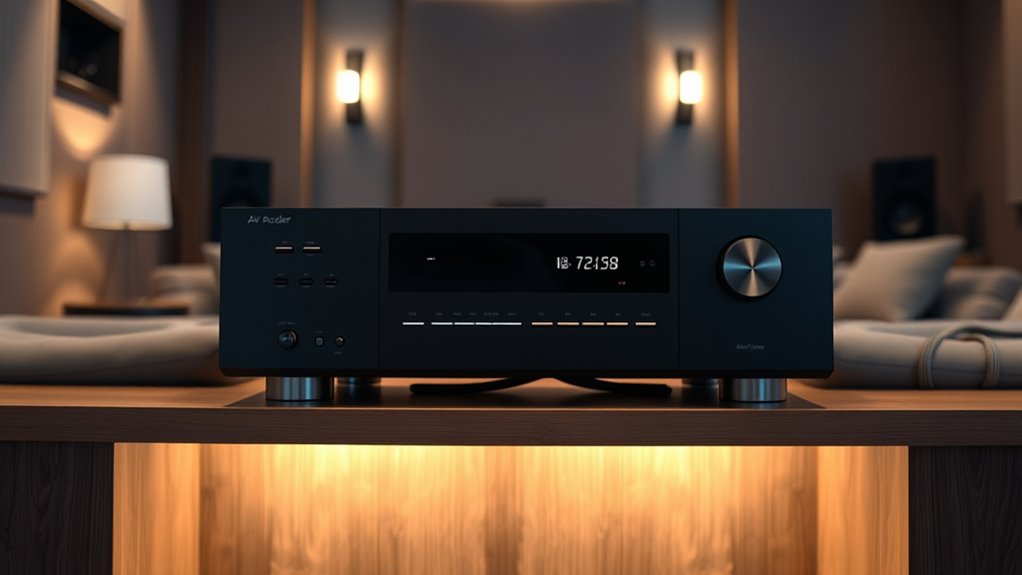
Searching for a quiet AV receiver can be tricky, as many models prioritize power over noise levels. The best options balance strong audio performance with subdued operation, ensuring your home theater stays peaceful. The Denon AVR-X2800H stands out for its powerful 8K UHD support and quiet operation, while the Yamaha RX-V385 offers a more budget-friendly, yet still relatively quiet, experience. However, tradeoffs often come in the form of features versus noise levels—more powerful units might generate more fan noise or electrical hum. Continue reading for a detailed breakdown of the top picks and what makes each one unique.

Get business pricing on your home office setup
- Business-only prices and quantity discounts
- Tax-exempt purchasing
- Multiple users, one account, clear invoices
Complete the kit



Key Takeaways
- Top models like the Denon AVR-X2800H excel in delivering high power quietly through advanced cooling and design.
- Budget options such as the Yamaha RX-V385 provide quieter operation but may lack some premium features.
- The inclusion of high-quality DACs and Bluetooth support doesn’t necessarily increase noise, offering a balance of connectivity and quietness.
- More compact or slimline models like the Marantz NR1510 tend to operate more quietly due to their smaller size and simplified cooling needs.
- Tradeoffs in this category often revolve around power output versus noise levels; more wattage can mean more fan noise or electrical hum.
| Sony STRDH190 2-Ch Home Stereo Receiver with Bluetooth and Phono Inputs |  | Best for Simplicity and Vinyl Enthusiasts | Power Output: 100 watts x 2 (8 ohms, 1 kHz) | Frequency Band: 2,400 MHz – 2,483.5 MHz | Speaker Impedance: 6–16 ohms | VIEW ON AMAZON | See Our Full Breakdown |
| Donner MAMP8 5.2 Channel Surround Sound AV Receiver with 4K HDR Support |  | Best for Customizable Home Theater Audio | Channels: 5.2 | Speaker Power: 75W*2 @4Ω (L/R), 38W*3 @4Ω | Supports: 4K HDR, Bluetooth 5.3 | VIEW ON AMAZON | See Our Full Breakdown |
| Denon AVR-X2800H 7.2 Channel Home Theater AV Receiver (95W x 7) – 8K UHD |  | Best for High-End 8K and Dolby Atmos Setups | Channels: 7.2 | Power Output: 95W per channel | HDMI Ports: 8 (6 In/2 Out) | VIEW ON AMAZON | See Our Full Breakdown |
| Sony STRDH590 5.2 Channel Surround Sound Home Theater Receiver |  | Best for Compact Home Theater Setups | Channel: 5.2 | Power: 725W | Frequency: 1KHz | VIEW ON AMAZON | See Our Full Breakdown |
| Yamaha RX-V385 5.1-Channel 4K Ultra HD AV Receiver with Bluetooth |  | Best Budget 4K AV Receiver with Auto-Calibration | Connectivity Technology: Bluetooth | Controller Type: IR Remote | Number of HDMI Ports: 4 | VIEW ON AMAZON | See Our Full Breakdown |
| Auris Blume HD Long Range Bluetooth 5.3 Music Receiver with Audiophile DAC |  | Best for Wireless High-Quality Audio Streaming | Connectivity Technology: Auxiliary, Bluetooth, RCA | Controller Type: iOS | Compatible Devices: iPhone, iPad, PC, Android, Tablet, Mac, MacBook, MacBook Pro | VIEW ON AMAZON | See Our Full Breakdown |
| Denon AVR-S670H 5.2 Channel Home Theater Receiver, 8K UHD HDMI, 75W x 5 |  | Best for High-Quality 8K Video and Audio | Channels: 5.2 | Power Output: 75W x 5 | Video Support: 8K UHD, HDR10+, Dolby Vision | VIEW ON AMAZON | See Our Full Breakdown |
| Denon AVR-X1700H 7.2 Channel AV Receiver – 80W/Channel, Built-in HEOS |  | Best for Versatile 8K Home Theater with Surround Sound | Channels: 7.2 | Power per Channel: 80W | HDMI Inputs: 3 dedicated 8K inputs | VIEW ON AMAZON | See Our Full Breakdown |
| Marantz NR1510 Slimline 5.2 Channel AV Receiver with HEOS and 50W |  | Best for Compact Spaces with High-Quality Sound | Power: 50 W per channel | Channels: 5.2 | HDMI Inputs: 6 | VIEW ON AMAZON | See Our Full Breakdown |
| Yamaha RX-V4A 5.2-Channel AV Receiver with MusicCast |  | Best for Latest HDMI Features and Multi-Room Streaming | Channels: 5.2 | HDMI: 4 in / 1 out | Video Support: 4K60, 4K120AB, 8K60 | VIEW ON AMAZON | See Our Full Breakdown |
| Pyle 7.1-Channel Hi-Fi Bluetooth Stereo Amplifier – 2000 Watt AV Home Theater Receiver with Radio, USB, RCA, HDMI, Microphone Inputs, Supports 4K UHD TV, 3D, Blu-Ray |  | Best Overall for Power and Versatility | Power Output: 2000 Watt MAX | Channels: 7.1 | Speaker Impedance: 4-16 Ohm | VIEW ON AMAZON | See Our Full Breakdown |
| Yamaha RX300A 5.2-Channel Home Theater AV Receiver with Dolby Atmos, 4K120/8K HDMI, and Bluetooth Multipoint |  | Best for Immersive Sound and Ease of Use | Channels: 5.2 | Power: 70W per channel | HDMI Inputs: 4 | VIEW ON AMAZON | See Our Full Breakdown |
| Onkyo TX-NR6100 7.2 Channel THX Certified Network AV Receiver – Black |  | Best for High-End Home Theater with Advanced Connectivity | Power: 210 W/Ch | Channels: 7.2 | Certification: THX Certified Select | VIEW ON AMAZON | See Our Full Breakdown |
More Details on Our Top Picks
Sony STRDH190 2-Ch Home Stereo Receiver with Bluetooth and Phono Inputs
The Sony STRDH190 stands out as a straightforward stereo receiver ideal for those who prioritize ease of use and vinyl playback. Compared with the Denon AVR-X2800H, it lacks surround sound and advanced video features, but for dedicated music listening, its simplicity can be a strength. The built-in Bluetooth supports wireless streaming, and the phono input makes it perfect for turntable owners. However, its limited to 2 channels and omits Wi-Fi, making it unsuitable for multi-room or surround setups. This model makes the most sense for users who want high-resolution audio without the complexity of modern home theater features.
Pros:- Wireless streaming via Bluetooth for easy connections
- Supports multiple speakers with zone switching
- Includes dedicated phono input for turntables
Cons:- Limited to 2 channels, not suitable for surround sound
- No Wi-Fi connectivity, restricting smart features
Best for: Vinyl collectors and casual music listeners who want quality sound without surround sound complexity.
Not ideal for: Home theater enthusiasts seeking immersive multi-channel sound or smart streaming features.
- Power Output:100 watts x 2 (8 ohms, 1 kHz)
- Frequency Band:2,400 MHz – 2,483.5 MHz
- Speaker Impedance:6–16 ohms
- Inputs:Phono, 4 stereo RCA, 3.5mm
- Outputs:Stereo RCA output
- Bluetooth:Yes
Our verdict“This is a solid choice for stereo music lovers who prioritize simplicity and vinyl playback over surround sound or smart home integration.”
Donner MAMP8 5.2 Channel Surround Sound AV Receiver with 4K HDR Support
The Donner MAMP8 offers a flexible 5.2 surround sound setup with 4K HDR pass-through, making it suitable for users wanting a personalized home theater experience. Unlike the Denon AVR-X2800H with its multiple HDMI inputs and 8K support, the MAMP8 emphasizes EQ customization and automatic setting saves, which benefits those who enjoy fine-tuning their sound. Its 75W per channel power may fall short for larger rooms or demanding speakers, and it lacks Dolby and DTS decoding, limiting surround sound options. This pick makes the most sense for tech-savvy users who value tailored audio and straightforward configuration over raw power or advanced video formats.
Pros:- Supports multiple input sources including HDMI, Bluetooth, and USB
- Customizable EQ controls with automatic save for tailored sound
- Supports 4K HDR pass-through for high-quality video
Cons:- Lacks Dolby and DTS decoding, limiting surround sound options
- Power output might be insufficient for large or demanding setups
Best for: Home theater enthusiasts who enjoy customizing audio settings and need versatile input options.
Not ideal for: Casual viewers or those seeking Dolby/DTS surround sound for immersive experiences.
- Channels:5.2
- Speaker Power:75W*2 @4Ω (L/R), 38W*3 @4Ω
- Supports:4K HDR, Bluetooth 5.3
- Input Options:HDMI, Bluetooth, USB, RCA, optical, coaxial, FM radio, Phono
- Remote:Multifunction with adjustable treble/midrange/bass
- EQ Control:Independent treble, midrange, bass adjustments
Our verdict“Ideal for users who want customizable audio with flexible inputs, but may not satisfy those needing Dolby/DTS surround sound or higher power output.”
Denon AVR-X2800H 7.2 Channel Home Theater AV Receiver (95W x 7) – 8K UHD
The Denon AVR-X2800H provides a compelling option for those seeking immersive 8K video and advanced surround sound with Dolby Atmos and DTS:X support. Compared with the Yamaha RX-V385, it offers more HDMI inputs and higher power output, making it better suited to larger or more complex home theaters. Its size, however, demands ample space, and setup can be intricate for beginners. The inclusion of Wi-Fi and Bluetooth allows seamless streaming, but the premium price tag might be a barrier for casual users. This receiver is best for serious home theater fans who want future-proofing and top-tier audiovisual quality.
Pros:- Supports 8K video pass-through and advanced HDR formats
- Multiple HDMI inputs with 8K support for versatile device connection
- Built-in Bluetooth and Wi-Fi for seamless multi-room streaming
Cons:- Setup can be complex and overwhelming for beginners
- Larger size requires significant installation space
Best for: Home theater enthusiasts who want 8K support, Dolby Atmos, and multiple device integrations.
Not ideal for: Entry-level users or those with limited space who prefer simpler, more affordable options.
- Channels:7.2
- Power Output:95W per channel
- HDMI Ports:8 (6 In/2 Out)
- Supports:8K UHD, Dolby Atmos, DTS:X
- Connectivity:Bluetooth, Wi-Fi, USB
- Additional Inputs:Phono, digital, analog
Our verdict“Best suited for users seeking cutting-edge video support and immersive surround sound in a premium setup.”
Sony STRDH590 5.2 Channel Surround Sound Home Theater Receiver
The Sony STRDH590 offers a solid 5.2 channel surround sound experience with virtual surround via S Force PRO, making it a good fit for smaller spaces or less demanding setups. While it supports 4K HDR pass-through and Bluetooth streaming, it falls short of larger models like the Yamaha RX-V385 in power and channel count. Its design is straightforward, but the lack of built-in Wi-Fi limits streaming options to Bluetooth and radio. This receiver makes sense for users who want decent surround sound without the bulk or complexity of high-end systems, especially in compact spaces.
Pros:- Supports 4K HDR pass-through for high-quality video
- Virtual surround with just two speakers, saving space
- Bluetooth connectivity for wireless streaming
Cons:- Limited to 5.2 channels, not ideal for larger setups
- No built-in Wi-Fi limits streaming options
Best for: Small living rooms or apartments where space is limited but decent surround sound is desired.
Not ideal for: Large rooms or users wanting native Wi-Fi streaming and extensive configuration options.
- Channel:5.2
- Power:725W
- Frequency:1KHz
- HDMI Inputs:4
- HDMI Outputs:1
- Connectivity:Bluetooth, FM Radio
Our verdict“An excellent choice for compact spaces needing surround sound without the complexity of larger receivers.”
Yamaha RX-V385 5.1-Channel 4K Ultra HD AV Receiver with Bluetooth
The Yamaha RX-V385 offers a balanced mix of affordability and performance, supporting 4K Ultra HD, HDR10, and Dolby Vision for vivid visuals. Its auto-calibration feature simplifies setup, making it suitable for users new to AV receivers. While it supports 5.1 channels and provides ample HDMI connectivity, it lacks Wi-Fi, limiting streaming to Bluetooth and local sources. Compared to the Denon AVR-X2800H, it’s less powerful and has fewer inputs, which means it’s better suited for smaller, less complex setups. This receiver makes the most sense for budget-conscious users who want reliable 4K support and straightforward operation.
Pros:- Supports high-quality 4K Ultra HD, HDR10, and Dolby Vision
- Auto-calibration ensures optimal sound with minimal effort
- Bluetooth connectivity for wireless streaming
Cons:- Limited to 5.1 channels, not suitable for large setups
- No built-in Wi-Fi for streaming services
Best for: Budget-minded users seeking a reliable 4K receiver with auto-calibration and basic surround sound.
Not ideal for: Users wanting multi-room audio, extensive HDMI inputs, or larger surround sound configurations.
- Connectivity Technology:Bluetooth
- Controller Type:IR Remote
- Number of HDMI Ports:4
- Output Power:100 watts
- Number of Channels:5.1
- Supported Internet Services:Cinemanow
Our verdict“A dependable, budget-friendly option for small rooms and basic surround sound with easy setup.”
Auris Blume HD Long Range Bluetooth 5.3 Music Receiver with Audiophile DAC
The Auris Blume HD stands out for its support of high-fidelity lossless audio via advanced Bluetooth codecs like LDAC and aptX HD, making it a strong choice for audiophiles who want seamless wireless streaming from their devices. Its long-range capability—over 100 feet through walls—sets it apart from many Bluetooth receivers, providing greater flexibility in placement. Unlike most AV receivers, it offers both digital optical and analog RCA outputs, ensuring versatile connectivity to various audio systems. However, setup requires compatible devices and app control, which might be a hurdle for less tech-savvy users. Its limited specifications on some features and absence of included accessories mean it’s best suited for those who prioritize audio quality and wireless convenience over plug-and-play simplicity.
Pros:- Supports high-quality lossless audio with advanced Bluetooth codecs
- Long wireless range up to 100+ feet through walls
- Versatile connectivity including optical and RCA outputs
Cons:- Requires compatible devices and app control for setup
- Limited detailed specifications for some features
Best for: Audiophiles seeking lossless wireless streaming with flexible connectivity options
Not ideal for: Casual listeners or those who prefer plug-and-play solutions without app setup
- Connectivity Technology:Auxiliary, Bluetooth, RCA
- Controller Type:iOS
- Compatible Devices:iPhone, iPad, PC, Android, Tablet, Mac, MacBook, MacBook Pro
- Connector Type:Optical, RCA
- Audio Encoding:Stereo
- Wireless Technology:Bluetooth
Our verdict“This pick is ideal for audiophiles who want high-fidelity wireless streaming with extensive range and versatile connections.”
Denon AVR-S670H 5.2 Channel Home Theater Receiver, 8K UHD HDMI, 75W x 5
The Denon AVR-S670H makes the most sense for users who need both high-quality audio and cutting-edge video support. Its support for 8K/60Hz and 4K/120Hz pass-through surpasses many competitors like the Yamaha RX-V4A, especially for those with future-proofing in mind. While it excels in delivering immersive home theater with Dolby Atmos and DTS:X support, its setup can be more complicated for beginners unfamiliar with multi-step configurations. The 75W per channel power output is sufficient for most medium-sized rooms but might fall short in very large spaces. Compared to the Denon AVR-X1700H, it offers fewer HDMI inputs but maintains excellent video quality and multi-room streaming.
Pros:- Supports latest 8K and 4K video formats for high-quality visuals
- Multi-room audio streaming via HEOS and Bluetooth
- Supports voice control with Alexa and others
Cons:- Complex setup process may challenge beginners
- Limited to 75W per channel, which might be insufficient for large rooms
Best for: Home theater enthusiasts who want top-tier 8K video support combined with high-quality audio streaming
Not ideal for: Entry-level users or small space setups where extensive HDMI inputs aren’t necessary
- Channels:5.2
- Power Output:75W x 5
- Video Support:8K UHD, HDR10+, Dolby Vision
- HDMI Support:8K/60Hz & 4K/120Hz pass-through, HDCP 2.3
- Connectivity:Wi-Fi, Bluetooth, HDMI ARC/eARC
- Voice Control:Alexa, others
Our verdict“This receiver is best suited for users who prioritize advanced video capabilities alongside high-quality audio in a home theater environment.”
Denon AVR-X1700H 7.2 Channel AV Receiver – 80W/Channel, Built-in HEOS
The Denon AVR-X1700H offers a compelling choice for those who want a robust 7.2 channel system with 80W per channel, supporting advanced 8K HDMI and immersive audio formats like Dolby Atmos and DTS:X. Its user-friendly setup, with on-screen guidance and color-coded connections, contrasts with more complex units like the AVR-S670H, making it accessible for newcomers. The additional two pre-outs facilitate future expansion, and built-in HEOS ensures seamless multi-room streaming. However, its 80W per channel might limit its power in very large or acoustically challenging rooms. Compared to the AVR-S670H, it provides more channels and power but comes with a slightly higher learning curve for setup.
Pros:- Supports advanced 8K HDMI and HDR formats for high-quality video
- Multi-dimensional audio support with Dolby Atmos and DTS:X
- Easy setup with on-screen guidance
Cons:- Complex setup may challenge beginners
- Limited to 80W per channel, which may be insufficient for very large rooms
Best for: Home theater enthusiasts who want a high-power, multi-dimensional audio system with future-proof video features
Not ideal for: Small room setups or users seeking a simple, plug-and-play receiver without extensive configuration
- Channels:7.2
- Power per Channel:80W
- HDMI Inputs:3 dedicated 8K inputs
- Supports:8K/60Hz, 4K/120Hz, Dolby Atmos, DTS:X
- Wireless Streaming:Wi-Fi, AirPlay 2, Bluetooth
- Voice Control:Alexa, Siri
Our verdict“This receiver suits users seeking a powerful, feature-rich home theater with room for expansion and advanced video support.”
Marantz NR1510 Slimline 5.2 Channel AV Receiver with HEOS and 50W
The Marantz NR1510 is tailored for those who need a sleek, space-saving AV receiver without sacrificing sound quality. Its high-quality tuning by Marantz’s Sound Master makes it stand out among slimline options like the Yamaha RX-V4A, especially for audiophiles who want balanced, detailed sound in smaller rooms. The 50W per channel output is adequate for moderate-sized spaces, but might fall short in larger or acoustically demanding environments. Its six HDMI inputs cover most typical needs, though larger setups with many devices may find this limiting. Compared to bulkier models, its slim profile allows for flexible placement but at the expense of lower power and fewer HDMI ports.
Pros:- Slimline design fits well in tight spaces
- High-quality sound tuning by Marantz Sound Master
- Supports high-resolution surround sound formats
Cons:- Limited to 50W per channel, not suitable for large spaces
- Only six HDMI inputs, which may be insufficient for extensive device connections
Best for: Owners of smaller rooms or apartments who prioritize sound quality in a compact form factor
Not ideal for: Large rooms or users with extensive device setups requiring multiple HDMI inputs
- Power:50 W per channel
- Channels:5.2
- HDMI Inputs:6
- Supports:Dolby TrueHD, DTS-HD Master Audio
- Connectivity:Analog, digital, phono
- Streaming:HEOS
Our verdict“This receiver is perfect for those needing a compact, high-quality audio solution in small spaces without extensive connectivity demands.”
Yamaha RX-V4A 5.2-Channel AV Receiver with MusicCast
The Yamaha RX-V4A is an excellent choice for users who want a feature-rich, modern AV receiver that supports the latest HDMI 2.1 specifications. Its support for 4K and 8K video, combined with MusicCast and built-in Wi-Fi, makes it highly versatile for streaming and multi-room setups. Automatic room calibration with YPAO simplifies setup for those who might find configuration daunting, unlike more manual units like the Denon AVR-X1700H. While its five channels with 50W per channel are sufficient for most smaller to medium rooms, the limited number of HDMI inputs might restrict larger device collections. Compared to the more powerful Denon models, the Yamaha offers a more streamlined experience with excellent streaming options.
Pros:- Supports latest HDMI 2.1 features for future-proof video quality
- Built-in Wi-Fi, MusicCast, and streaming services for versatile entertainment
- Automatic room calibration simplifies setup
Cons:- Limited number of HDMI inputs for extensive device setups
- Power output of 50W per channel may limit use in larger rooms
Best for: Homeowners seeking a modern, easy-to-configure receiver with advanced HDMI features and multi-room streaming
Not ideal for: Enthusiasts needing high power output or extensive HDMI inputs for large setups
- Channels:5.2
- HDMI:4 in / 1 out
- Video Support:4K60, 4K120AB, 8K60
- Wireless Features:Wi-Fi, AirPlay 2, MusicCast
- Audio Formats:Dolby TrueHD, DTS-HD Master
- Room Calibration:YPAO
Our verdict“This model is well-suited for users who prioritize modern features and streaming flexibility in smaller or medium-sized rooms.”
Pyle 7.1-Channel Hi-Fi Bluetooth Stereo Amplifier – 2000 Watt AV Home Theater Receiver with Radio, USB, RCA, HDMI, Microphone Inputs, Supports 4K UHD TV, 3D, Blu-Ray
The Pyle PT796BT stands out for its remarkable 2000W peak power, making it ideal for those seeking truly immersive sound in large spaces. Compared to the Yamaha RX300A, which offers a more refined but less powerful experience, Pyle’s amplifier prioritizes raw output, suitable for demanding home theaters. Its extensive input options, including HDMI, USB, and RCA, provide flexibility, but the setup can be overwhelming for beginners. The built-in Bluetooth 5.0 ensures easy wireless streaming from modern devices, and support for 4K UHD pass-through guarantees high-quality video compatibility. The tradeoff is its size and weight, requiring significant space, and the remote control needs batteries (not included). This model makes the most sense for users who want power and versatility over sleek design or simplicity.
Pros:- Massive 2000W peak power for large spaces
- Supports multiple audio/video inputs including HDMI, USB, and RCA
- Built-in Bluetooth 5.0 for seamless wireless streaming
Cons:- Heavy and large, demanding significant space
- First-time setup can be complex and intimidating
Best for: Large home theater enthusiasts who need high power and multiple input options
Not ideal for: Small rooms or those preferring a compact, easy-to-set-up receiver
- Power Output:2000 Watt MAX
- Channels:7.1
- Speaker Impedance:4-16 Ohm
- Bluetooth Version:5.0
- Wireless Range:30+ ft.
- Dimensions:16.9 x 13.8 x 5.5 inches
- Weight:26.68 lbs
- Supported Audio Formats:MP3, WMA, APE, FLAC
Our verdict“Best suited for users prioritizing raw power and input versatility over sleek design or simplicity.”
Yamaha RX300A 5.2-Channel Home Theater AV Receiver with Dolby Atmos, 4K120/8K HDMI, and Bluetooth Multipoint
The Yamaha RX300A offers a balanced approach with its immersive Dolby Atmos and DTS Virtual:X support, making it ideal for those who want a more refined, surround sound experience without excessive complexity. Compared to the Onkyo TX-NR6100, which boasts higher power and more advanced connectivity, Yamaha emphasizes ease of setup with automatic room correction and straightforward Bluetooth Multipoint streaming. Its four HDMI inputs are suitable for most home setups, but may fall short for very large or complex systems. While it provides excellent sound quality and high-res video support, its power output of 70W per channel might limit performance in larger rooms. It’s a solid choice for users who value sound quality and simplicity over maximum power or extensive connectivity.
Pros:- Immersive Dolby Atmos and DTS Virtual:X sound
- Supports 4K120 and 8K video formats for future-proofing
- Automatic room correction simplifies setup
Cons:- Limited to 4 HDMI inputs, which may be restrictive
- Power output may be insufficient for very large spaces
Best for: Homeowners seeking high-quality surround sound with user-friendly setup
Not ideal for: Large rooms or users needing maximum power and multiple HDMI inputs
- Channels:5.2
- Power:70W per channel
- HDMI Inputs:4
- HDMI Outputs:1
- Video Support:4K120/8K60, Dolby Vision, HDR10+
- Bluetooth:Multipoint
- Room Correction:Yes
- Supported Audio Formats:Dolby Atmos, DTS Virtual:X
Our verdict“Ideal for users who prioritize sound immersion and ease of installation over raw power or extensive connectivity.”
Onkyo TX-NR6100 7.2 Channel THX Certified Network AV Receiver – Black
The Onkyo TX-NR6100 excels in delivering dynamic, immersive sound thanks to its THX Certified Select approval and support for Dolby Atmos and DTS:X. Its 8K HDMI 2.1 with 40Gbps bandwidth makes it suitable for users planning to upgrade to the latest high-resolution video sources. Compared with the Yamaha RX300A, which emphasizes ease of use, the Onkyo offers a more complex but potentially more powerful experience for advanced setups. Its support for Discrete Zone 2 audio/video adds flexibility but may be overkill for smaller or simpler systems. The main drawback is its challenging setup process, which might deter less tech-savvy users. This receiver makes sense for dedicated home theater enthusiasts who want premium sound, cutting-edge video support, and a high level of customization.
Pros:- Supports Dolby Atmos and DTS:X for immersive multi-dimensional sound
- 8K HDMI 2.1 with 40Gbps bandwidth enables high-res, future-proof video
- THX Certified Select for consistent, high-quality audio
Cons:- Complex setup may be difficult for beginners
- Lack of integrated streaming services may require additional devices
Best for: Aficionados seeking high-performance, future-proof connectivity, and THX-certified audio
Not ideal for: Casual viewers or those intimidated by complex configuration tasks
- Power:210 W/Ch
- Channels:7.2
- Certification:THX Certified Select
- HDMI:8K with HDMI 2.1 40Gbps
- Zones:Discrete Zone 2
- Supported Audio Formats:Dolby Atmos, DTS:X
Our verdict“Best for serious home theater users who want premium audio, advanced video features, and are comfortable with complex setup processes.”

How We Picked
Our selection process focused on how effectively each AV receiver minimizes operational noise while maintaining solid audio performance. We evaluated cooling systems, fan noise levels, build quality, and the overall design aimed at reducing audible distraction. Performance metrics such as power output and support for high-resolution formats were considered, but only in relation to their noise profiles. We also factored in connectivity options, ease of use, and value for money. The ranking reflects a balance between quiet operation and core AV features, ensuring buyers get models suited for peaceful home environments without sacrificing performance.Factors to Consider When Choosing Quiet Av Receiver
Choosing a quiet AV receiver involves more than just looking at specs; understanding the broader factors can prevent common pitfalls. For example, a higher wattage model might seem appealing but could generate more operational noise due to increased cooling requirements. Consider the placement of your receiver—compact designs often operate more quietly due to less demanding cooling needs. Connectivity options like Bluetooth or HDMI are essential for modern setups but won’t impact noise directly. Additionally, think about your room size and whether you need a more powerful unit or something that prioritizes silence. Finally, reliability and build quality are key—cheaper units might produce more noise over time or have poorer insulation.Power Output and Cooling Design
Higher wattage receivers tend to generate more heat, requiring robust cooling solutions that can introduce fan noise. Look for models with fanless designs or advanced cooling systems that operate silently—these are often found in slim or compact units. While more power can be tempting for larger rooms, it doesn’t always mean better for noise-sensitive environments. Balance your room size and volume needs with the cooling approach to find a model that provides enough sound without excess noise.Build Quality and Noise Insulation
A well-constructed receiver with solid chassis and good internal insulation can significantly reduce operational noise. Cheaper models often cut costs on these aspects, leading to louder fans or electrical hums. Investing in higher-quality materials not only improves durability but also enhances noise suppression, making your home theater more peaceful. Pay attention to user reviews mentioning noise levels and consider models with metal enclosures or noise-dampening features.Connectivity and Features
Modern AV receivers come with a range of connectivity options—Bluetooth, Wi-Fi, HDMI, and more. While these features add convenience, they don’t directly influence noise levels. However, some models with extensive wireless features may have additional internal components that could contribute to electrical hum or fan activity. Prioritize models with efficient circuitry and minimal extra features if quiet operation is a priority, especially in smaller or shared spaces.Placement and Room Size
Where you position your receiver impacts noise perception. Placing it inside a cabinet or a dedicated AV rack can muffle any fan noise, while open placement might make it more noticeable. For smaller rooms or shared spaces, select a compact or slimline model known for quiet operation. Larger rooms may accommodate more powerful units, but consider models designed with noise reduction in mind to avoid disturbing others.Value vs. Premium Features
Budget-friendly models like the Yamaha RX-V385 deliver decent performance with quieter operation, but they might lack advanced features like 8K support or multi-zone audio. Conversely, premium models such as the Onkyo TX-NR6100 boast cutting-edge technology but could produce more noise due to their internal components. Match your needs—if silence is paramount, prioritize models with proven quiet operation, even if it means sacrificing some high-end features. Conversely, if you want state-of-the-art audio and video, be prepared for potential tradeoffs in noise.Frequently Asked Questions
Will a more powerful AV receiver necessarily be louder?
Not always. While higher wattage units can produce more heat, which may require more cooling, many modern models incorporate advanced, silent cooling solutions. Fans can be very quiet or even fanless, especially in compact designs. The key is to look for models specifically designed with noise reduction in mind. Reading reviews focused on noise performance can help identify which high-power units operate quietly in real-world conditions.
How can I reduce the noise my AV receiver makes during operation?
Positioning plays a significant role; placing your receiver inside a cabinet or on a sound-absorbing surface can cut down on perceived noise. Choosing a model with a fanless or low-noise cooling system is also effective. Regular maintenance, such as cleaning vents and ensuring proper ventilation, can prevent overheating and reduce fan activity. Additionally, controlling the volume and setting the receiver to lower power modes when full power isn’t needed can help maintain a quieter environment.
Are compact or slim AV receivers quieter than larger models?
Generally, yes. Smaller or slimline models tend to generate less heat, reducing the need for active cooling and fan noise. They often operate with fewer internal components that produce electrical hum or vibration. However, they may also have lower power output, making them less suitable for large rooms or demanding setups. For smaller spaces where quiet operation is a priority, these models can be a very effective choice.
Does Bluetooth or wireless connectivity impact the noise level of an AV receiver?
Not directly. Connectivity features like Bluetooth or Wi-Fi are mainly for convenience and do not influence operational noise significantly. However, some wireless modules can add internal circuitry that may contribute to electrical hum if poorly designed. When choosing a quiet receiver, focus on models with high-quality internal components and good shielding to prevent any additional noise from wireless features. Wireless features are best considered for their convenience, not noise performance.
Is it worth paying extra for a THX certified AV receiver for quieter operation?
Not necessarily. While THX certification indicates a certain standard of audio and build quality, it doesn’t guarantee quieter operation. Noise levels are more affected by cooling design, internal components, and overall build quality. If quiet operation is your priority, look for models explicitly praised for low noise in reviews or with features like fanless cooling. THX certification can be a bonus for audio fidelity but isn’t a direct indicator of quieter operation.
Conclusion
For those seeking the best overall balance of quiet operation and high performance, the Denon AVR-X2800H makes a strong case thanks to its advanced cooling and support for 8K UHD. Budget-conscious buyers or those in smaller rooms will find the Yamaha RX-V385 offers a quiet experience at a lower price point. If premium features and ultimate silence are desired, the Onkyo TX-NR6100 provides a robust package, though it may generate more noise. Beginners should consider simpler, quieter models like the Yamaha RX-V385, while audiophiles seeking high power and minimal disturbance might prefer the Denon or Marantz options. Ultimately, matching your room size, power needs, and noise sensitivity will guide you toward the right choice.