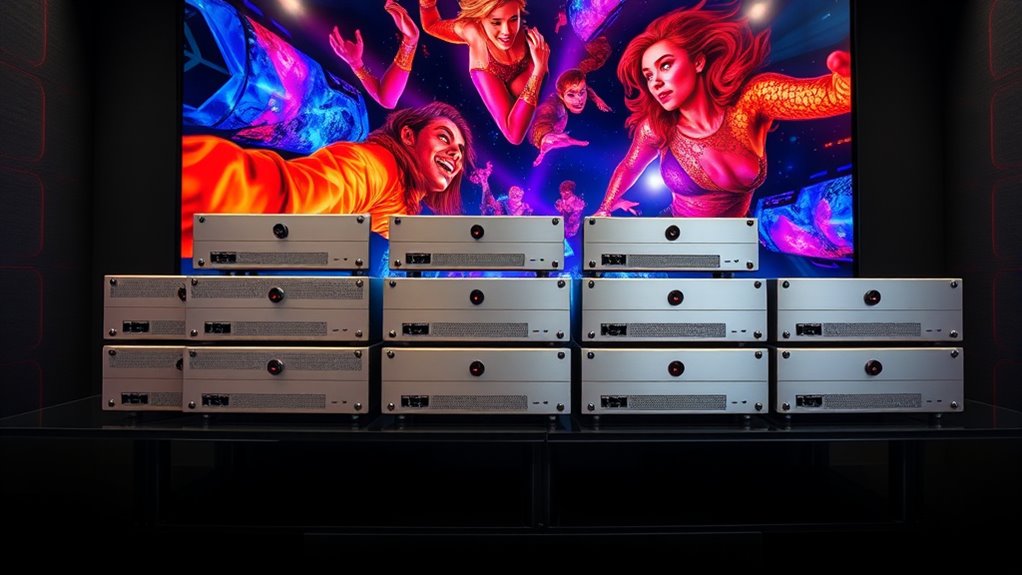

Choosing the right AV distribution amplifier depends heavily on your specific needs, whether it’s multi-room home entertainment, professional audio setups, or compact personal systems. The RCA 1 in 8 Out AV Splitter stands out for its simplicity and affordability, ideal for distributing composite signals to multiple screens. Meanwhile, the Rolls RA163 offers professional-grade balanced connections, perfect for high-quality audio distribution in more complex environments. Lastly, the Rolls DA134 provides a versatile, space-saving solution for smaller setups that require stereo distribution from common consumer devices. Each has distinct advantages, but also notable tradeoffs, which I’ll clarify to help you make the best choice.

Get business pricing on your home office setup
- Business-only prices and quantity discounts
- Tax-exempt purchasing
- Multiple users, one account, clear invoices
Complete the kit


Key Takeaways
- The RCA splitter is best for simple, budget-friendly multi-screen setups using composite signals.
- The Rolls RA163 excels in professional audio environments needing high-quality, balanced lines.
- The Rolls DA134 is ideal for compact, versatile stereo distribution from consumer devices.
- Tradeoffs include limited connectivity options with the RCA splitter, complexity of professional gear with the RA163, and fewer channels on the DA134.
- Your choice should match your technical needs, setup size, and desired sound/video quality.
| RCA 1 in 8 Out AV Audio Video Splitter Amplifier for Cable Box, DVD, DVR, Analog TV |  | Best for Simple Multi-Display Distribution | Input ports: 1 | Output ports: 8 | Product size: 9 x 3.5 x 1.7 inches | VIEW ON AMAZON | See Our Full Breakdown |
| Rolls RA163 8-Channel Distribution Amplifier |  | Best for Professional Audio Applications | Operation Mode: Mono or Stereo | Inputs: XLR jack | Outputs: XLR jack | VIEW ON AMAZON | See Our Full Breakdown |
| Rolls DA134 4-Channel Distribution Amplifier |  | Best for Compact Stereo Distribution | Channels: 4 | Operation: Mono or Stereo | Input Compatibility: iPad, iPod, laptop | VIEW ON AMAZON | See Our Full Breakdown |
More Details on Our Top Picks
RCA 1 in 8 Out AV Audio Video Splitter Amplifier for Cable Box, DVD, DVR, Analog TV
This RCA splitter excels at distributing a single composite video input to multiple displays, making it a solid choice for multi-screen setups in both home and commercial environments. Its main advantage is the ability to connect up to eight outputs from one source, which is especially useful for basic video distribution without complex wiring. However, it’s limited to composite RCA connections, so it’s not suitable for high-definition signals or modern digital inputs. The lack of remote control or advanced features makes it straightforward but less flexible for more sophisticated applications. Compared with the Rolls options, this device is far more accessible for casual users but lacks the professional-grade connectivity and control features that more complex setups require.
Pros:- Allows multiple outputs from a single input
- Includes standard US plug adapter
- Suitable for both home and commercial use
Cons:- Does not support remote control
- Limited to composite RCA connections
- No remote sensing capability
Best for: Budget-conscious homeowners or small business environments needing simple multi-screen video distribution
Not ideal for: Users seeking high-definition or digital signal support, or advanced remote control features
- Input ports:1
- Output ports:8
- Product size:9 x 3.5 x 1.7 inches
- Adapter output:9V 500mA
- Supported:Composite 3 RCA
Our verdict“A practical, affordable choice for basic multi-screen composite video distribution, with limited advanced features.”
Rolls RA163 8-Channel Distribution Amplifier
The Rolls RA163 is designed for professional audio environments, supporting mono or stereo configurations with all XLR inputs and outputs. Its +20 dB gain switch allows for flexible signal boosting, making it suitable for long cable runs or low-level inputs. Its high-quality balanced lines ensure minimal noise and interference, which is vital in high-fidelity setups. The main tradeoff is its complexity; it’s less intuitive for casual users unfamiliar with professional audio gear, and it only supports eight channels, limiting scalability. Compared with the simpler RCA splitter, the RA163 offers superior sound quality and durability but at a higher cost and learning curve. This makes it ideal for audio engineers or serious installers rather than casual consumers.
Pros:- Supports mono or stereo operation
- All inputs and outputs are XLR for professional connectivity
- High-level balanced lines ensure sound clarity
Cons:- Limited to 8 outputs
- Potentially complex for beginners
- No mention of power supply or extra features
Best for: Professional audio setups requiring balanced, high-quality sound distribution
Not ideal for: Basic home users or those needing more than eight channels without professional audio experience
- Operation Mode:Mono or Stereo
- Inputs:XLR jack
- Outputs:XLR jack
- Gain:+20 dB
Our verdict“A robust, professional-grade amplifier suited for high-fidelity audio environments, with a steeper learning curve.”
Rolls DA134 4-Channel Distribution Amplifier
This Rolls DA134 offers a compact, user-friendly solution for stereo distribution, supporting up to four channels. Its front panel volume controls enable easy adjustments, and it accepts inputs from consumer devices like iPads, iPods, or laptops. The stereo pass-through feature allows seamless connection to additional amplifiers or speakers. Its main limitations are the small number of channels and the absence of remote control or additional advanced features. Compared with the larger RA163, the DA134 is more suitable for smaller setups or personal use, where space and simplicity are priorities. For users needing broader multi-channel distribution or professional audio features, this device may fall short, but it excels for straightforward stereo sharing from common devices.
Pros:- Compact and space-saving design
- Flexible mono or stereo operation
- Easy connectivity with common consumer devices
Cons:- Limited to 4 channels
- No remote control or advanced features
- Not suitable for large or complex setups
Best for: Small, space-constrained setups needing versatile stereo distribution from consumer electronics
Not ideal for: Large-scale audio or video systems requiring more channels or professional-grade features
- Channels:4
- Operation:Mono or Stereo
- Input Compatibility:iPad, iPod, laptop
- Features:Stereo pass-thru, front panel volume controls
- Power Supply:Included Rolls PS27s
Our verdict“A practical, versatile device for small stereo distribution needs, especially from personal devices, with limited scalability.”

How We Picked
In selecting these AV distribution amplifiers, I prioritized versatility, connectivity options, and suitability for different environments. I examined product specifications, user reviews, and professional use cases to determine how each performs in practical scenarios. I focused on balance between ease of use and advanced features, ensuring options for beginners as well as professionals. The goal was to highlight products that stand out in their category, offering clear advantages and tradeoffs relevant to different user needs.
Factors to Consider When Choosing Av Distribution Amplifiers
When selecting an AV distribution amplifier, it’s important to consider your specific setup needs, signal type, number of outputs, and whether you prioritize simplicity or professional features. Understanding the differences between basic splitters, professional-grade audio amplifiers, and compact consumer-focused devices will help you choose the best fit for your environment.
Understanding Your Signal and Distribution Needs
Start by identifying whether you need to distribute video, audio, or both. Basic composite video signals, like those supported by the RCA splitter, are suitable for simple multi-TV setups. For high-quality audio or professional sound systems, balanced lines using XLR connections, like the RA163, provide cleaner, interference-resistant signals. Consider the number of outputs you need; larger setups may require more channels or scalable options.
Connectivity Options and Ease of Use
Evaluate whether you need consumer-grade connections (such as RCA or HDMI) or professional-grade XLR and balanced lines. Simpler devices tend to be plug-and-play, ideal for non-technical users. More advanced units offer features like gain control, remote operation, and multiple operation modes, which are essential for complex environments but may be overwhelming for beginners.
Size, Scalability, and Future-Proofing
Assess your space constraints and whether your system might expand in the future. Compact units like the DA134 fit well in tight spaces and are easy to integrate into existing equipment. Larger, more scalable options like the RA163 support more channels and professional connections but require a more robust setup and technical knowledge.
Frequently Asked Questions
What is the main difference between an AV splitter and a distribution amplifier?
An AV splitter typically divides a single signal into multiple outputs without signal boosting, which can lead to signal degradation over long distances or multiple outputs. In contrast, a distribution amplifier actively amplifies the signal, maintaining quality across many outputs and longer cable runs. This makes distribution amplifiers essential for larger or more complex setups where signal integrity is critical.
Are AV distribution amplifiers suitable for digital signals like HDMI?
While some distribution amplifiers support digital signals such as HDMI, the products reviewed here focus on analog signals like composite video and audio or balanced audio lines. For HDMI or other digital formats, you’ll need specialized digital distribution amplifiers designed specifically for those connections, as the analog models won’t support digital signals without conversion.
Can I use these amplifiers for outdoor or rugged environments?
Most of these units are intended for indoor use, with limited weatherproofing or rugged features. If you need outdoor or ruggedized equipment, look for models specifically designed for outdoor conditions, with weather-resistant enclosures and power options suitable for harsh environments. These options are generally not included in the current lineup.
Do I need a professional to install these distribution amplifiers?
For basic models like the RCA splitter or DA134, most users can set them up with minimal technical knowledge, following straightforward instructions. However, for professional-grade units like the RA163, especially when integrating into complex audio systems, consulting a professional ensures optimal configuration and performance, particularly regarding wiring and ground loops.
What should I consider when choosing between mono and stereo operation?
Mono operation is suitable for single-channel audio, often used in public address or simple sound distribution. Stereo operation provides two channels, offering richer sound, ideal for music, movies, and high-fidelity audio. Decide based on your audio content and whether your setup benefits from stereo sound or only requires mono signals.
Conclusion
For casual home users or small setups focusing on basic video distribution, the RCA splitter provides a budget-friendly, straightforward solution. Audiophiles or professional sound engineers will find the RA163 more suited to their needs, thanks to its balanced lines and high-quality output. Meanwhile, those with limited space or seeking a simple stereo distribution from consumer devices will appreciate the versatility of the DA134. Match your choice to your technical comfort, setup size, and desired signal quality for the best results.
Fall Picks
fall essentials
As an affiliate, we earn on qualifying purchases.