
TL;DR

Get business pricing on your home office setup
- Business-only prices and quantity discounts
- Tax-exempt purchasing
- Multiple users, one account, clear invoices
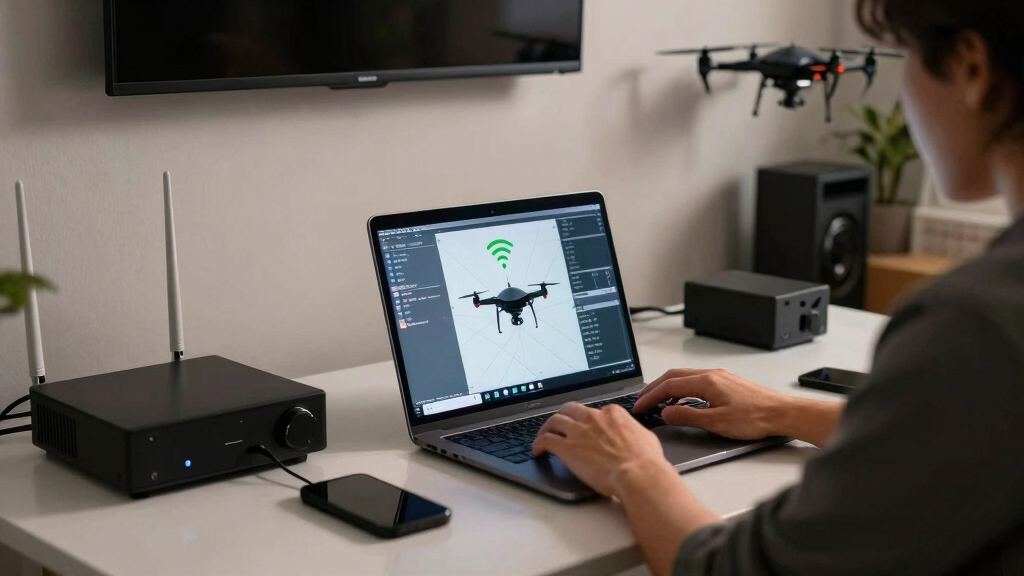
QuadRF has developed a technology capable of detecting drones and viewing WiFi signals through walls. While these capabilities are confirmed, the extent and potential applications are still being evaluated. This development raises questions about privacy and security.
QuadRF has announced a new technology that can detect drones in the air and visualize WiFi signals through walls. This breakthrough, confirmed by the company, could have significant implications for security, privacy, and surveillance practices worldwide.
According to QuadRF, their new system employs advanced radio frequency (RF) sensing techniques to identify the presence of drones in a given area. The company states that their technology can also see WiFi signals penetrating walls, providing a form of indoor wireless mapping. These claims were shared in a recent press release and during a demonstration attended by select industry analysts. Experts note that RF sensing technologies capable of such detection are emerging, but QuadRF’s specific claims about wall-penetrating WiFi visualization are still being scrutinized. The company emphasizes that their system does not require line-of-sight and can operate at significant distances, making it potentially useful for security agencies, law enforcement, and private security firms. However, the full technical details, including the range, resolution, and potential for false positives, have not yet been publicly disclosed. It is also unclear whether the technology has been tested in real-world scenarios or remains in prototype stages. Privacy advocates have raised concerns about the potential misuse of such capabilities, but no regulatory or legal implications have been officially announced by QuadRF at this stage.Implications for Privacy and Security
The ability to detect drones and visualize WiFi signals through walls could dramatically impact security protocols and privacy rights. Security agencies might leverage this technology for surveillance and threat detection, but it also raises concerns about unauthorized monitoring and data collection. The technology’s potential to see through walls challenges existing privacy boundaries and could lead to new regulations or restrictions. For consumers and privacy advocates, this development underscores the need for awareness about RF sensing capabilities and their limits. As the technology advances, debates around ethical use and oversight are likely to intensify, making this a pivotal moment in surveillance technology’s evolution.
As an affiliate, we earn on qualifying purchases.
Emerging RF Sensing Technologies and Privacy Concerns
RF sensing technologies capable of detecting drones and visualizing wireless signals have been in development for several years. Companies and research institutions have demonstrated various forms of RF-based detection, primarily for security and military applications. QuadRF’s announcement builds on these advances by claiming to combine drone detection with WiFi visualization through walls, a feat that has been difficult due to technical challenges. Prior to this, similar capabilities have been limited to laboratory settings or constrained environments. The broader context includes ongoing debates over privacy rights and the potential misuse of surveillance tools. Regulatory frameworks are still evolving, and experts warn that widespread adoption could lead to intrusive monitoring if not properly controlled.
“Our system offers unprecedented detection capabilities for security applications, respecting all applicable laws and regulations.”
— QuadRF spokesperson
As an affiliate, we earn on qualifying purchases.
Technical Details and Real-World Testing Status
It is not yet clear how effective QuadRF’s technology is outside controlled demonstrations. Details about the detection range, resolution, and false positive rate remain undisclosed. The extent to which the system can reliably visualize WiFi signals through various wall materials or in cluttered environments is also uncertain. Additionally, whether the technology has been adopted or tested by third parties has not been confirmed, and independent verification is still pending.
As an affiliate, we earn on qualifying purchases.
Further Testing and Regulatory Review Expected
QuadRF is expected to publish more technical details and conduct broader testing in the coming months. Industry analysts anticipate that regulatory agencies may review the technology’s implications for privacy and security. Lawmakers and privacy advocates are likely to scrutinize its use, potentially leading to new guidelines or restrictions. Meanwhile, competitors and security firms will watch closely to assess the technology’s practical deployment and limitations.
As an affiliate, we earn on qualifying purchases.
Key Questions
Can QuadRF’s technology detect all drones?
It is not yet confirmed if the system can detect all types of drones or only specific models. Details about its detection capabilities are still being evaluated.
How does the WiFi visualization through walls work?
QuadRF claims to visualize WiFi signals penetrating walls using RF sensing techniques, but technical specifics and effectiveness in different environments are still unclear.
Is this technology legal to use in the US and other countries?
Legal considerations depend on local laws governing surveillance and privacy. No official legal status or restrictions have been announced yet.
When will more details about the technology be available?
QuadRF has indicated that further technical disclosures and testing results are expected in the coming months.
What are the privacy concerns associated with this technology?
The ability to see through walls and detect drones raises concerns about unauthorized surveillance and data privacy, prompting calls for regulatory oversight.
Source: hn
Halloween Picks
halloween
As an affiliate, we earn on qualifying purchases.