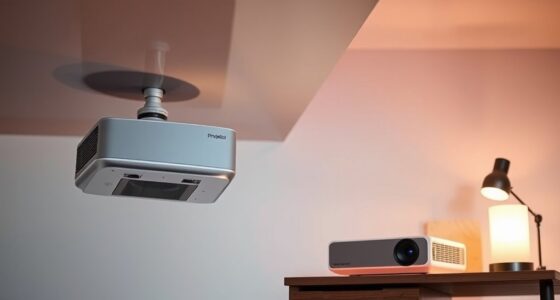
Before you start, understand your projector’s throw ratio to make certain of proper setup. Measure your space and compare it with the projector’s recommended projection distance to avoid blurry or distorted images. Double-check lens compatibility if you plan to upgrade or adjust the lens, and use zoom or lens shift features to fine-tune the image. If issues persist, troubleshooting the distance and compatibility will help. Keep exploring to master more tips for sharp, correctly sized visuals.
Key Takeaways
- Measure your room’s projection distance and compare it with the projector’s specified throw ratio.
- Confirm lens compatibility before upgrading or replacing to prevent distorted or blurry images.
- Use zoom and lens shift features to adjust image placement without moving the projector physically.
- Ensure the projected image matches room dimensions for optimal clarity by matching throw ratio and space.
- Troubleshoot by checking for focus issues or lens incompatibility if images appear blurry or distorted.

Hitachi 3.0 Throw Ratio Video Projector (CP-WU8440)
4200 Lumens Brightness
As an affiliate, we earn on qualifying purchases.
As an affiliate, we earn on qualifying purchases.
Projector Throw Ratio: Key Setup Tips and Troubleshooting
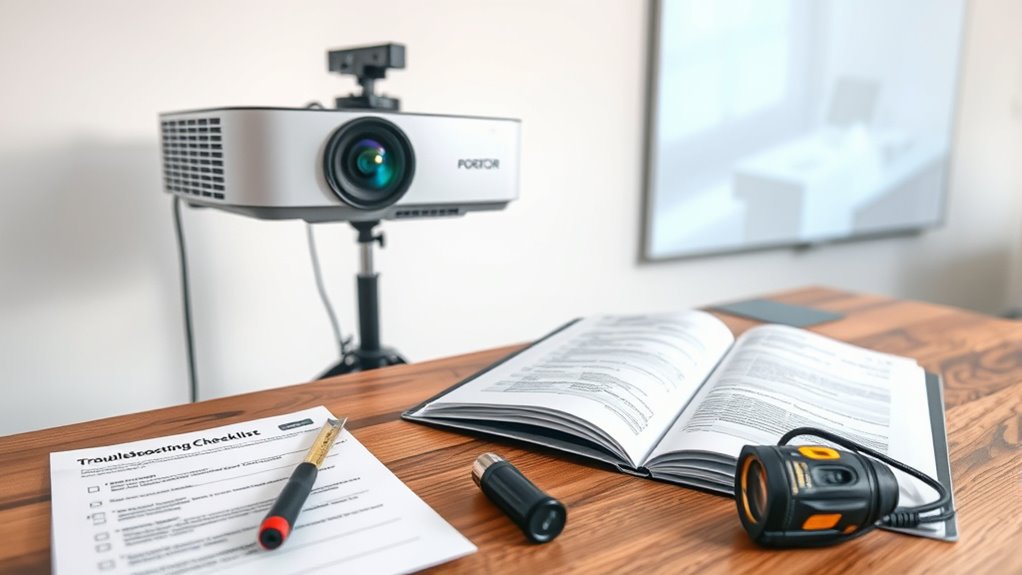
Understanding throw ratio is essential before setting up your projector, as it determines whether your device will fit your space and deliver a clear image. This ratio helps you figure out the projection distance needed to produce your desired image size. If your projection distance is too short or too long for your projector’s throw ratio, you might end up with an image that’s blurry, distorted, or too small. To avoid these issues, you must consider your space carefully and match it to your projector’s throw ratio specifications. For example, a short-throw projector is designed to project large images from a closer distance, making it ideal for small rooms. Conversely, a long-throw projector requires more space but can cover larger areas from farther away. Knowing your projection distance allows you to select the right projector that fits your room dimensions and guarantees maximum image quality. Additionally, understanding the throw ratio helps you plan your setup more efficiently and ensures compatibility with your intended space.
Lens compatibility is another vital aspect tied to throw ratio. Different projectors come with specific lenses, and not all lenses are interchangeable. If you plan to upgrade or replace your lens, you need to verify that it’s compatible with your projector model to maintain image clarity and proper focus. Incompatibility can lead to a distorted or uneven picture, defeating the purpose of choosing the right throw ratio in the first place. Before making any purchases or adjustments, check your projector’s specifications and consult the manufacturer’s compatibility list. This will help you avoid costly mistakes and ensure that your setup remains seamless.
When troubleshooting throw ratio issues, start by measuring your available projection distance and comparing it to your projector’s throw ratio. If your projected image is smaller than expected, you might need to move your projector closer or select a model with a shorter throw ratio suitable for your space. If the image is blurry or distorted, it could be due to lens incompatibility or incorrect focus settings. Adjust the lens or replace it with a compatible one if necessary. Always double-check your projector’s specs to confirm that the lens and projection distance align with your room layout. If your projector offers zoom or lens shift features, utilize them to fine-tune the image placement without moving the device physically, which can help maximize projection quality.
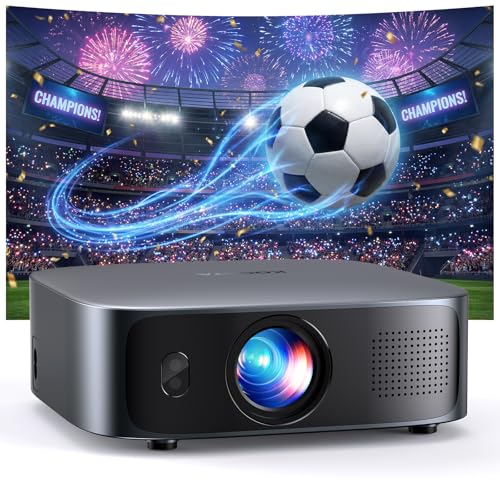
Short Throw Projector 4K with WiFi and Bluetooth,2000ANSI Auto Focus Keystone Smart Projector Built in Apps Dolby Audio Home Theater Movie Portable Outdoor Projector Ceiling Gunmetal
Unveil 2026 New Era of Smart Projectors: Say goodbye to messy cables, long throw distances, and tedious setup….
As an affiliate, we earn on qualifying purchases.
As an affiliate, we earn on qualifying purchases.
Frequently Asked Questions
How Do I Measure My Projector’s Throw Ratio Accurately?
To measure your projector’s throw ratio accurately, start by noting your projection distance—the space from the projector to the screen. Adjust the lens zoom to its default setting to guarantee consistency. Then, divide the projection distance by your desired image width. This calculation gives you the throw ratio. Keep the lens steady during measurement for precision, and repeat if necessary to confirm accuracy.
Can I Change My Projector’s Throw Ratio?
Yes, you can change your projector’s throw ratio by swapping out the projection lens. This adjustment helps you adapt to different room sizes, ensuring your image fits perfectly. When selecting a new lens, consider your room size and desired image size. Keep in mind that some projectors allow zoom adjustments, but for a more significant change, a different lens provides better control over your projection’s throw ratio.
What Are Common Causes of Incorrect Throw Ratio Readings?
You might see incorrect throw ratio readings due to lens distortion or sensor misalignment. Lens distortion can alter how the image projects, making measurements inaccurate. Sensor misalignment happens when the projector’s internal components shift, throwing off the ratio calculations. Check for proper lens installation and ensure the sensor is correctly aligned. Regular calibration and careful handling help prevent these issues, keeping your throw ratio readings accurate for better image performance.
How Does Throw Ratio Affect Image Size and Clarity?
You might think a perfect throw ratio guarantees a clear image, but it actually influences your setup’s image size and clarity. A mismatch in lens compatibility can cause image distortion, making details blurry or stretched. When the throw ratio is too high or low, your projector either shrinks or enlarges the image, affecting clarity. Ensuring the right throw ratio and compatible lens helps you achieve sharp, correctly sized visuals.
Is a Shorter or Longer Throw Better for Small Rooms?
In small rooms, a shorter throw is better because it allows you to project a larger screen size without taking up too much space. With limited room dimensions, a short throw projector helps you achieve clear, sharp images close to the wall or screen. This setup minimizes distortion and clutter, ensuring your viewing experience remains immersive and comfortable without sacrificing image quality.
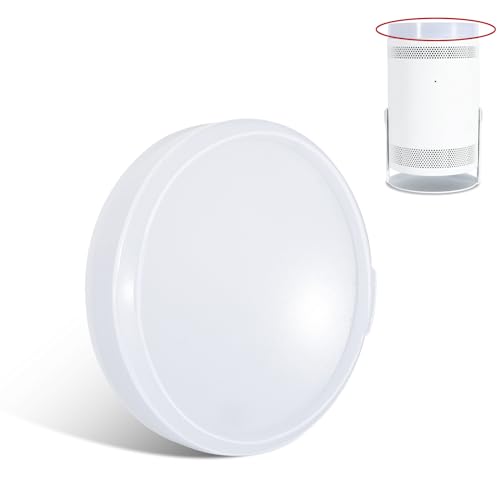
Projector Lens Cover Compatible with Samsung Freestyle Plastic Cover, Freestyle 2 Projector Lens Cap for SP-LSP3BLA (1st gen); SP-LFF3CLA (2nd gen)
【Compatible Models】: SP-LSP3BLA (1st gen); SP-LFF3CLA (2nd gen) SP-LSP3BLAXXL; SP-LFF3CLAXXXY; SP-LFF3CLAXXXP; SP-LFF3CLAXXZA
As an affiliate, we earn on qualifying purchases.
As an affiliate, we earn on qualifying purchases.
Conclusion
Now that you’ve navigated the maze of throw ratios, remember—your projector’s perfect picture is within reach, like a star waiting to be discovered. With a steady hand and a keen eye, you’ll fine-tune your setup, transforming your space into a cinematic universe. Troubleshooting becomes a dance, not a chore, as you orchestrate clarity and focus. Embrace the journey, knowing each adjustment guides you closer to the masterpiece hiding in plain sight.

Maxmartt 8pcs Adjust Frequency Screwdriver Set – Anti-static Kit for High Frequency Circuit Adjustment – Plastic Alignment Tool
【High-quality materials】This insulated screwdriver kit frequency screwdriver is adopted precision zirconia ceramics bits, good quality and durable. Strong…
As an affiliate, we earn on qualifying purchases.
As an affiliate, we earn on qualifying purchases.