
Throw ratio explains how projector size relates to the distance from your screen, helping you place your projector correctly for sharp, properly sized images. It’s made up of components like lens focus and throw distance, and you can calculate it by dividing your projection distance by your desired screen width. Knowing the different types of throw ratios guides you to pick the perfect projector for your space—keep going to learn more about making the best choice.

Get business pricing on your home office setup
- Business-only prices and quantity discounts
- Tax-exempt purchasing
- Multiple users, one account, clear invoices
Key Takeaways
- Throw ratio indicates how projector size relates to its distance from the screen, guiding proper placement.
- It is calculated by dividing the throw distance by the desired image width.
- Different throw ratios (short, standard, long) suit various room sizes and projection needs.
- Short throw projectors are ideal for small spaces; long throw for large venues.
- Understanding throw ratio helps select the right projector and achieve optimal image quality.
As an affiliate, we earn on qualifying purchases.
What Is Throw Ratio and Why Does It Matter?
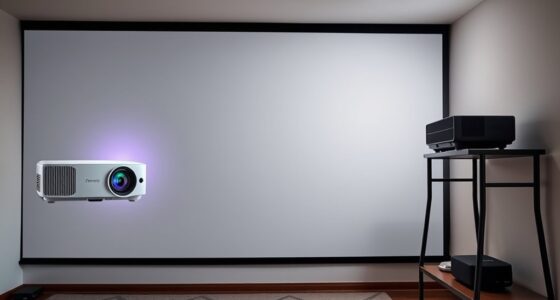
Have you ever wondered how a projector determines the size of the image it projects relative to its distance from the screen? The answer lies in the throw ratio. This number tells you how far the projector needs to be from the screen to produce a specific image size. Proper projector placement depends on understanding throw ratio because it directly impacts how large or small your image will appear. If you place the projector too close or too far, the image may be blurry or improperly sized. Knowing the throw ratio helps you choose the right projector for your space, ensuring you get a clear, appropriately sized image. Ultimately, understanding throw ratio allows you to optimize your setup for the best viewing experience. Additionally, considering the market trends in projector technology can help you select a model that meets your needs now and in the future.
As an affiliate, we earn on qualifying purchases.
Understanding the Components of Throw Ratio
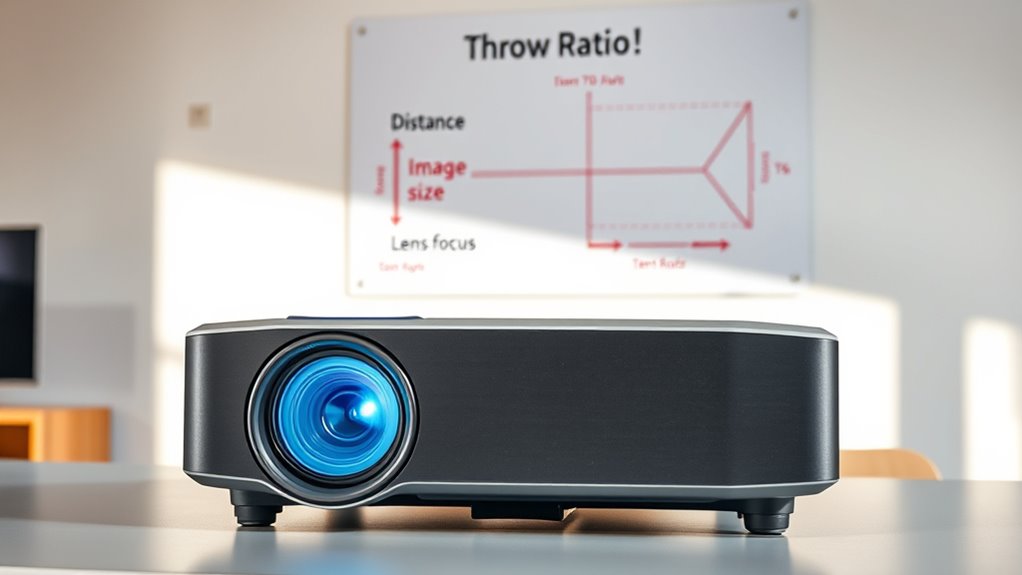
Understanding the components of throw ratio involves examining two key measurements: the projector’s lens distance and the width of the projected image. The lens focus determines how sharply the image appears, while the image size depends on the throw ratio and distance from the screen. Properly adjusting these components can significantly improve your viewing experience. Here’s a simple table to clarify these components:
| Component | Description | Impact on Image |
|---|---|---|
| Lens focus | Adjusts clarity of the image | Ensures sharpness |
| Throw distance | Distance from projector to screen | Changes image size |
| Image size | Width of projected image | Affected by throw ratio and distance |
Additionally, understanding how throw ratio influences image size can help you select the right projector setup.
projector with adjustable throw ratio
As an affiliate, we earn on qualifying purchases.
As an affiliate, we earn on qualifying purchases.
How to Calculate and Use Throw Ratio for Your Space
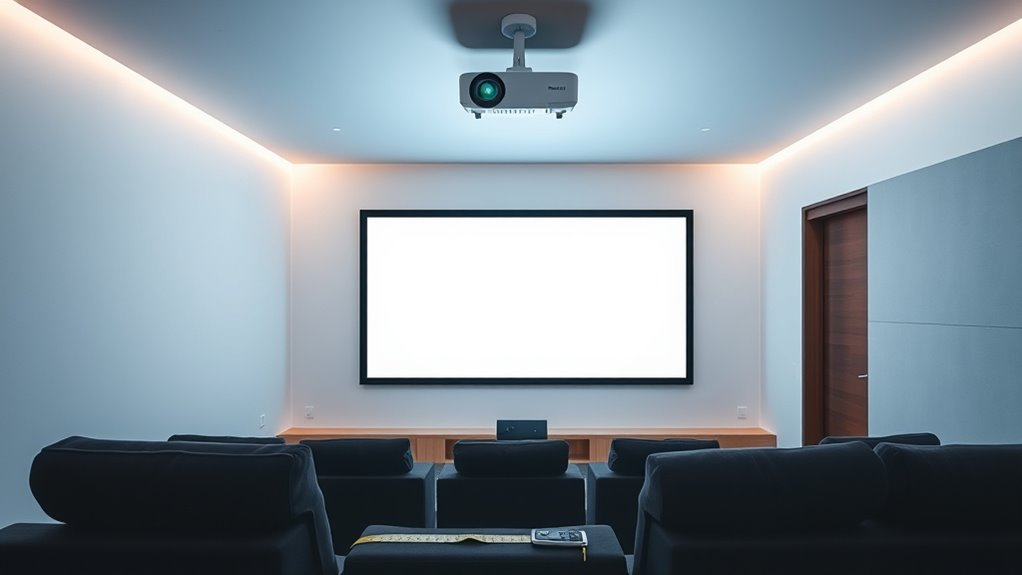
Wondering how to determine the right throw ratio for your space? First, measure your projection distance—the space between your projector and screen. Then, decide on your desired screen size. To find the appropriate throw ratio, divide the projection distance by the screen width. For example, if your projection distance is 10 feet and your screen width is 5 feet, your ideal throw ratio is 2:1. Using this calculation helps you choose a projector with the correct throw ratio, ensuring your image fits perfectly without needing to move the projector or resize your screen. Keep in mind that a lower throw ratio is better for small spaces, while a higher one works well for larger rooms. Understanding cryptocurrency investment options can also help diversify your investments beyond traditional settings. This simple calculation makes selecting the right projector setup straightforward and tailored to your space.
As an affiliate, we earn on qualifying purchases.
Different Types of Throw Ratios and What They Mean
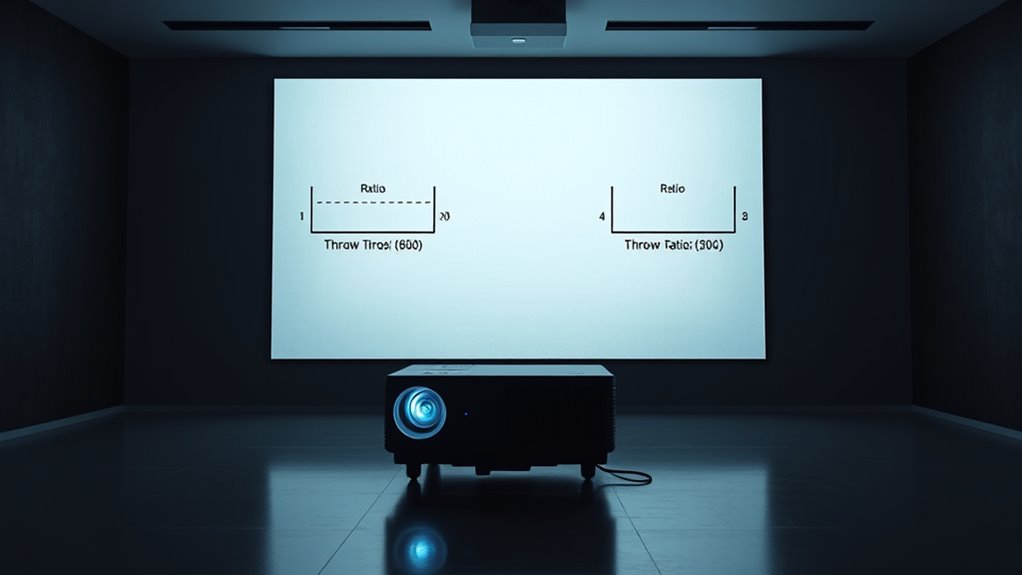
Different types of throw ratios determine how far a projector needs to be from the screen to produce a specific image size. Short throw projectors have a low throw ratio, allowing you to place them close to the screen, ideal for small rooms. Long throw projectors require more distance, suitable for large venues. Understanding these differences helps you pick the right projector for your space. Here’s a quick comparison:
| Throw Type | Typical Distance | Ideal Use |
|---|---|---|
| Short Throw | 1-3 feet | Small rooms, classrooms |
| Standard Throw | 6-12 feet | Living rooms, offices |
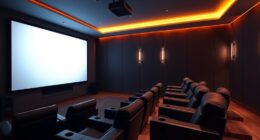
| Long Throw | 15+ feet | Large auditoriums, theaters |
Knowing whether you need a short throw or long throw projector ensures suitable image size and placement. For precise setup, considering time zone information can also be helpful when coordinating installation times across different locations.
Tips for Choosing the Right Projector Based on Throw Ratio
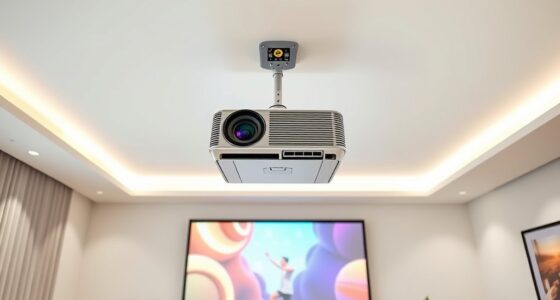
Choosing the right projector based on throw ratio starts with evaluating your space and how close or far the projector will be from the screen. Your projection distance directly affects the image size and clarity. If you want a large screen in a small room, opt for a short-throw projector, which can produce a big image from a close distance. Conversely, if you have ample space, a long-throw projector allows for greater projection distance, ideal for larger screens. Consider your desired screen size and available space when selecting a throw ratio. Ensuring the projector’s throw ratio matches your room’s dimensions helps you achieve *ideal* image quality without distortion or keystone issues. Measure your space carefully, and choose a projector that fits your projection distance and screen size needs. Additionally, understanding projector statistics can help you make an informed decision based on common usage scenarios and performance expectations.
Frequently Asked Questions
How Does Ambient Light Affect Throw Ratio Effectiveness?
Ambient light impacts throw ratio effectiveness by reducing your projector’s contrast, making images appear washed out. When there’s a lot of ambient light, you’ll need a projector with a shorter throw ratio or higher lumens to maintain brightness and clarity. This way, your projector can compensate for the light, ensuring sharp images and better contrast, even in brightly lit rooms. Controlling ambient light enhances overall picture quality.
Can Throw Ratio Change Over the Lifespan of a Projector?
Yes, your projector’s throw ratio can change over its lifespan. As the projector ages, lens zoom might become less precise, affecting projection distance and image size. Dust or wear can also impact lens clarity, altering the effective throw ratio. Regular maintenance and calibration help maintain accurate projection distance, ensuring your lens zoom functions *at its best* and your image stays sharp and correctly sized over time.
Are There Portable Projectors With Adjustable Throw Ratios?
Yes, some portable projectors come with adjustable throw ratios, giving you the flexibility to project a clear image no matter your space. Think of these projectors as a chameleon, adapting to different environments effortlessly. With an adjustable throw, you can easily fine-tune your portable projector to fit small conference rooms or cozy living rooms, making setup quick and seamless while ensuring your visuals are always sharp and bright.
How Does Throw Ratio Influence Projector Placement Flexibility?
Throw ratio directly impacts your projection distance and lens selection, making it easier or harder to position your projector. A smaller throw ratio means you can place the projector closer to the screen, offering more flexibility in tight spaces. Conversely, a larger throw ratio requires more distance. Your choice of lens also influences placement options, so understanding throw ratio helps you select the right projector for your room and setup needs.
What Are Common Mistakes When Calculating Throw Ratio?
Nearly 60% of projector setup errors come from misjudged distances. When calculating throw ratio, avoid common mistakes like using incorrect measurements or ignoring lens shift capabilities. Many people make calculation errors because they don’t double-check their distances or assume standard ratios without considering room size. To prevent this, measure carefully, account for projector placement, and understand your projector’s throw ratio specs to guarantee a perfect fit.
Conclusion
Now that you understand throw ratio, you’re like a skilled captain steering your projector’s potential. Think of it as a compass guiding you to the perfect fit for your space, ensuring your image lands just right. With this knowledge, you can confidently steer toward the ideal projector, transforming any room into your personal theater. Just remember, mastering throw ratio is the key to making your viewing experience smooth sailing from start to finish.
Fall Picks
fall essentials
As an affiliate, we earn on qualifying purchases.