When matching a projector to your screen size, understanding the throw ratio helps you choose the right device for your space. A short throw ratio is ideal for small rooms, allowing large images from close proximity, while a long throw ratio suits bigger areas. Your lens focal length also influences how big an image you can get at certain distances. Getting these details correct ensures a clear, properly sized picture—keep exploring to learn how to optimize your setup perfectly.
Key Takeaways
- Match the projector’s throw ratio to your room size to achieve desired screen size without distortion.
- Short throw projectors are ideal for small spaces, allowing large images from close distances.
- Long throw projectors suit large rooms, projecting sizable images from farther away.
- Lens focal length influences image width at a given distance, affecting how well the projector fits the space.
- Measure your room and consider projection distance to select a projector with the appropriate throw ratio and lens.
Understanding throw ratio is vital when choosing a projector because it directly affects the size of the screen you can achieve in your space. The throw ratio is a simple ratio that compares the projection distance to the width of the projected image. For example, a throw ratio of 1.5:1 means that for every foot of projection distance, the image will be 1.5 feet wide. Knowing this helps you determine how far your projector should be placed from the screen to produce your desired size. Whether you’re setting up in a small conference room or a home theater, understanding your room’s dimensions and the projector’s projection distance is essential. If your space is limited, a projector with a short throw ratio allows you to achieve a large screen from a close distance, while a long throw ratio is better suited for larger rooms where the projector can be placed farther back.
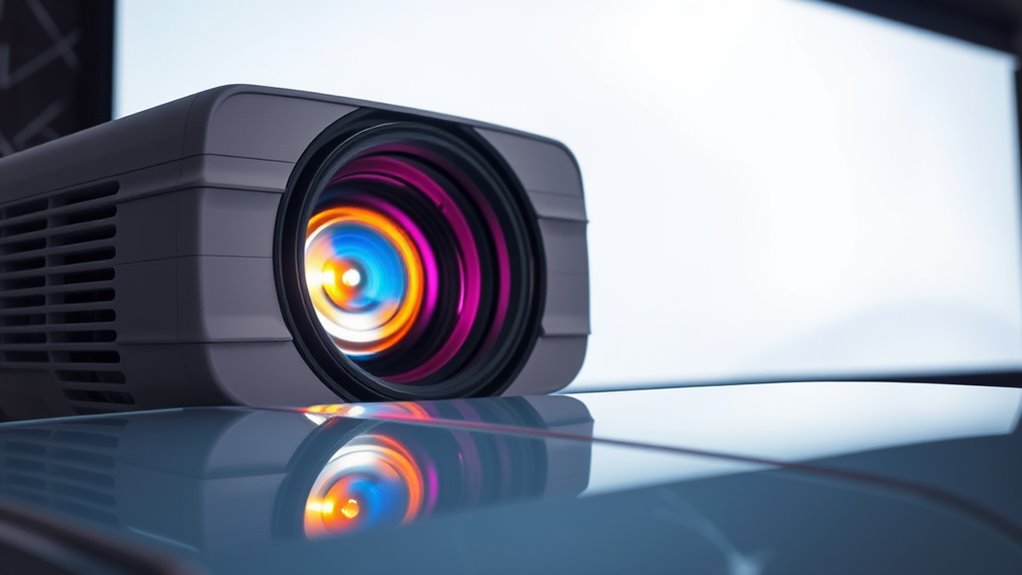
Your lens focal length plays a significant role in this calculation. The lens focal length determines how wide or narrow the projected image will be at a given projection distance. A lens with a shorter focal length produces a wider field of view, enabling larger images from closer distances. Conversely, a longer focal length lens offers a narrower field of view, which is ideal for projecting smaller images over longer distances. When selecting a projector, understanding how the lens focal length interacts with the projection distance helps you find the right balance for your space. If you want a big screen in a tight room, a projector with a short throw ratio and a wide-angle lens is your best bet. On the other hand, if you have a large hall, a projector with a longer throw ratio and a telephoto lens might be more appropriate.
Matching your projector’s throw ratio with your room’s dimensions guarantees you get the best screen size without sacrificing image quality or having to move the projector excessively. It’s not just about choosing the most powerful projector but about selecting one that fits your space and viewing needs. Measure your room carefully, consider how far the projector can be placed from the screen, and pay attention to the lens focal length. This way, you’ll prevent issues like a distorted or overly small image and maximize your viewing experience. In essence, understanding the relationship between projection distance, lens focal length, and throw ratio empowers you to make an informed choice, ensuring your projector delivers the perfect screen size for your space.

Philoent【Google TV Included】Smart Mini Projector, Ultra Short Throw for Big Screen in Small Room, Auto Keystone Portable Proyector with WiFi Bluetooth, Support 4K Movie – Home Theater Bedroom Outdoor
🥇【Instant Full Google TV Access – No Setup Needed】 Experience the complete Google TV ecosystem directly, with no…
As an affiliate, we earn on qualifying purchases.
As an affiliate, we earn on qualifying purchases.
Frequently Asked Questions
How Does Ambient Light Affect Projector Image Quality?
Ambient light can considerably reduce your projector image quality by washing out colors and lowering contrast. It causes screen glare, making it harder to see details clearly. To improve your viewing experience, you should control ambient light with curtains or blinds and consider a projector with higher brightness (lumens). Using a matte screen surface also helps minimize glare, ensuring your image remains sharp and vibrant even in well-lit rooms.
Can a Short-Throw Projector Work in Small Rooms?
Yes, a short-throw projector can work in small rooms, but you should consider its limitations. Short-throw projectors are designed for limited space, allowing you to project a large image from a short distance. However, room size considerations matter; too close to the wall can cause shadows or image distortion. Measure your space carefully to guarantee the projector’s throw ratio fits your room, and avoid potential setup issues.
What Are the Benefits of Ultra-Short-Throw Projectors?
Ever wondered why ultra-short-throw projectors are popular? They offer big screen sizes from just inches away, thanks to their low throw ratio. This means you can enjoy a spacious display without cluttering your room or risking shadows. Perfect for small spaces, they minimize installation hassle and reduce glare. Wouldn’t it be great to have a large screen without sacrificing room space? Ultra-short-throw projectors make that possible.
How Do Lens Shift and Zoom Impact Setup Flexibility?
Lens shift and zoom enhance your setup flexibility by allowing easy lens adjustment and zoom versatility. You can fine-tune the image position without moving the projector, making installation simpler in tight spaces. Zoom lets you adjust the image size without changing the projector’s position, while lens shift offers precise control over image placement. This means you can achieve ideal alignment effortlessly, saving time and ensuring a perfect projection every time.
Are Higher Lumen Projectors Better for Bright Environments?
Think of brightness levels like sunlight pouring into a room—you want enough to brighten the space without washing out details. Higher lumen projectors excel in bright environments, making images vivid and clear. They often offer better contrast ratios, which enhances picture depth. So, yes, in well-lit spaces, a higher lumen projector is your best bet, ensuring your visuals stay sharp and vibrant even under strong ambient light.
![[3000+ Licensed Apps/Live TV/HDR10+/50W DoIby Audio] Smart 4K-Projector with WiFi and Bluetooth, Goiaey 3200ANSI Outdoor Projector with 360°Stand, Auto Focus, Auto Keystone, Short Throw Proyector](https://m.media-amazon.com/images/I/51tybuNKSUL._SL500_.jpg)
[3000+ Licensed Apps/Live TV/HDR10+/50W DoIby Audio] Smart 4K-Projector with WiFi and Bluetooth, Goiaey 3200ANSI Outdoor Projector with 360°Stand, Auto Focus, Auto Keystone, Short Throw Proyector
➤ AI MOVIN 3.0 System for Superior Performance—-Powered by the advanced AI MOVIN 3.0 system, Goiaey upgrade GO2…
As an affiliate, we earn on qualifying purchases.
As an affiliate, we earn on qualifying purchases.
Conclusion
Understanding throw ratio helps you choose the right projector for your space. For example, a projector with a 1.5:1 throw ratio can project a 100-inch screen from about 10 feet away. Did you know that nearly 60% of home theater setups fail because of mismatched projector and screen sizes? By matching your projector’s throw ratio to your room, you make certain a clear, immersive picture without sacrificing space or quality.
![[AI Auto Focus/Auto Lens Cap] Outdoor-Projector-4K with WiFi 6 and Bluetooth: 1500 ANSI Portable Projector with Auto 6D Keystone & Zoom, Jimveo Native 1080P Movie Proyector 2026 Upgraded](https://m.media-amazon.com/images/I/51NbInL1chL._SL500_.jpg)
[AI Auto Focus/Auto Lens Cap] Outdoor-Projector-4K with WiFi 6 and Bluetooth: 1500 ANSI Portable Projector with Auto 6D Keystone & Zoom, Jimveo Native 1080P Movie Proyector 2026 Upgraded
[World’s 1st Smart Projector with AI Auto-Focus + Auto Lens Cap] E30 Pro portable projector with 2026 upgrade…
As an affiliate, we earn on qualifying purchases.
As an affiliate, we earn on qualifying purchases.
![[3200 ANSI/ Official Apps/50W Audio] Outdoor 4K Projector with WiFi and Bluetooth, Auto Focus, Auto Keystone Smart Projector Support DoIby Audio, 2026 Upgrade GO2 Short Throw Projector with 360°Stand](https://m.media-amazon.com/images/I/41-laeqxhwL._SL500_.jpg)
[3200 ANSI/ Official Apps/50W Audio] Outdoor 4K Projector with WiFi and Bluetooth, Auto Focus, Auto Keystone Smart Projector Support DoIby Audio, 2026 Upgrade GO2 Short Throw Projector with 360°Stand
Highest 3200 ANSI Lumens & 360°Rotatable Stand– With upgrade 3200 ANSI lumens brightness, the GO2 outdoor projector offers…
As an affiliate, we earn on qualifying purchases.
As an affiliate, we earn on qualifying purchases.