TL;DR

Get business pricing on your home office setup
- Business-only prices and quantity discounts
- Tax-exempt purchasing
- Multiple users, one account, clear invoices
House Beautiful has published a roundup of 27 designer approaches to hiding televisions or making them blend into a room. The examples include cabinets, millwork, closets, credenzas, fabric-covered doors and artwork-like screens; the report does not compare costs or establish which method works best.
House Beautiful has published a 27-example roundup of ways designers conceal televisions or make them blend into home interiors, showing options that range from cabinet doors and closets to decorative panels and screens styled as art. The ideas address a common design trade-off: keeping a TV available for watching while reducing its visual prominence when it is off.
The examples in the report use both built-in features and movable furnishings. Melbourne designer Kylie Buhagiar, of Golden, describes a wall-hung metal joinery box with hinged doors that fold back to reveal the TV. Vancouver designer Gillian Segal used a folding millwork door system, which she said was a cost-effective solution for a room serving as both a formal living space and a family room.
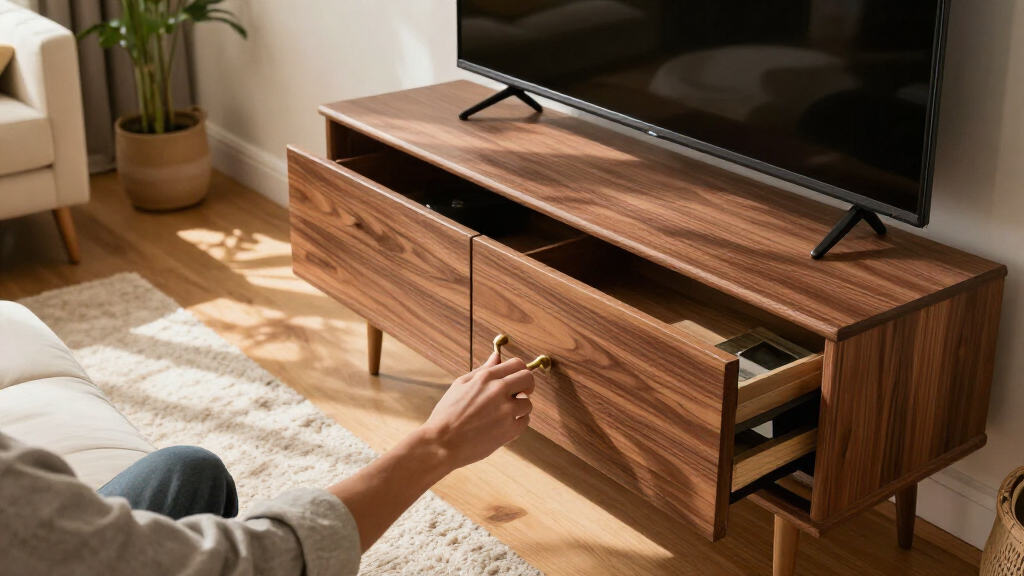
Other projects place screens inside or behind existing furniture and storage. The roundup describes a TV tucked into a closet in a guest room, another housed in a wooden credenza, and a screen concealed in a green cabinet with fabric covering its glass. An outdoor-room example uses a pagoda-shaped cabinet above a fireplace, while a kitchen example uses a Samsung Frame TV.
Several strategies make the screen part of the decor rather than hiding it behind a door. Designers in the roundup use Frame TVs styled to resemble photographs, a decorative frame coordinated with other room details, abstract-looking panels above a fireplace, and a bi-fold painting that moves aside. The report also includes a hidden pop-up function as one of its approaches, though the supplied excerpt does not give details about that installation.
Keeping Screens Out of Sight
The roundup is useful to homeowners planning a room where a television is wanted but should not dominate the view. It illustrates that concealment can be built into cabinetry, millwork or furniture, or achieved through decor that helps the screen blend into its surroundings. The choice affects more than appearance: a hinged door, closet or pop-up mechanism requires a different layout from a screen designed to remain visible as art.
The examples also show how rooms may need to serve competing purposes. Segal’s project, for instance, was intended for both formal entertaining and family use, while another example places a screen in a kitchen where children watch TV. These are designers’ project descriptions, not evidence that one solution suits every household. The report offers ideas rather than a tested comparison of durability, viewing comfort or price.
Products Worth Considering

Samsung 65-Inch The Frame Pro Neo QLED 4K TV (2026) Bundle with Modern Brown Bezel, HDMI Cables, and Home Theater Guide

Samsung 75-Inch The Frame Pro 4K Neo QLED Smart TV (QN75LS03FW)

Samsung 55-Inch The Frame QLED 4K TV (2026) Bundle
As an affiliate, we earn on qualifying purchases.
From Cabinetry to Art-Like Screens
The source is a design roundup, not a report on a newly announced product, building standard or research finding. Its central subject is the range of ways designers handle the visual presence of a television in a home. Some approaches physically cover or store the screen; others leave it visible but match it to artwork, wall finishes or room colors.
Among the named designers, Ariel Okin adds a frame to a Samsung Frame TV so it relates to other details in the room, while Denise McGaha uses a Frame TV styled as a photograph within a blue-and-grey palette. Architect Ken Pursley describes a bi-fold panel painting by Stuart Coleman Budd as “true kinetic art”, emphasizing that its bronze hinges make the movable panel’s function visible rather than pretending it is fixed artwork.
““In the main living room, the TV is discreetly integrated into a wall-hung metal joinery box, with hinged doors that elegantly stack back to reveal the screen when needed.””
— Kylie Buhagiar, designer at Golden
Costs and Practical Limits
The supplied report excerpt does not provide a full description of all 27 approaches, and it gives no comparative pricing, installation requirements or performance testing. Segal calls her millwork system cost-effective, but the source does not state its cost or compare it with other options. It is also unclear from the excerpt how the pop-up installation works, what equipment each concealment method accommodates, or whether the examples are suitable for every room and screen size.
The article presents individual design projects and attributed descriptions. It does not establish that the pictured results are broadly achievable without custom work, nor does it report feedback from homeowners about maintenance, access or long-term use.
Choosing a Method for Your Room
The roundup gives readers a starting point for discussing screen placement with an interior designer, cabinetmaker or other relevant installer. A practical next step is to consider how often the TV will be used, whether it needs to be visible from multiple seating areas, and how much space a cabinet door or moving panel requires when open.
House Beautiful’s supplied material does not announce a follow-up, product launch or broader industry development. Readers seeking a particular design should consult the original roundup for its complete set of examples and ask about cost, installation and access before committing to built-in concealment.
Key Questions
What is the House Beautiful report about?
It is a roundup of 27 designer ideas for hiding TVs or helping them blend into home interiors. The examples include cabinetry, closets, credenzas, decorative panels and art-like screens.
Which ideas physically conceal a television?
The source describes TVs behind hinged cabinet doors, folding millwork, closet doors and painting panels. It also mentions a pop-up function, though the supplied excerpt does not explain its mechanism.
Can a TV be made to look like artwork?
Yes. The roundup describes Frame TVs styled as photographs and screens concealed behind abstract-looking panels or a movable painting. These are examples from individual projects, not a guarantee that every television can be disguised in the same way.
Does the report say how much these projects cost?
No general cost comparison is provided. Gillian Segal calls one folding millwork solution cost-effective, but the source gives no price or comparison with the other methods.
Source: housebeautiful.com