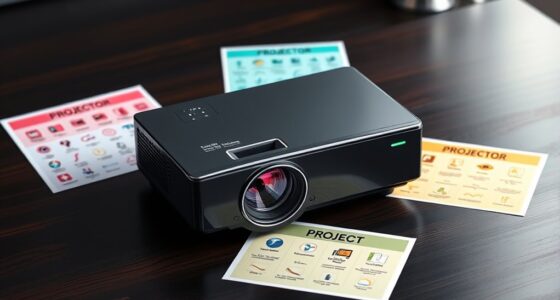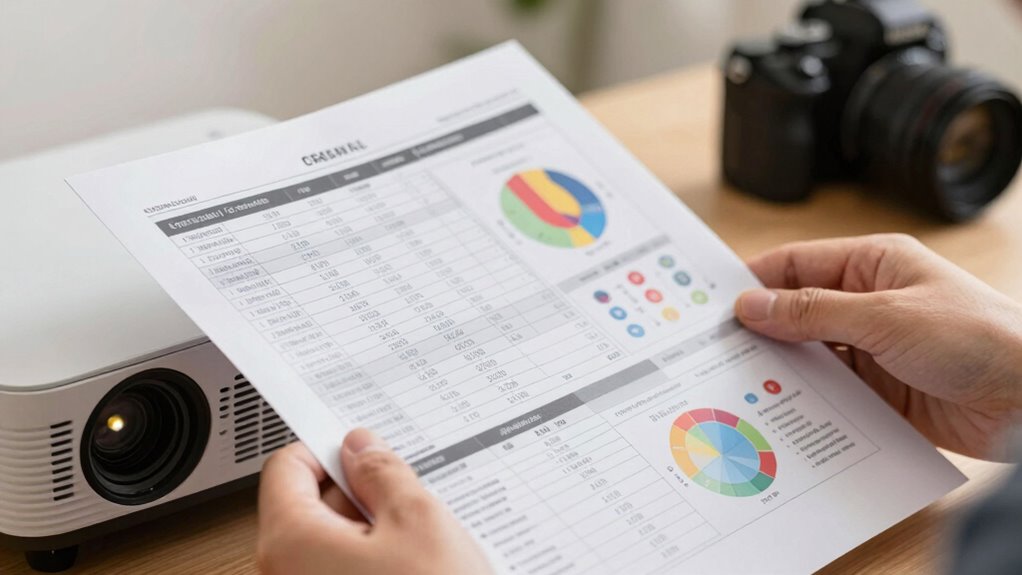
When reviewing projector spec sheets, focus on key details like resolution, which determines image sharpness and clarity. Check the lamp life to understand how often you’ll need replacements and the brightness to see if it suits your environment. Contrast ratio impacts picture depth, especially in dark scenes. Pay attention to all these specs together to gauge performance and maintenance needs. Keep exploring, and you’ll discover even more tips to choose the perfect projector for your needs.

Get business pricing on your home office setup
- Business-only prices and quantity discounts
- Tax-exempt purchasing
- Multiple users, one account, clear invoices
Key Takeaways
- Focus on display resolution and contrast ratio to assess image quality and detail clarity.
- Check lamp life both in hours and modes to understand maintenance frequency and costs.
- Consider brightness levels to ensure visibility in your intended environment.
- Review the technology type (LCD or DLP) for maintenance and performance insights.
- Compare specifications holistically to balance image quality, durability, and budget.
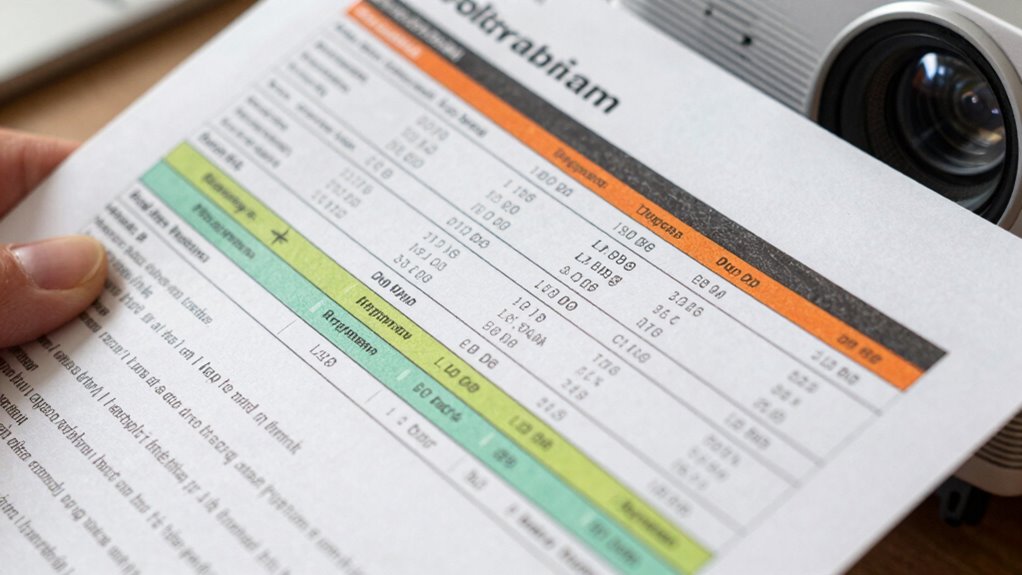
Ever wondered how to make sense of a projector spec sheet? It can seem overwhelming at first, with all those numbers and technical terms. But once you understand what to look for, reading these sheets becomes much easier. Two of the most critical features to focus on are display resolution and lamp life. These specs directly impact your viewing experience and how long your projector will serve you.
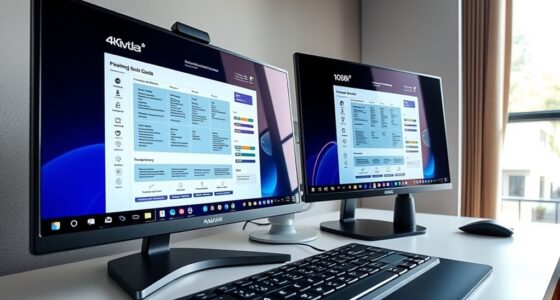
Display resolution refers to the number of pixels the projector can display, usually listed as width x height (for example, 1920 x 1080). Think of resolution as the level of detail and clarity you’ll see on the screen. Higher resolutions mean sharper images, which are essential if you’re projecting detailed graphics or watching high-definition videos. A low resolution might suffice for casual presentations, but for crisp visuals, aim for at least 1080p. Keep in mind that resolution isn’t just about the numbers; it also depends on the projector’s ability to handle content at that resolution without distortion or pixelation. Additionally, understanding the brightness of the projector can help ensure clear images even in well-lit rooms, making it a key consideration alongside resolution.
Higher resolutions deliver sharper images, ideal for detailed graphics and HD videos; aim for at least 1080p for crisp visuals.
Lamp life is another vital statistic because it indicates how long your projector’s lamp will last before needing replacement. Most spec sheets list lamp life in hours, often with two figures: typical or average life and maximum or extended life. For example, a projector might have a lamp life of 3000 hours in standard mode and up to 10,000 hours in eco mode. Knowing this helps you estimate ongoing costs and maintenance needs. A longer lamp life means fewer replacements and less downtime, which is especially important if you’re using the projector regularly or in a commercial setting. Additionally, contrast ratio plays a significant role in image quality, especially in dark scenes. Remember that lamp life can be affected by usage patterns, so if you’re planning to use the projector daily, opting for models with longer lamp lives could save you money in the long run. It’s also worth noting that the type of projection technology, such as LCD or DLP, can influence image quality and maintenance considerations. Being aware of projection technology can help you understand potential differences in image quality and upkeep requirements.
Other specs to consider include brightness and contrast ratio, but understanding display resolution and lamp life gives you a solid foundation. When you’re comparing projectors, focus on these features first, and you’ll be better equipped to choose a device that suits your needs. By paying close attention to these details, you avoid wasting money on a projector that doesn’t meet your expectations or requires frequent, costly maintenance. So, next time you review a spec sheet, take a moment to decode these key features—and you’ll gain confidence in making the right choice.
As an affiliate, we earn on qualifying purchases.
Frequently Asked Questions
What Is the Difference Between ANSI Lumen and Lumens?
ANSI lumen measures the brightness of a projector based on a standardized test, giving you a more accurate idea of how bright the image will appear in a typical setting, which helps with color accuracy. Lumens are a broader measure of brightness that can vary, affecting noise levels and image clarity. Knowing both helps you choose a projector that offers ideal brightness, minimal noise, and true color reproduction for your needs.
How Do Contrast Ratio and Brightness Affect Image Quality?
Contrast ratio and brightness directly impact your image quality, affecting color accuracy and noise levels. Higher contrast ratios provide deeper blacks and more vibrant colors, making images pop. Brightness guarantees the image is visible in various lighting conditions, reducing noise and graininess. Together, these specs help you achieve clearer, more accurate visuals, especially in challenging environments. So, prioritize both for sharp, vivid images with minimal noise.
What Projector Features Are Essential for Home Theater Use?
For home theater use, you need a projector that supports a large screen size for immersive viewing. Look for high contrast ratios and brightness to enhance picture quality, especially in well-lit rooms. Sound quality is equally important, so choose a model with good built-in speakers or audio outputs for external sound systems. This guarantees a cinematic experience with vibrant visuals and clear sound, making your home theater setup complete.
How Does Throw Distance Influence Projector Placement?
Throw distance directly affects your projector placement; a longer throw distance means you’ll need to position it farther from the screen, influencing the projection angle. You should consider your mounting options to optimize placement—ceiling mounts or table setups—based on your space. Accurate throw distance guarantees clear image size and quality, so measure carefully to match your projector’s specifications. Proper placement avoids distortion and guarantees an immersive viewing experience.
Are There Specific Specs for 4K or 8K Projectors?
Think of 4K and 8K projectors as the high-definition TVs of the projector world. Yes, there are specific specs for these models, mainly focusing on resolution, contrast ratio, and brightness. Projection technology varies, with some using LCD or DLP. Don’t forget to check lamp life, especially for brighter, more detailed images. These specs help determine if the projector meets your needs for clarity and longevity.
As an affiliate, we earn on qualifying purchases.
Conclusion
So, next time you’re deciphering a projector spec sheet, remember—it’s not as intimidating as it looks. You might even find yourself enjoying the challenge, as if decoding secret messages. After all, who knew that understanding lumens and contrast could make you feel like a tech wizard? Just don’t get too carried away—your new projector might just become your favorite puzzle. Happy spec sheet reading, and may your movies always look crystal clear!
As an affiliate, we earn on qualifying purchases.
As an affiliate, we earn on qualifying purchases.
Halloween Picks
halloween
As an affiliate, we earn on qualifying purchases.