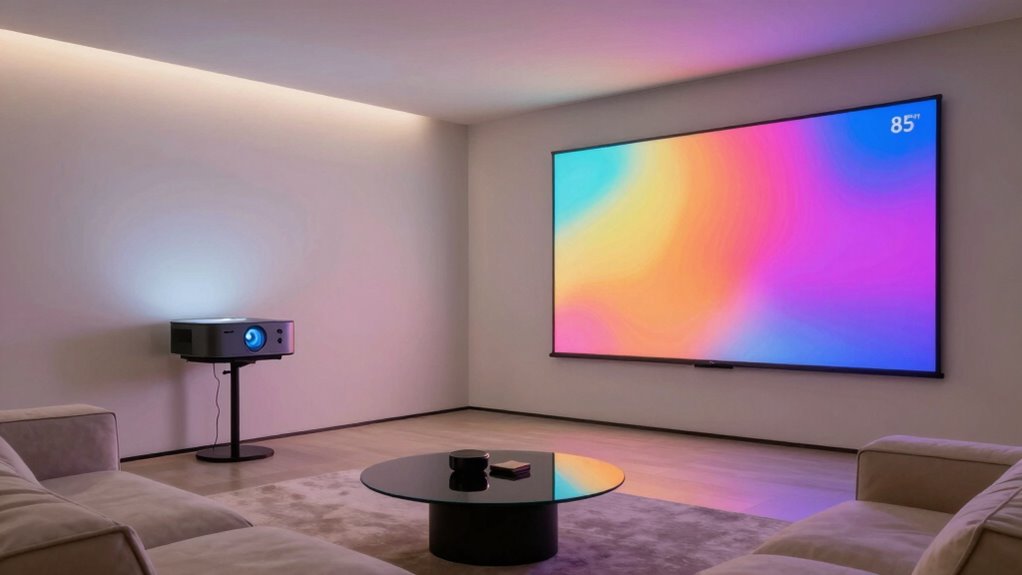

To choose between a projector and a giant TV, consider your room size, lighting, and how often you’ll watch. If you have a dedicated dark space and want a large immersive screen, a projector is ideal and usually more budget-friendly. For bright rooms or quick setup, a giant TV offers convenience and less maintenance. Your viewing habits and room conditions will guide the best choice—keep exploring to find the perfect fit for your space.

Get business pricing on your home office setup
- Business-only prices and quantity discounts
- Tax-exempt purchasing
- Multiple users, one account, clear invoices
Key Takeaways
- Consider room size, lighting conditions, and available space to determine whether a projector or a TV best fits your environment.
- Evaluate your budget for initial purchase and ongoing maintenance, balancing cost against desired screen size and quality.
- Decide how often and in what lighting conditions you’ll use the device to choose between quick-access TVs or immersive projectors.
- Assess installation and setup effort, opting for TVs if ease and speed are priorities, or projectors if you want a larger, customizable screen.
- Think about long-term maintenance and operational costs to select the option that offers sustainable value for your viewing habits.
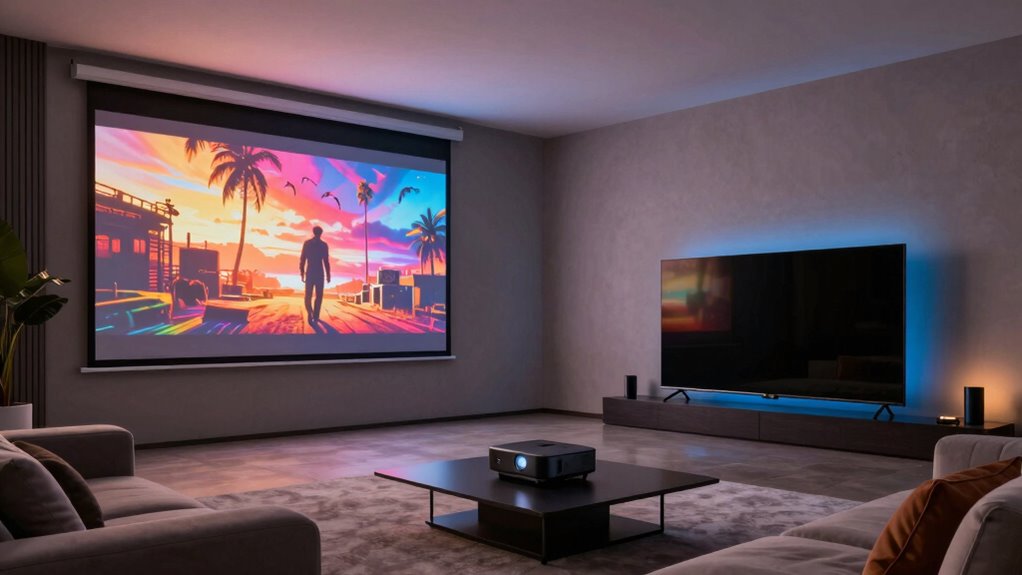
When deciding between a projector and a giant TV, understanding your space, budget, and viewing habits is vital. Your choice largely depends on the size of the screen you want and how much effort you’re willing to put into setup and maintenance. If you’re aiming for an immersive experience with a massive display, consider how much space you have to accommodate the equipment and whether your room’s lighting conditions are suitable. Projectors can deliver enormous screens, often exceeding 100 inches, but their screen size is limited by the distance between the projector and the wall or screen. You’ll want to measure your room carefully to confirm the projector can produce the size you desire without distortion or loss of clarity.
Choosing between a projector and a TV depends on your space, budget, and desired screen size.
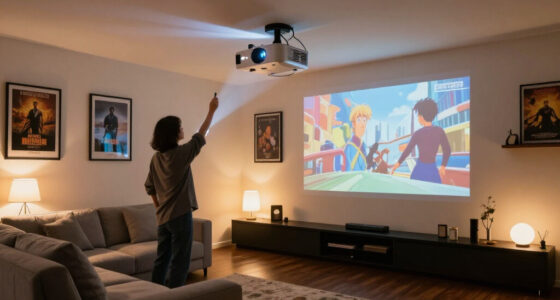
Installation requirements are another critical factor. Projectors typically need a dedicated setup area, a stable surface or mount for ceiling installation, and proper placement to achieve ideal image quality. They also often require darkened rooms to deliver a clear picture, especially during daytime or brightly lit environments. Conversely, a giant TV comes as a ready-to-use device that’s straightforward to install—just place it on a stand or mount it on the wall, and you’re set. Its installation is usually less involved, and you don’t need to worry about alignment or ambient light interference as much. However, larger TVs are limited by available wall space and may be more expensive as the screen size increases.
In terms of budget, giant TVs can be costly, especially for models with ultra-high resolutions and expansive screens, but their upfront cost is typically higher than that of a projector and screen combined. You should also factor in the ongoing costs for bulbs or maintenance with projectors, which may require replacements over time. If you’re budget-conscious, a large TV might seem like a more straightforward investment, offering convenience and consistent picture quality without the need for ongoing setup adjustments. Additionally, considering how emerging trends in digital publishing influence consumer preferences can help inform your decision-making process about home entertainment technology. Understanding projector technology can further clarify which option aligns best with your needs and expectations.
Your viewing habits play a significant role as well. If you mostly watch in a bright room or want a quick, hassle-free setup, a giant TV makes sense. But if you love creating a home theater experience and don’t mind dimming the lights or setting up a dedicated space, a projector can deliver an impressive cinematic scale. Ultimately, your decision hinges on balancing screen size desires, installation effort, budget constraints, and how you plan to use your viewing space regularly.
4K projector with high lumen brightness
As an affiliate, we earn on qualifying purchases.
As an affiliate, we earn on qualifying purchases.
Frequently Asked Questions
How Does Ambient Lighting Affect Projector Image Quality?
Ambient light can considerably impact your projector’s image clarity. When there’s too much ambient light, your projector’s image may appear washed out or less vibrant, making it harder to see fine details. To guarantee sharp, clear images, you should minimize ambient light in your viewing area, use blackout curtains or dim the lights. This allows your projector to perform at its best, delivering bright, vivid images even in less-than-ideal lighting conditions.
What Are the Maintenance Costs for Projectors Versus Large TVS?
Imagine maintaining a garden; projectors are like delicate blooms needing regular pruning and bulb replacements, which can be costly. Large TVs are sturdy trees with consistent screen brightness and lower ongoing costs. Projectors often consume more power and require bulb changes, increasing maintenance expenses. In contrast, TVs have minimal upkeep, offering stable power consumption and long-term savings, making them a more budget-friendly choice for hassle-free, bright displays.
Can Projectors Be Used Outdoors Effectively?
Yes, projectors can be used outdoors effectively, but you need a proper outdoor setup. Choose a flat, stable surface for your screen and use a weatherproof projector cover when not in use. Weather considerations are essential—avoid rainy or overly humid conditions, as moisture can damage the projector. Also, make sure the projector is bright enough to combat ambient light, and consider adding wind protection to keep it steady.
What Is the Typical Lifespan of a Projector Compared to a TV?
You’ll find that projectors typically last around 7,000 to 20,000 hours, depending on usage and lamp quality, while TVs usually last about 50,000 hours. When considering screen resolution and portability options, projectors can be more flexible for outdoor use and compact storage, but they may need bulb replacements over time. TVs tend to be more durable with consistent clarity, making them ideal for long-term, high-resolution viewing.
How Does Sound Quality Compare Between Projectors and Giant TVS?
Sound quality varies between projectors and giant TVs. Generally, giant TVs have better sound clarity because they feature integrated speakers designed for peak audio. Projectors often lack powerful built-in speakers, requiring external audio solutions for better sound quality. If you prioritize clear, immersive audio, a large TV with integrated speakers is usually the better choice. However, with external sound systems, projectors can also deliver excellent sound quality.
As an affiliate, we earn on qualifying purchases.
Conclusion
Ultimately, choosing between a projector and a giant TV is like picking between a whispering breeze and a roaring storm—each offers its own magic. Think of the projector as a window to infinite possibilities, casting cinematic dreams onto any surface, while the giant TV stands like a steadfast guardian, ready to deliver vivid clarity at a moment’s notice. Trust your space, your style, and your soul’s desire—let your choice be the star of your home’s story.
As an affiliate, we earn on qualifying purchases.
large wall mount TV for living room
As an affiliate, we earn on qualifying purchases.
As an affiliate, we earn on qualifying purchases.
Fall Picks
fall essentials
As an affiliate, we earn on qualifying purchases.