
TL;DR

Get business pricing on your home office setup
- Business-only prices and quantity discounts
- Tax-exempt purchasing
- Multiple users, one account, clear invoices
A Livingetc report explains kogei as Japanese objects made for daily use and shaped by regional materials, accumulated knowledge and makers’ judgment. The concept offers a way to notice the design in ordinary household items, while a sharp decline in employment across Japan’s traditional craft industries highlights the vulnerability of the networks behind them.
Livingetc has published a report on kogei, a Japanese approach to making everyday objects that links their use to regional materials, inherited skills and human judgment. The explanation, drawing on comments from Nakagawa executive vice president Tasuku Ogino, frames kogei as a way to recognize design in ordinary items such as cloths and bowls—not only in decorative or collectible works.
Ogino defines kogei as tools for everyday life shaped by practical knowledge developed over generations, local ways of living and the materials available in each region. The report says the idea is distinct both from art made primarily to be admired and from industrial production focused on uniformity and efficiency. An object’s value as kogei, in this account, comes from being useful and continuing to adapt as daily life changes.
The report also cautions against treating hand production as the defining test. Nakagawa’s Hana Fukin kitchen cloth, for example, is woven by machine from kaya, a breathable fabric associated with Nara. Operators adjust for humidity and the individual behavior of each loom. The process combines machinery with ongoing human judgment, which Ogino identifies as central to the tradition.
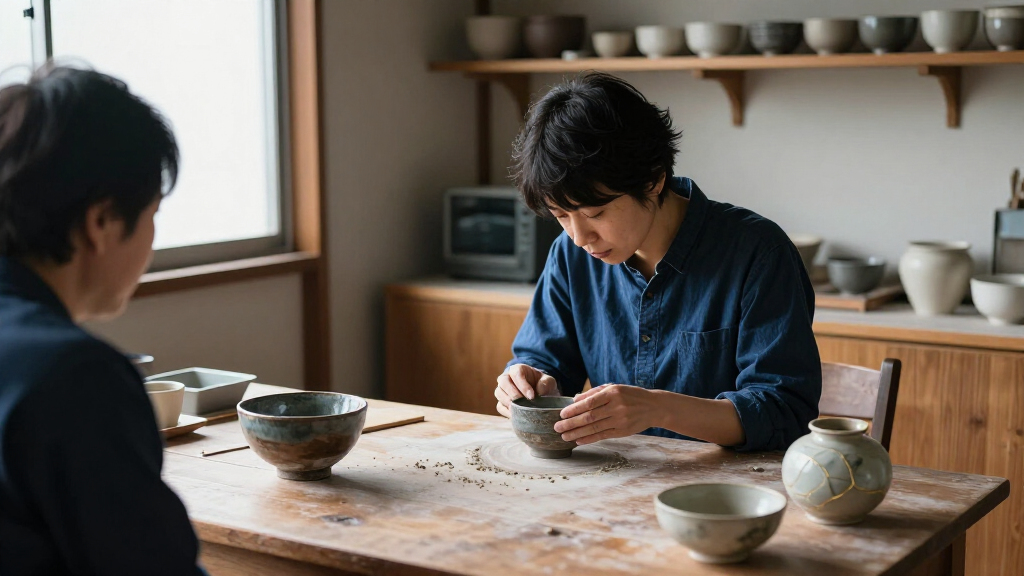
Kogei production may also involve multiple specialists rather than one celebrated artisan. A ceramic object can require separate expertise in clay, glaze, molds and firing. The report says these linked roles are often rooted in a production region, meaning the loss of one skill can affect the others.
Why Everyday Craft Needs Its Networks
The concept matters for two reasons: it changes how people might look at objects at home, and it points to the communities that sustain their making. In the report’s framing, a bowl or cloth need not be rare, expensive or signed to carry design knowledge. Attention shifts from display value alone to how an object works, where its materials come from and what decisions shaped it.
That regional knowledge depends on people and production links that can be difficult to rebuild once lost. The report cites employment in Japan’s traditional craft industries falling from 288,000 people in 1979 to 48,334 in 2022. Those figures describe employment across the industries, not kogei alone, but they underline the pressure facing the broader craft workforce.
As an affiliate, we earn on qualifying purchases.
How Kogei Differs From Craft
The Livingetc report says Japanese distinguishes among words for art, craft and everyday craft, placing kogei in the last category. It presents the idea as different from a Western understanding of craft that may emphasize handmaking or the work of an individual maker. For kogei, the method alone does not determine whether an object belongs: local origins, knowledge passed between generations, practical use and human judgment are all part of the definition.
Nakagawa, the company whose definition informs the report, was founded in Nara in 1716 and works with more than 800 workshops across Japan, according to the supplied material. The report also says Japan’s government list of traditional crafts contains 244 crafts, with at least one represented in each of the country’s 47 prefectures. It describes everyday use as a starting point for the government’s criteria.
As an affiliate, we earn on qualifying purchases.
What the Report Does Not Establish
The supplied report does not give a publication date, identify a new policy or program, or announce a specific change in Nakagawa’s operations. Its employment figures cover Japan’s traditional craft industries overall; they should not be read as a count of kogei makers specifically. The material also does not provide a breakdown by region or occupation, so it is unclear which parts of the production network have experienced the steepest losses.
The report offers a definition and examples rather than a formal test for deciding whether any particular object qualifies as kogei. It also does not quantify whether greater consumer interest in these objects would reverse employment declines or sustain regional workshops.
As an affiliate, we earn on qualifying purchases.
How Regional Workshops Can Continue
No next event or deadline is given in the supplied material. The practical question raised by the report is whether regional workshops can maintain the range of specialist roles, materials and knowledge that production depends on. Nakagawa says its aim is to pass on the regional ecosystems behind kogei; the report does not set out a timeline or measure for that work.
For readers, the account suggests a more attentive way to evaluate household objects: consider their everyday purpose, local materials and the people involved in making them. Whether that interest translates into stronger demand or more stable employment remains uncertain.
traditional Japanese craft materials
As an affiliate, we earn on qualifying purchases.
As an affiliate, we earn on qualifying purchases.
Key Questions
What does kogei mean?
Kogei refers to useful objects shaped by local materials, inherited practical knowledge and makers’ judgment. The report describes it as everyday craft rather than art made mainly for display.
Does kogei have to be handmade?
No. The report says machine-made objects can be kogei when they remain rooted in regional knowledge and human judgment. Its example is a machine-woven cloth whose operators adjust the process to conditions and the loom.
Is kogei always made by one artisan?
No. A single object may involve specialists in several stages, such as preparing clay, applying glaze, making molds and firing ceramics. The report emphasizes that these regional production links are part of the tradition.
Why does the report say kogei is under pressure?
It cites a decline in employment across Japan’s traditional craft industries, from 288,000 people in 1979 to 48,334 in 2022. The figures cover the industries broadly, not kogei alone.
Source: rss
Halloween Picks
halloween
As an affiliate, we earn on qualifying purchases.