
TL;DR

Get business pricing on your home office setup
- Business-only prices and quantity discounts
- Tax-exempt purchasing
- Multiple users, one account, clear invoices
Building an AI workstation used to be cheaper, but in 2026, prebuilt systems often match or beat DIY costs due to component shortages and bulk buying. The decision now hinges more on support, speed, and how much control you want.
Imagine you’re standing in front of two options: build a custom AI powerhouse or buy a ready-to-run system. For years, building your own was the obvious choice for saving cash. But now, thanks to shortages and bulk buying, the game has changed. The real question isn’t just about money anymore—it’s about speed, support, and control.
In this guide, you’ll learn how to weigh these factors, whether you’re a hobbyist, a researcher, or a business. If you’re considering your options, you might find this build vs buy a prebuilt AI workstation guide helpful. The decision has shifted from simple cost to a broader mix of convenience, risk, and long-term flexibility. Ready to find out which option suits your AI ambitions best?
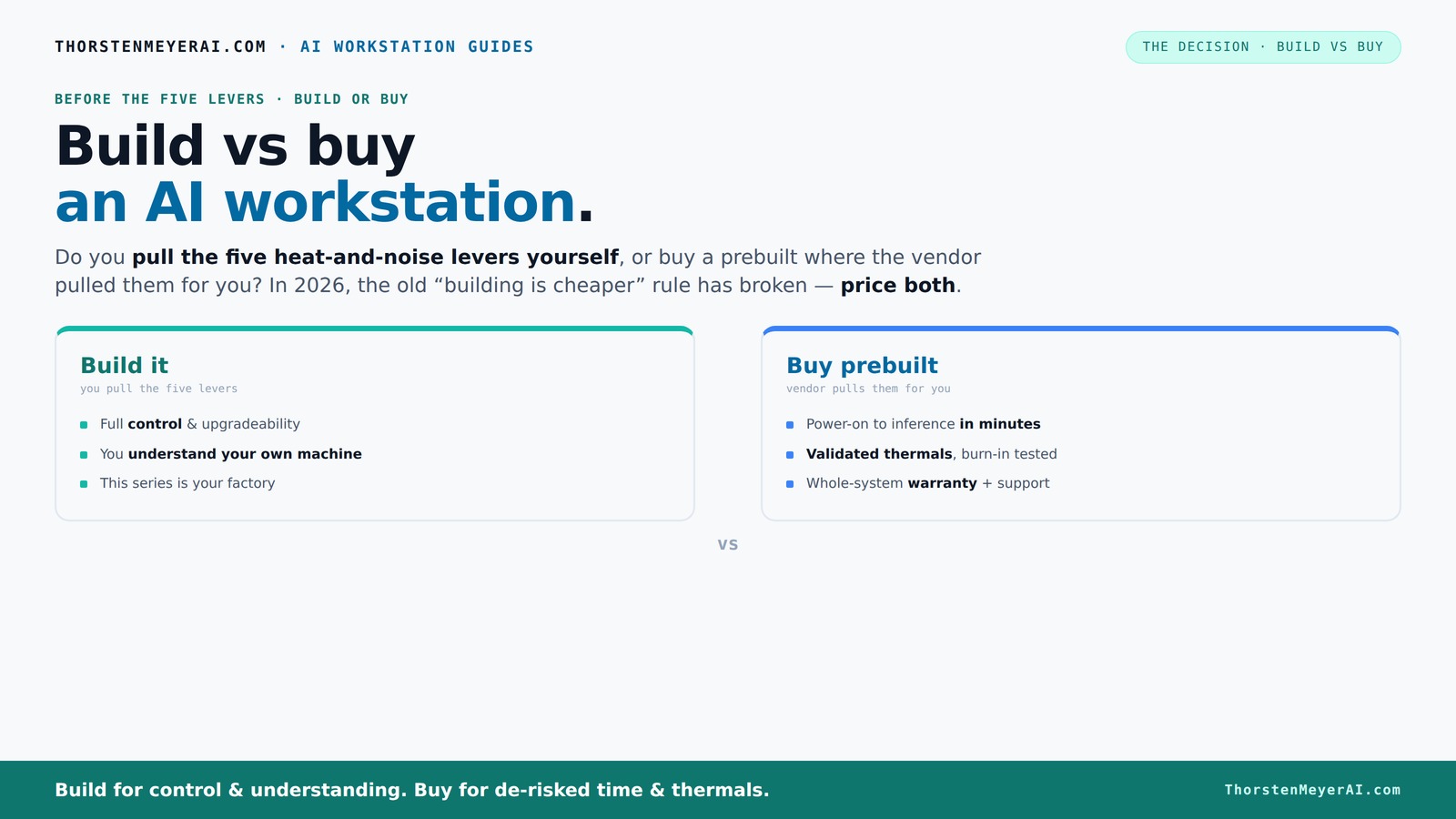
Build vs buy
an AI workstation.
The real question behind this whole series: do you pull the five heat-and-noise levers yourself, or buy a prebuilt where the vendor pulled them for you? And in 2026, the old “building is cheaper” rule has broken. Match your situation in Part 3.
Key Takeaways
- In 2026, the cost advantage of building your own AI workstation has diminished due to component shortages and bulk buying by vendors.
- Prebuilt systems often include validated thermals, quiet cooling, and support, making them ideal for those who prioritize speed and reliability.
- Building your own rig offers maximum customization, learning, and upgrade flexibility for hobbyists and technical users willing to invest time.
- Support, warranties, and tested stability can significantly reduce risk—often worth the extra premium, especially for critical workloads.
- Compare exact configurations and total costs now; the old mantra of 'build cheaper' no longer applies universally.
As an affiliate, we earn on qualifying purchases.
Why 2026 Changes the Build vs Buy Game
Building your own AI workstation was traditionally cheaper, but 2026 flipped that script. Component shortages mean GPU prices soar, RAM costs climb, and supply chains strain. A DIY build that once cost under $1,000 now easily hits $1,250 or more, without even considering assembly time or troubleshooting.
Meanwhile, major vendors like Dell and BIZON have bought in bulk early, locking in lower prices. Their prebuilt systems now match or beat DIY costs, especially when you factor in support, testing, and warranties. This shift highlights how supply chain dynamics directly influence cost-effectiveness and strategic choices for AI setups. The implications are significant: what was once a straightforward savings decision now requires careful consideration of support and reliability, which can be more valuable than raw hardware savings. For more insights, see our article on build vs buy a prebuilt AI workstation.
So, the old rule—build for savings, buy for convenience—is no longer black and white. You must compare exact configurations, factoring in the true cost of your time, expertise, and risk.
As an affiliate, we earn on qualifying purchases.
The 5 Levers of a Powerful AI Workstation — Who Pulls Them?
Running a high-performance AI system is about balancing heat, noise, and stability. There are five levers: undervolting the GPU, matching the cooling system, optimizing airflow, tuning fan curves, and placement. Who pulls these levers makes a big difference because each adjustment can improve performance, reduce noise, and extend hardware lifespan, but also involves trade-offs.
When you buy prebuilt, the vendor handles all of this. They validate thermals, test for hours, and often include water-cooling for quieter, cooler operation. This means you’re paying for a system that’s been optimized for stability and longevity, reducing the risk of thermal throttling that can degrade performance or cause hardware failure. These factors matter because in AI workloads, consistent thermal management ensures sustained performance, avoiding costly downtime or hardware replacements.
Build it yourself, and you get full control. You pick a quiet GPU, like the RTX 4090 with a custom undervolt, choose a case with sound-dampening panels, and carefully tune airflow. This effort can significantly improve your system’s noise profile and thermal performance but requires expertise and ongoing adjustments. You can learn more about home theater projectors and setup guides that include tips on quiet and efficient cooling solutions. Ultimately, who pulls these levers depends on your technical skill and willingness to tinker for optimal results.
As an affiliate, we earn on qualifying purchases.
When Buying Prebuilt Makes Your Life Easier
If your time costs more than the price premium, a prebuilt system is the way to go. It arrives with OS, drivers, and AI frameworks like CUDA and TensorFlow preinstalled. Just power on, and you’re ready to train or generate results in minutes, which is critical when deadlines are tight or when you lack the technical expertise to configure complex systems.
For busy professionals or teams, this saves days of fiddling with BIOS settings, compatibility issues, and troubleshooting. Plus, reputable vendors validate thermals and run long stress tests, reducing the risk of thermal throttling or hardware failures mid-project. This validation not only ensures performance but also extends the lifespan of your hardware, which can be a cost-saving in the long run. The support contracts offered by vendors like Lambda are invaluable during critical phases, providing quick assistance and peace of mind that can prevent costly delays. For more on ready-to-use AI systems, visit drunkenspeculation.com for reviews related to home automation and AI integration.
The convenience, validation, and support benefits are especially vital for organizations where downtime is expensive, or for users who prefer to focus on their AI work rather than system maintenance. These factors make prebuilt systems a strategic choice for many.
professional AI workstation support
As an affiliate, we earn on qualifying purchases.
As an affiliate, we earn on qualifying purchases.
When Building Your Own AI Machine Is Still Worth It
Building your own AI workstation shines when you want maximum control and customization. You can pick a specific GPU like the RTX 4090 or the upcoming A100, fine-tune cooling, and tailor the hardware for your workload. This flexibility allows you to optimize for performance, noise, or power efficiency, which can be crucial for specialized applications or environments with strict noise or thermal constraints. For example, a hobbyist with a few hours a week can save money by assembling a machine with a high-end GPU and a quiet case, like those featured here. Plus, you learn firsthand how each component affects thermal and noise performance, giving you insights that can help in future upgrades or troubleshooting. For tips on optimizing your home workspace, check out homeevaly.com for interior design ideas.
This path demands time, patience, and some technical know-how. But it offers the advantage of understanding your system deeply, enabling you to make targeted upgrades and repairs, which can extend the system’s useful life and adaptability. For more on home automation and robotics, visit autohomebots.com. Moreover, building allows experimenting with different cooling solutions or component brands, giving you a level of customization that prebuilt systems typically cannot match. For those who value the learning process and long-term control, the DIY route remains compelling despite the initial effort.
Cost Comparison: Building vs Buying in 2026
| Factor | Build Your Own | Buy Prebuilt |
|---|---|---|
| Upfront Hardware Cost | Usually lower, but rising due to shortages and bulk buying effects which can push DIY prices upward. The tradeoff is the potential for savings if you already possess some components or can source parts at discounts. | Often higher, includes assembly, validation, and support margins. While the initial cost can be higher, the value comes in the form of guaranteed stability and reduced setup time. |
| Time to Use | Slower — sourcing, assembly, setup, and potential troubleshooting can take days or weeks, especially for complex configurations or if issues arise. | Faster — plug and play, with pre-installed OS, drivers, and AI frameworks, enabling you to start training or inference almost immediately, which is critical when deadlines are tight. |
| Customization | Highest — you choose every component, cooling solution, and configuration, allowing precise tailoring to your workload and preferences, but at the cost of increased complexity and time. | Moderate — predefined configurations limit customization but often include options to select between different performance tiers, cooling solutions, or support levels without extensive setup. |
| Support & Warranty | None — self-managed, which means you’re responsible for troubleshooting, repairs, and upgrades, increasing risk and potential downtime. | Included — vendor support, warranties, and often on-site service, which can significantly reduce downtime and maintenance headaches, especially vital during critical projects. |
| Compatibility & Reliability | Higher risk — potential for compatibility issues, thermal problems, or hardware failures if components are mismatched or improperly configured. This requires technical expertise and ongoing maintenance. | Validated and tested by vendor — ensures compatibility and stability, reducing the chance of failures or thermal throttling that can compromise performance or cause hardware damage. |
Hidden Costs and Long-Term Flexibility
Both choices involve hidden costs that can influence the total ownership experience over time. Building a custom system might seem cheaper initially, but troubleshooting, ongoing upgrades, and potential compatibility surprises can add up, especially if you lack experience. For instance, thermal issues might require additional cooling solutions or part replacements, which incur costs and time. These hidden expenses can diminish the perceived savings and impact system reliability.
Prebuilts often include support and warranties, which simplify maintenance but may limit upgrade paths. Vendor-specific components or proprietary cooling solutions can lock you into certain brands or configurations, making future upgrades more expensive or complex. This tradeoff impacts long-term flexibility: do you want a system that can evolve with your needs, or one that remains stable but less adaptable?
For example, a DIY build allows swapping GPUs or adding RAM without vendor restrictions, maintaining adaptability and potentially extending system lifespan. Conversely, a prebuilt might restrict upgrades to certain models or brands, but it offers the advantage of reduced downtime and hassle. Your choice depends on whether you prioritize customization and future-proofing or convenience and immediate reliability.
Frequently Asked Questions
Is it cheaper to build or buy a prebuilt AI workstation?
In 2026, the cost difference is less clear. Component shortages have pushed DIY prices upward, sometimes matching or exceeding prebuilt costs. Always price your exact setup first—sometimes bulk buying beats piecing it together yourself.
When does a prebuilt workstation make more sense than DIY?
If you need a system quickly, want guaranteed stability, support, and minimal setup time, a prebuilt is the smarter choice. It’s also better for multi-GPU setups and long, demanding workloads where validated thermals matter.
What am I paying extra for in a prebuilt system?
You pay for assembly, extensive testing, thermal validation, warranty, and support. These factors can save you days of troubleshooting and the risk of hardware failures during critical AI training or inference tasks.
Is warranty/support worth the premium?
Absolutely. For professional or team environments, support reduces downtime and guarantees help during failures. For hobbyists, it can mean fewer headaches and longer system lifespan.
How much customization do I lose with prebuilt systems?
You give up some control over the exact components and cooling choices. But many vendors now offer highly optimized, configurable options that meet most AI workloads’ needs without sacrificing too much flexibility.
Conclusion
The choice between build and buy isn’t just about saving money anymore. It’s about what matters most: speed, support, control, or customization. In 2026, the smart move depends on your workload, expertise, and how quickly you need results.
If you value quick deployment and peace of mind, a prebuilt system is your best bet. But if you love tinkering and want a system tailored precisely to your needs, building remains a rewarding challenge—just be ready for the trade-offs.
Evergreen bestsellers Picks
bestsellers
As an affiliate, we earn on qualifying purchases.