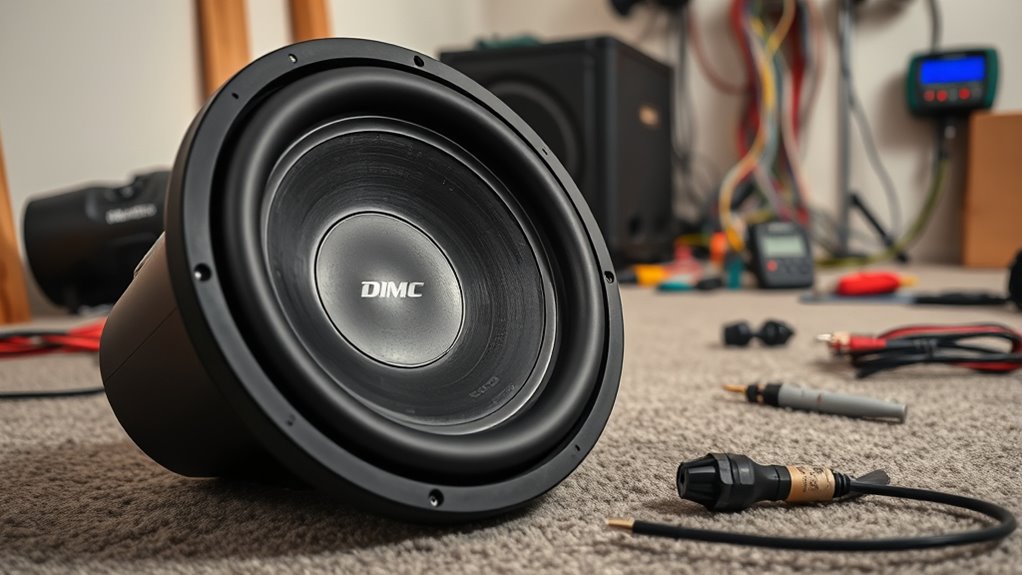

To set up your subwoofer successfully, start by placing it along the longest wall or near a corner for more bass impact, but avoid placing it too close to prevent muddy sound. Connect it with quality cables, then adjust the volume and crossover gradually while testing with familiar bass tracks. Experiment with phase settings until you find tight, balanced bass that blends seamlessly. Fine-tuning these basics guarantees deep, clear sound—keep exploring to master every detail.

Get business pricing on your home office setup
- Business-only prices and quantity discounts
- Tax-exempt purchasing
- Multiple users, one account, clear invoices
Key Takeaways
- Experiment with subwoofer placement near walls or corners for deeper bass, but avoid tight corners to prevent muddiness.
- Use a high-quality, appropriately gauged cable and secure connections to ensure clear signal transfer.
- Adjust phase and polarity settings to achieve seamless bass integration with main speakers.
- Fine-tune volume and crossover frequency gradually using test tracks or calibration tools for balanced sound.
- Consider room acoustics and add treatments or furniture to reduce reflection and improve bass clarity.
subwoofer placement speaker stand
As an affiliate, we earn on qualifying purchases.
As an affiliate, we earn on qualifying purchases.
Choosing the Right Location for Your Subwoofer

Choosing the right location for your subwoofer is essential to achieving balanced and powerful bass. Your room’s acoustics play a significant role in how the sound disperses, so experiment with different spots to find the best balance. Generally, placing the subwoofer near a wall or corner can boost bass response, but too close might cause boomy or muddy sounds. The size of your subwoofer also influences placement; larger subwoofers produce more bass and may need more strategic positioning to avoid overwhelming the space. Avoid placing it in enclosed corners or tight spots that can cause sound reflections. Instead, try placing it along the longest wall or near a wall to enhance low frequencies while maintaining clarity. Adjusting placement based on your room’s acoustics guarantees you get the best bass performance. Additionally, understanding contrast ratio can help you optimize your room setup to improve overall sound quality and clarity.
high quality subwoofer RCA cables
As an affiliate, we earn on qualifying purchases.
As an affiliate, we earn on qualifying purchases.
Properly Connecting Your Subwoofer to the System

To guarantee your subwoofer performs its best, you need to connect it correctly to your system. This involves choosing the right cables, placing the subwoofer properly, and adjusting volume levels for a balanced sound. Let’s go over these key steps to get your setup just right. Be sure to consider proper safety measures when handling electronic components to prevent damage or injury.
Correct Cable Selection
Selecting the right cable is essential for ensuring your subwoofer connects properly and delivers ideal sound quality. You need to consider cable gauge, as thicker cables (lower gauge numbers) reduce resistance and support better power transfer, especially for longer runs. For most setups, a 14 or 12-gauge cable provides reliable performance. Additionally, choosing the correct connector types is crucial—look for RCA cables for line-level connections or speaker wire terminals for direct speaker hookup. Make sure the connectors fit your subwoofer and receiver ports securely to prevent signal loss. Avoid using thin or cheap cables that can cause interference or degrade sound. Proper cable selection guarantees optimal performance, minimizes noise, and guarantees your subwoofer produces deep, clear bass without interruptions. Using high-quality cables can also significantly improve overall audio clarity and durability.
Optimal Placement Tips
Properly connecting your subwoofer to your system is key to achieving deep, balanced bass. Placement directly impacts speaker calibration and how your room’s acoustics influence sound quality. Consider these tips:
- Position your subwoofer near a wall or corner to enhance bass response, but avoid placing it directly in a corner to prevent boomy sound.
- Experiment with different spots, listening for smooth, even bass without boominess or nulls caused by room reflections.
- Use room acoustics to your advantage by placing the sub where it minimizes standing waves, ensuring better integration with your main speakers.
- Understanding sound reflection principles can help you find the optimal placement for clearer, more accurate bass response.
These steps help optimize subwoofer placement, leading to more accurate speaker calibration and a richer listening experience.
Adjusting Volume Levels
Once you’ve found the ideal spot for your subwoofer, it’s time to focus on adjusting its volume to match your system. Proper bass calibration is essential to achieve balanced sound without overpowering other speakers. Start by setting the subwoofer’s volume knob to a moderate level, then play a familiar track with deep bass. Adjust the volume gradually while listening carefully, aiming for a seamless blend with your main speakers. Keep in mind room acoustics, as reflective surfaces can amplify bass, making calibration tricky. Use your receiver’s test tones or a calibration microphone if available to fine-tune the subwoofer’s output. The goal is to create a natural, full-bodied sound that enhances your listening experience without overwhelming your space. Ensuring your equipment is properly connected and configured can significantly improve overall sound quality.
As an affiliate, we earn on qualifying purchases.
Adjusting Crossover and Volume Settings

Adjusting your crossover and volume settings is key to achieving balanced sound. You want to set the crossover frequency so your subwoofer complements your main speakers without overlapping too much. Keep these tips in mind to avoid frequency clashes and make certain of smooth, powerful bass. Regularly reapply sunscreen to protect your skin from damage and maintain your tan’s longevity.
Crossover Frequency Tips
To get the most out of your subwoofer, setting the right crossover frequency and volume is essential. Proper crossover frequency adjustment guarantees your bass integrates seamlessly with your main speakers, avoiding muddy or disconnected sound. Use these tips to optimize your settings:
- Start with a crossover around 80Hz, then fine-tune based on your room and speakers.
- Listen for smooth bass integration, adjusting the crossover to eliminate gaps or overlaps.
- Experiment with bass management techniques, like gradually increasing the crossover until the bass feels balanced and natural.
- Remember that sound design principles, such as layering and manipulation, can help you craft cohesive and immersive bass sounds.
Volume Balance Strategies
Balancing your subwoofer’s volume with your main speakers is key to achieving a cohesive sound. Room acoustics play a significant role, as reflections and absorption affect how bass frequencies are perceived. Start by setting your subwoofer’s volume to a moderate level, then listen carefully. If the bass feels overpowering or disconnected, adjust the volume gradually until it blends seamlessly. Ensuring speaker compatibility is vital—if your main speakers handle midrange frequencies well, your subwoofer should support only the low end. Use your receiver’s calibration tools or manual adjustments to fine-tune the balance. Remember, the goal is a smooth shift between subwoofer and speakers, creating a full, immersive sound without booming or gaps. Proper sound calibration is essential for optimal audio quality.
Avoiding Frequency Overlap
Ensuring your subwoofer and main speakers don’t produce overlapping bass frequencies is essential for clear, balanced sound. Excessive frequency overlap can cause muddiness and make your system sound boomy, especially with room modes complicating bass response. To avoid this, focus on these key adjustments:
- Set your crossover frequency so it smoothly progresses between speakers and subwoofer.
- Use a low-pass filter to cut off higher frequencies from the subwoofer.
- Fine-tune the subwoofer volume to prevent overpowering or underwhelming bass.
- Incorporate automation technology to dynamically adjust settings for optimal sound quality during different listening conditions.
room acoustic treatment for bass
As an affiliate, we earn on qualifying purchases.
As an affiliate, we earn on qualifying purchases.
Fine-Tuning Placement With Listening Tests

Fine-tuning your subwoofer’s placement through listening tests is one of the most effective ways to achieve ideal sound quality. Your listening environment and room acoustics play a pivotal role in how bass sounds. Move the subwoofer gradually while listening for tightness, depth, and clarity. Focus on areas where bass sounds boomy or weak, then reposition accordingly. Use the following table to understand different placement options:
| Placement Area | Effect on Room Acoustics | Suggested Adjustment |
|---|---|---|
| Corner | Boosts bass, possible boom | Reduce proximity to walls |
| Mid-wall | Balanced bass response | Slightly move away from walls |
| Center of Room | Even distribution, smooth bass | Adjust distance from listening position |
Test and tweak until you find the placement that best suits your space. Remember that room acoustics can significantly influence bass response, so consider adding acoustic treatments if necessary.
Managing Phase and Polarity for Optimal Bass

Managing phase and polarity is crucial for achieving clear, powerful bass, as improper settings can cause sound cancellations and weaken low-frequency response. When your subwoofer’s phase alignment is off, bass can sound thin or muddy. Polarity switching helps correct this by reversing the subwoofer’s speaker cone movement, ensuring it moves in sync with your main speakers.
Here are three essential tips:
- Use a phase switch or knob to toggle between 0° and 180° and listen for the tightest, most cohesive bass.
- Perform test sounds at different listening positions to confirm phase alignment across your room.
- Adjust the subwoofer’s phase setting until bass sounds seamless with the main speakers, maximizing low-frequency clarity.
Troubleshooting Common Setup Issues

When setting up your subwoofer, common issues like uneven bass, buzzing sounds, or difficulty syncing with your main speakers can arise. Room acoustics play a vital role—hard surfaces can cause echo and uneven sound distribution, while furniture can dampen bass. To fix these problems, start with proper speaker pairing; ensure your subwoofer matches your main speakers’ power and size for balanced sound. Adjust the subwoofer’s placement—moving it closer to walls or corners can enhance bass response. If buzzing persists, check for loose connections or interference from other electronics. Use your receiver’s calibration tools to fine-tune the settings and improve integration with your main speakers. Taking these steps will help you troubleshoot common setup issues effectively.
Frequently Asked Questions
How Do I Match My Subwoofer With Different Types of Speakers?
To match your subwoofer with different speakers, start by setting the crossover frequency so it complements your main speakers’ range, usually between 80-120Hz. Check their impedance—make sure your sub and speakers have compatible impedance levels to prevent damage. Adjust the volume gradually, and listen for a seamless blend, ensuring your subwoofer enhances your system without overpowering or underwhelming your speakers.
What Are Signs My Subwoofer Is Incorrectly Calibrated?
You’ll notice signs your subwoofer is incorrectly calibrated when you experience phase cancellation, where bass seems to vanish or sound uneven, and bass distortion, which makes low frequencies harsh or muddy. If the bass feels disconnected from the rest of your speakers, or if it’s overly boomy or weak, these are clues you need to verify your settings. Proper calibration ensures smooth, balanced bass without phase issues or distortion.
Can I Use Multiple Subwoofers in One Room?
Yes, you can use multiple subwoofers in one room. To get the best sound, focus on proper subwoofer placement and phase adjustment. Place your subwoofers in different locations to reduce standing waves and improve bass response. Adjust the phase settings on each subwoofer to guarantee they work together smoothly, avoiding cancelation or reinforcement issues. Proper calibration helps achieve balanced, powerful bass throughout your space.
How Often Should I Recalibrate My Subwoofer Settings?
You should recalibrate your subwoofer settings about once every six months, especially if you notice changes in sound quality or room acoustics. Don’t ignore speaker placement or room conditions, as they can impact calibration. Even if things sound fine, regular recalibration ensures peak bass response. Over time, equipment shifts or room changes can affect performance, so staying proactive keeps your setup sounding its best.
What Safety Precautions Should I Take During Setup?
During setup, you should prioritize electrical safety and handling precautions. Always unplug the subwoofer before making connections to prevent electrical shocks. Use insulated tools and avoid working in wet conditions. Keep cords organized to prevent tripping hazards, and guarantee your power source can handle the subwoofer’s load. Follow manufacturer instructions carefully, and handle components gently to avoid damage. These precautions keep you safe and ensure ideal performance.
Conclusion
Mastering your subwoofer setup is like tuning a finely crafted instrument—you’ll find that perfect harmony with patience and attention. By choosing the right spot, connecting everything properly, and making thoughtful adjustments, you’ll release deep, powerful bass that transforms your listening experience. Remember, each tweak brings you closer to sonic bliss, turning your space into a symphony of sound. Keep experimenting, and let your system’s full potential resonate through every beat.
Fall Picks
fall essentials
As an affiliate, we earn on qualifying purchases.