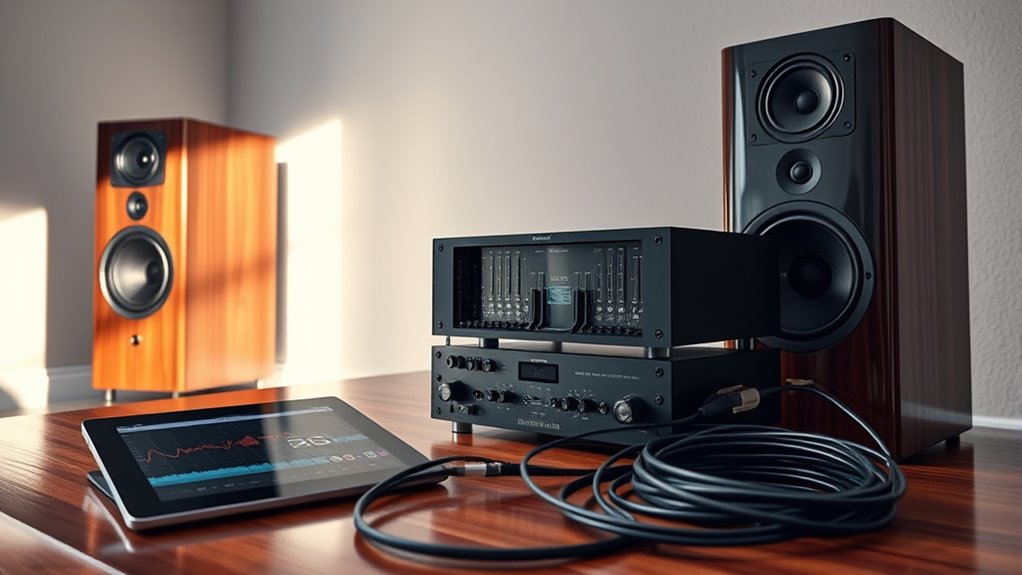

When searching for premium advanced room EQ kits, you’re looking for solutions that combine precise sound calibration, flexible control, and professional-grade features. The Behringer DEQ2496 stands out as the best overall choice for its comprehensive digital processing and versatile setup options. The IK Multimedia ARC System offers an excellent balance of room correction with user-friendly software, making it ideal for those new to room tuning. These kits often involve tradeoffs between complexity, cost, and ease of use, making it vital to choose one that matches your technical comfort level and audio goals. Continue reading for a detailed breakdown of each option and guidance on selecting the right kit for your needs.

Get business pricing on your home office setup
- Business-only prices and quantity discounts
- Tax-exempt purchasing
- Multiple users, one account, clear invoices
Complete the kit


Key Takeaways
- Top picks balance advanced features with user-friendly interfaces, avoiding overly complex setups for non-professionals.
- Room correction systems like the IK Multimedia ARC provide holistic sound improvements through software, differing from traditional equalizers.
- Higher-priced kits often include more precise calibration tools but may require more technical knowledge to operate effectively.
- Feedback detection systems excel in live settings but may be less suited for studio environments where detailed equalization is preferred.
- The best kits offer a combination of flexibility, build quality, and ease of integration with existing audio systems, rather than just raw features.
| Behringer Ultragraph Pro FBQ1502 15-Band Stereo Graphic Equalizer |  | Best Overall for Versatile Live and Studio Use | Number of Bands: 15 | Application: Live and studio | Feedback Detection System: Yes | VIEW ON AMAZON | See Our Full Breakdown |
| EMB Professional EB831EQ Graphic Equalizer Limiter with Noise Reduction for Audio Systems |  | Best Value for Multi-Function Audio Processing | Type: 3 NR Noise Reduction | Application: Home, DJ, Club, Studio, Stage, Live Sound | Form Factor: Rackmount | VIEW ON AMAZON | See Our Full Breakdown |
| Behringer DEQ2496 |  | Best for High-Resolution Professional Room and Loudspeaker Equalization | Resolution: 24-bit/96 kHz | DSP Technology: 32/40-bit floating-point | Dynamic Range: 113 dB | VIEW ON AMAZON | See Our Full Breakdown |
| dbx 231s Dual Channel 31-Band Equalizer |  | Best for Precise, Professional Multi-Band Equalization | Number of Bands: 31 | Frequency Bands: 1/3-octave | Boost/Cut Range: 6 or 12 dB | VIEW ON AMAZON | See Our Full Breakdown |
| IK Multimedia ARC Studio Room Correction System with Microphone and Software |  | Best for Automated, Studio-Quality Room Calibration | Microphone: High-precision measurement microphone | Software: Advanced calibration software | Processor: Stand-alone correction processor | VIEW ON AMAZON | See Our Full Breakdown |
| FBQ1502HD Feedback Detection System |  | Best for Precise Feedback Troubleshooting | Feedback Detection: Yes | Mono Subwoofer Output: Yes | Adjustable Crossover: Yes | VIEW ON AMAZON | See Our Full Breakdown |
More Details on Our Top Picks
Behringer Ultragraph Pro FBQ1502 15-Band Stereo Graphic Equalizer
The Behringer Ultragraph Pro FBQ1502 stands out for its professional-grade sound quality combined with a revolutionary feedback detection system, making it a top pick for both live sound engineers and studio professionals. Compared with the IK Multimedia ARC Studio, which focuses on room correction, this EQ offers more hands-on control with its 15 bands and dedicated subwoofer output, giving it an edge in direct sound shaping. However, its complex setup may be intimidating for beginners or casual users who prefer plug-and-play solutions. Its shielded toroidal transformers and adjustable crossover provide high fidelity and flexibility, but the learning curve can be steep for those unfamiliar with advanced audio gear. This model is best suited for professionals who need precise control and feedback management in demanding environments, and those willing to invest time in setup.
Pros:- Professional-grade sound quality with low noise
- Innovative feedback detection system for cleaner sound
- Versatile application with dedicated subwoofer output
Cons:- Complex setup can be daunting for newcomers
- Overkill for casual or home users
Best for: Professional sound engineers and advanced musicians needing versatile, high-quality equalization in live and studio settings
Not ideal for: Beginners or casual hobbyists who prefer simple, straightforward EQ solutions without extensive setup
- Number of Bands:15
- Application:Live and studio
- Feedback Detection System:Yes
- Subwoofer Output:Yes
- Crossover Frequency:Adjustable
- Transformers:Shielded toroidal
Our verdict“This EQ excels for experienced users seeking precise, versatile control in demanding audio environments.”
EMB Professional EB831EQ Graphic Equalizer Limiter with Noise Reduction for Audio Systems
The EMB Professional EB831EQ combines graphic EQ, limiter, and noise reduction in a single rackmount unit, making it a compelling choice for those needing multiple processing features without extra equipment. Unlike the dbx 231s, which offers more precise band control, this unit emphasizes multifunctionality, reducing the need for additional gear. Its noise reduction capabilities help clean up background hiss, especially useful in live or DJ setups. However, the device’s limited information on the number of bands and controls suggests a steeper learning curve for optimal operation, and it might lack some advanced features that professionals expect from dedicated EQs. This pick is best for users who want an all-in-one solution that simplifies their setup while maintaining core audio enhancement capabilities.
Pros:- All-in-one audio processing with EQ, limiter, and noise reduction
- Reduces background noise for cleaner sound
- Rackmount design for professional setups
Cons:- Limited control details may hinder precise adjustments
- Potentially complex for users unfamiliar with audio processing
Best for: DJs, home sound system enthusiasts, and small live setups seeking an affordable, multi-purpose processor
Not ideal for: Audio engineers requiring detailed, high-resolution equalization or complex room calibration
- Type:3 NR Noise Reduction
- Application:Home, DJ, Club, Studio, Stage, Live Sound
- Form Factor:Rackmount
- Features:Graphic Equalizer, Limiter, Noise Reduction
Our verdict“This unit offers a practical, space-saving solution for users who need basic multi-function audio processing without extensive complexity.”
Behringer DEQ2496
The Behringer DEQ2496 offers a high-resolution 24-bit/96 kHz conversion and advanced analysis tools, making it ideal for mastering and detailed room calibration. Its 4 EQ modules, including graphic, parametric, and feedback destroyer, provide a broad palette for precise sound shaping. Unlike the IK Multimedia ARC Studio, which focuses on automated room correction, this processor requires manual setup but allows for more granular control, appealing to users who want to fine-tune their acoustic environment. The absence of a built-in display and reliance on external control can slow workflow, especially for less experienced users. This device is best for professionals who prioritize high-resolution processing and advanced analysis over ease of use.
Pros:- Exceptional dynamic range with 24-bit/96 kHz resolution
- Multiple EQ modules for versatile sound shaping
- Advanced real-time analysis tools
Cons:- Steep learning curve due to complex interface
- No integrated display, requiring external control
Best for: Audio mastering engineers and high-end studio owners needing precise room and speaker calibration
Not ideal for: Beginners or those seeking quick, automated solutions for room correction
- Resolution:24-bit/96 kHz
- DSP Technology:32/40-bit floating-point
- Dynamic Range:113 dB
- EQ Modules:4
- FFT Analyzer:61-band real-time
Our verdict“This processor is suited for users demanding high-resolution, detailed control for mastering and calibration tasks.”
dbx 231s Dual Channel 31-Band Equalizer
The dbx 231s is a classic dual-channel 31-band EQ, offering detailed 1/3-octave control ideal for precise tone shaping in live sound or studio environments. Its switchable boost/cut ranges of 6 or 12 dB provide flexibility for aggressive adjustments, and front panel bypass simplifies troubleshooting. Compared with the Behringer Ultragraph Pro, which offers more bands and feedback management, the dbx 231s is more about meticulous control rather than broad-spectrum adjustments. Its lack of digital connectivity or automation features makes it less suited for modern integrated setups. This unit is best for professionals who need detailed, dependable EQ control in a straightforward package.
Pros:- Highly detailed 31-band control with 1/3-octave precision
- Switchable boost/cut ranges for flexible adjustments
- Front panel bypass for quick troubleshooting
Cons:- No digital or network connectivity options
- Potentially complex for users unfamiliar with multi-band EQs
Best for: Sound technicians and studio engineers who prioritize detailed, reliable equalization without digital bells and whistles
Not ideal for: Home users or beginners seeking simple, automated room correction or digital integration
- Number of Bands:31
- Frequency Bands:1/3-octave
- Boost/Cut Range:6 or 12 dB
- Input Types:¼” TRS and female XLR
- Output Types:¼” TRS and male XLR
- Input Gain Range:12 dB
Our verdict“This EQ is ideal for professionals needing meticulous, hands-on frequency control with dependable performance.”
IK Multimedia ARC Studio Room Correction System with Microphone and Software
The IK Multimedia ARC Studio offers a streamlined approach to room correction, combining a high-precision microphone, advanced calibration software, and a dedicated processor. Unlike traditional EQs such as the Behringer DEQ2496, this system automates frequency corrections, making it accessible for users who want effective acoustic optimization without deep technical knowledge. Its ability to simulate studio monitors and provide consistent calibration makes it ideal for both home and professional studios. However, the setup involves additional hardware and software steps that may challenge those unfamiliar with audio calibration. Its price point and complexity make it less suitable for casual users.
Pros:- Precise acoustic optimization for professional-quality sound
- Easy to integrate into various studio environments
- Simulates high-end studio monitor tonal characteristics
Cons:- Complex setup for users unfamiliar with calibration procedures
- Requires additional hardware and software
- Price may be prohibitive for hobbyists
Best for: Studio owners and audio professionals seeking quick, reliable room correction with minimal manual intervention
Not ideal for: Beginners or budget-conscious users who prefer simple equalizers without automated calibration features
- Microphone:High-precision measurement microphone
- Software:Advanced calibration software
- Processor:Stand-alone correction processor
- Compatibility:Wide range of studio setups
- Features:Room correction, monitor emulation
Our verdict“This system offers automated, high-precision room correction ideal for professionals seeking consistent, studio-level sound without manual EQ adjustments.”
FBQ1502HD Feedback Detection System
The FBQ1502HD Feedback Detection System stands out for its ability to instantly identify problematic frequencies, making it ideal for live sound environments where quick adjustments are critical. Unlike the Behringer Ultragraph Pro FBQ1502, which focuses mainly on graphic equalization, the FBQ1502HD emphasizes real-time feedback detection, providing a targeted tool for troubleshooting. Its audio analyzer functions allow for detailed sound analysis, helping sound engineers fine-tune their systems efficiently. The dedicated mono subwoofer output with an adjustable crossover offers flexibility for managing low-frequency feedback, a feature often overlooked in simpler EQ kits. However, the product’s limited detailed specs and potential complexity may deter beginners, and its lack of pricing or customer ratings makes assessing value difficult. This system is best suited for advanced live sound technicians who need immediate feedback control, but it may be too complex for newcomers.
Pros:- Instant feedback detection accelerates troubleshooting
- Functions as a detailed audio analyzer for comprehensive sound assessment
- Dedicated mono subwoofer output with adjustable crossover enhances low-frequency control
Cons:- Limited detailed specifications may hinder understanding of full capabilities
- Potentially complex interface could be overwhelming for new users
- No pricing or customer ratings available, making value assessment difficult
Best for: Experienced sound engineers or live performance setups requiring precise feedback elimination
Not ideal for: Beginners or small home studios lacking technical expertise in feedback management
- Feedback Detection:Yes
- Mono Subwoofer Output:Yes
- Adjustable Crossover:Yes
- Low-Cut Filter:Yes
- Frequency Response:Not specified
- Power Supply:Standard AC
- Dimensions:Not specified
- Weight:Not specified
Our verdict“This feedback detection system is a powerful choice for professionals who need real-time feedback control, but it may be excessive for casual or beginner users.”

How We Picked
These products were selected based on their combination of advanced sound processing capabilities, build quality, user interface, and versatility. We prioritized solutions that offer professional-grade features suitable for dedicated audio environments, yet remain accessible beyond pure studio use. Each product was evaluated for ease of setup, calibration accuracy, software integration, and overall value — balancing performance with complexity. The ranking reflects the overall effectiveness in delivering precise room correction and equalization, considering both technical specifications and user experience.Factors to Consider When Choosing Premium Advanced Room Eq Kits
Choosing a premium advanced room EQ kit involves understanding key factors that influence sound quality, usability, and investment value. It’s important to consider compatibility with your existing audio setup, the level of control you need, and whether you’re aiming for live or studio application. These factors can make a significant difference in how well a device performs and how easy it is to operate, especially for those new to advanced room correction. Being aware of common pitfalls, such as overcomplicating your setup or overspending on features you won’t use, will help you make a more informed decision.Calibration Precision and Software Integration
High-quality room EQ kits should provide precise calibration tools that accurately analyze your space. The effectiveness of room correction depends heavily on how well the system measures your room’s acoustics and applies corrections. Look for kits that integrate seamlessly with user-friendly software, making calibration straightforward without requiring extensive technical expertise. Overly complicated software can deter users from achieving optimal results, so balance sophistication with accessibility.
Control and Flexibility
Advanced kits vary in how much control they offer over EQ parameters. Consider whether you need multi-channel processing, customizable filters, or automatic room correction. Greater flexibility often involves a steeper learning curve but can yield more tailored sound. For users who want quick setup or less manual adjustment, simpler interfaces with preset options may be preferable, even if they sacrifice some customization potential.
Build Quality and Durability
Since room EQ kits can be a long-term investment, paying attention to build quality is essential. Devices with rugged enclosures, high-quality components, and reliable connections reduce the risk of failure or noise issues over time. Cheaper or poorly made units might save money initially but can lead to frustration and additional expenses later. Consider your environment and choose a product that can withstand regular use or transportation if needed.
Cost and Value
Premium kits tend to carry a higher price tag, but it’s important to evaluate whether the added features justify the cost. Cheaper options might lack advanced calibration tools or software integration, limiting their effectiveness. Conversely, overspending on features you don’t need can be inefficient. Focus on the core capabilities that will make a real difference for your application, balancing cost with expected performance.
Application and Use Case
Different room EQ kits excel in various scenarios. For example, live sound setups benefit from feedback detection systems, while studio environments demand detailed parametric EQs and room correction software. Clarify your primary goal—whether it’s improving home theater sound, live performance, or recording—and select a kit built for those needs. Misaligning a product’s strengths with your use case can result in subpar performance or unnecessary complexity.
Frequently Asked Questions
Can I use a room EQ kit without professional calibration experience?
Yes, many advanced room EQ kits now offer automatic calibration and user-friendly interfaces designed for non-experts. However, achieving the best results often requires some understanding of acoustics and calibration procedures. Investing time in learning the basics can improve outcomes significantly, but modern kits aim to make this process as straightforward as possible for beginners. If you’re new, look for systems with guided setup and software that simplifies measurement and correction tasks.
Is it necessary to upgrade to a premium room EQ kit if I already have a basic equalizer?
Upgrading to a premium advanced kit provides much more precise room correction, dynamic filtering, and software integration that basic equalizers cannot match. While a standard EQ can make minor adjustments, a dedicated room correction system actively analyzes your space and compensates for acoustic anomalies, creating a more balanced sound. If your aim is professional-grade audio or optimized listening in challenging environments, investing in a premium system can be worthwhile.
How much setup time should I expect with a premium room EQ kit?
The setup duration varies depending on the complexity of the system and your familiarity with audio calibration. Basic automatic systems might take 30-60 minutes, including measurement and adjustments. More advanced setups with manual controls and detailed software can extend to several hours, especially if fine-tuning is desired. Planning for a dedicated calibration session ensures you get the most out of your investment and achieve the desired sound quality.
Are feedback detection systems better for live sound or studio use?
Feedback detection systems excel in live sound environments where feedback issues are common and need immediate addressing. They quickly identify problematic frequencies, helping sound engineers prevent feedback loops during performances. In contrast, studio or room correction kits focus more on precise equalization and room tuning for recorded audio or listening spaces. Choose feedback detection if your primary concern is live feedback management, but for detailed room correction, a dedicated EQ or software-based system is preferable.
Should I prioritize software features or hardware quality when selecting a premium room EQ kit?
Both aspects are important, but the right balance depends on your needs. High-quality hardware ensures durability and signal integrity, while advanced software enables precise calibration, easier operation, and room correction capabilities. For most users, software integration offers significant value, especially if it simplifies complex tasks. However, neglecting hardware quality can lead to reliability issues over time. Aim for a solution that combines robust build with intuitive, powerful software for the best overall experience.
Conclusion
For those seeking the best overall performance, the Behringer DEQ2496 offers comprehensive features and precise control suitable for professional settings. If budget-conscious buyers want the most value, the FBQ1502HD Feedback Detection System provides essential feedback management at a lower cost. IK Multimedia’s ARC System makes sense for beginners or home users looking for straightforward room correction. The Behringer Ultragraph Pro FBQ1502 and the EMB Professional EB831EQ are solid choices for those upgrading existing setups or focusing on specific application needs like live feedback control or simple EQ adjustments. Ultimately, your choice depends on your environment, budget, and technical comfort level.