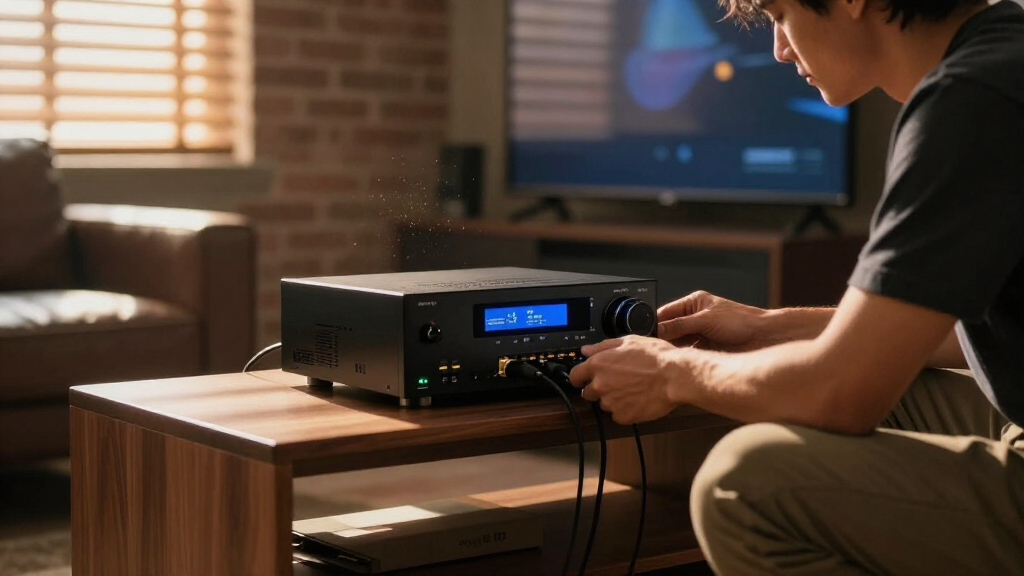
Smart home theater receivers vary most in how many speakers they support, how they connect to streaming services, and whether they handle newer gaming and video formats. I’d make the Denon AVR-X1700H my best overall pick for its 7.2-channel setup and HEOS network features; the Onkyo TX-NR7100 stands out for larger immersive systems, while the Yamaha RX-V6A offers a flexible MusicCast option. Simpler 5.2-channel receivers can suit compact rooms, but they give up expansion and some network features. Buyers also need to distinguish a full network receiver from a more basic Bluetooth amplifier. Read on for the complete comparison and a guide to choosing the right fit.

Get business pricing on your home office setup
- Business-only prices and quantity discounts
- Tax-exempt purchasing
- Multiple users, one account, clear invoices
Complete the kit



Key Takeaways
- The Denon AVR-X1700H is the most balanced smart pick here, pairing a 7.2-channel layout with HEOS network features for buyers who want room to expand without choosing the most elaborate receiver.
- The Onkyo TX-NR7100 is the specialist for bigger immersive setups: its 9.2-channel design and THX certification give it a distinct role beyond the more compact 5.2- and 7.2-channel options.
- Networked models offer more than Bluetooth: HEOS, MusicCast, and network features on several Onkyo receivers better fit buyers who want audio streaming and multiroom options.
- HDMI capability should match the sources you own: several listed models advertise 8K or 4K/120Hz support, while the Sony STR-DH590 and Yamaha YHT-4950U are positioned around 4K-era systems.
- The Donner MAMP4 and MAMP8 fill a different niche: their karaoke, microphone, radio, and straightforward input features may suit casual or mixed-use rooms, while dedicated AV receivers offer a more clearly specified path to networked theater setups.


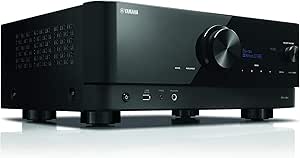


| smart home theater receiver | Channels | Video support | Power output |
|---|---|---|---|
| Sony STR-DH590 5.2-Channel 4K | 5.2 | 4K HDR, HDCP 2.2 | — |
| Onkyo TX-NR5100 7.2-Channel 8K | 7.2 | 8K | — |
| Denon AVR-X1700H 7.2-Channel A | 7.2 | 8K/60Hz and select 4K/120Hz passthrough | 80 W per channel |
| Onkyo TX-NR7100 9.2-Channel TH | 9.2 | — | — |
| Denon AVR-S570BT 5.2 Channel A | 5.2 | 8K, HDR, HLG, Dolby Vision, HDR10+, Dynamic HDR | 70 W x 5; 310 W total |
| Yamaha YHT-4950U 4K Ultra HD 5 | 5.1 | 4K Ultra HD at 60fps, HDR, Dolby Vision, Hybrid Log-Gamma, HDCP 2.2 | — |
| Onkyo TX-NR6050 7.2-Channel Ne | 7.2 | 8K/60Hz, 4K/120Hz | 90 watts per channel |
| Donner MAMP4 5.1 Channel Stere | 5.1 | — | — |
| Denon AVR-S770H 7.2-Channel 8K | 7.2 | — | 75W per channel |
| Onkyo TX-NR6100 7.2 Channel TH | 7.2 | 8K pass-through | 210 W per channel |
| Denon AVR-S670H 5.2-Channel 8K | 5.2 | — | 75W x 5 |
| Yamaha RX-V6A 7.2-Channel AV R | 7.2 | 4K60, 4K120AB, 8K60B | — |
| Yamaha RX300A 5.2-Channel Home | 5.2 | 4K/120, 8K/60, Dolby Vision, HDR10+ | 70W |
| Donner MAMP8 5.2 Channel Surro | 5.2 | — | — |
More Details on Our Top Picks
Sony STR-DH590 5.2-Channel 4K HDR Home Theater AV Receiver with Bluetooth
The Sony STR-DH590 is the straightforward pick for a living room system built around a 4K HDR TV and a conventional 5.2 speaker layout. Its four HDMI inputs cover a few sources, while Bluetooth and FM radio add basic listening options without relying on network streaming features. Compared with the Denon AVR-S570BT, the Sony offers similar channel capacity and Bluetooth, but the Denon adds newer 8K and HDMI 2.1 gaming support. The Sony’s virtual front surround can suit a two-speaker setup when rear speakers are impractical, though it does not replace discrete surround speakers. Its older 4K HDR passthrough also makes it a less future-ready choice, and Bluetooth uses the crowded 2.4 GHz band. I’d choose it for a modest, uncomplicated theater system rather than a gaming-focused upgrade.
Pros:- Supports 4K HDR passthrough with HDCP 2.2
- Five main channels and two subwoofer outputs support a 5.2 layout
- Bluetooth streaming and FM radio provide simple listening options
- Four HDMI inputs accommodate several connected sources
Cons:- No 8K or 4K/120Hz gaming passthrough listed
- Virtual front surround is designed for a two-speaker arrangement
- Bluetooth operates on the 2.4 GHz band
Best for: Viewers building a basic 5.2-channel setup around a 4K HDR television who want Bluetooth and FM radio.
Not ideal for: Gamers seeking 4K/120Hz passthrough or buyers planning an Atmos height-speaker system.
- Channels:5.2
- HDMI inputs:4
- HDMI outputs:1
- Video support:4K HDR, HDCP 2.2
- Bluetooth:Yes; 2.4 GHz band
- Audio inputs:4 stereo RCA
- Digital audio inputs:1 optical, 1 coaxial
Our verdict“Choose the STR-DH590 for a simple 4K HDR 5.2 system; skip it if you need newer gaming video features or height channels.”
Onkyo TX-NR5100 7.2-Channel 8K Smart AV Receiver
For a theater system that also serves as a current-generation gaming hub, the Onkyo TX-NR5100 puts its strongest case in HDMI 2.1 support: 4K/120Hz HDR, VRR, ALLM, and QFT can help compatible consoles and displays deliver smoother play with less delay. Its 7.2 channels also give a buyer more room to build a surround layout than the Sony STR-DH590’s 5.2-channel design. Onkyo lists Dolby Atmos and DTS:X support, with eARC for sending high-bitrate audio from a TV. The tradeoff is that the supplied details emphasize video and audio compatibility without specifying streaming services, voice control, or room correction. Compared with the more feature-rich Denon AVR-X1700H, this is the more gaming-centered option, while Denon lists broader wireless streaming and control integrations.
Pros:- Passes through 4K/120Hz HDR video
- VRR, ALLM, and QFT support gaming-focused HDMI 2.1 features
- 7.2-channel layout supports a larger system than 5.2-channel receivers
- eARC and listed Dolby Atmos and DTS:X format support
Cons:- Product data does not specify built-in Wi-Fi music streaming or voice assistant support
- Product data does not specify room correction
- 8K support is listed, but the supplied details do not state refresh-rate or input counts
Best for: Console and PC gamers pairing a 4K/120Hz-capable display with a 7.2-channel home theater system.
Not ideal for: Buyers who prioritize built-in Wi-Fi music streaming, voice assistant options, or detailed room-correction features.
- Channels:7.2
- Video support:8K
- Gaming passthrough:4K/120Hz HDR
- Gaming features:VRR, ALLM, QFT
- Audio return channel:eARC
- Supported audio formats:Dolby Atmos, DTS-HD Master Audio, DTS:X, Dolby TrueHD
- Color:Black
Our verdict“Pick the TX-NR5100 if 4K/120Hz gaming and a 7.2-channel system are your priorities, and compare the Denon AVR-X1700H if streaming integrations matter more.”
Denon AVR-X1700H 7.2-Channel AV Receiver with HEOS
The Denon AVR-X1700H suits a household that wants one receiver for surround sound, wireless music, and voice control. Its HEOS, Wi-Fi, AirPlay 2, and Bluetooth give it a broader listening toolkit than the Onkyo TX-NR5100, whose supplied details focus more on HDMI 2.1 gaming. Six HDMI inputs make it easier to leave several sources connected, and the receiver supports 8K/60Hz plus select 4K/120Hz passthrough. That “select” qualification matters to gamers: the supplied information does not claim every HDMI input handles those higher-bandwidth signals. With 7.2 channels, Dolby Atmos, and DTS:X, it can anchor an immersive system, while 80 watts per channel is specified for planning speaker needs. Its richer connectivity makes it more versatile than the Sony STR-DH590, but also more than a basic TV-and-speaker setup may need.
Pros:- HEOS, Wi-Fi, AirPlay 2, and Bluetooth cover several wireless listening methods
- Six HDMI inputs support multiple connected sources
- Dolby Atmos and DTS:X support immersive surround layouts
- Lists 80 watts per channel and two subwoofer pre-outs
Cons:- Only select HDMI inputs support 8K and 4K/120Hz passthrough
- More streaming and control features may be unnecessary for a simple system
- Power output is specified, but suitability still depends on room and speaker needs
Best for: Households that want a 7.2-channel Atmos system with multiple wireless music options and voice assistant compatibility.
Not ideal for: Gamers who need high-refresh-rate passthrough from every HDMI input or buyers seeking a basic two-speaker receiver.
- Channels:7.2
- Power output:80 W per channel
- HDMI inputs:6
- Video support:8K/60Hz and select 4K/120Hz passthrough
- Audio formats:Dolby Atmos, Dolby Atmos Height Virtualization, DTS:X, DTS Virtual:X
- Streaming:HEOS Built-in, Wi-Fi, AirPlay 2, Bluetooth
- Voice assistants:Amazon Alexa, Google Assistant, Apple Siri, Josh.ai
- Other connections:2 digital, 2 analog, 1 coaxial, 1 phono input; eARC; 2 subwoofer pre-outs
Our verdict“Choose the AVR-X1700H if streaming flexibility and voice control are as important as 7.2-channel surround sound.”
Onkyo TX-NR7100 9.2-Channel THX Certified AV Receiver
The Onkyo TX-NR7100 is the system-builder’s choice here: its 9.2 channels, three HDMI outputs, and built-in Dirac Live room correction give a larger installation more flexibility than the Denon AVR-X1700H’s 7.2-channel arrangement. Dirac Live can help tune sound to the room, though the supplied compatible USB microphone is not included, so setup requires that additional piece. THX certification, Dolby Atmos, and DTS:X round out its theater credentials. For gaming, it lists 4K/120Hz HDR passthrough with VRR, ALLM, and QFT, placing it beyond the Onkyo TX-NR5100 in channel capacity and multi-room options. The tradeoff is complexity: buyers with a compact 5.1 system may not use its expansion headroom, and Sonos integration requires a separate Sonos Port. It makes most sense when room tuning and future system growth justify the added setup effort.
Pros:- Nine main channels and two subwoofer channels support an expanded system
- Built-in Dirac Live room correction
- Three HDMI outputs and discrete Zone 2 HDMI switching
- THX certification, Atmos, DTS:X, and 4K/120Hz gaming features
Cons:- Compatible USB microphone for PC or Mac Dirac Live setup is not included
- Sonos integration requires a separate Sonos Port
- Its channel and zone capacity may be excessive for small, simple systems
Best for: Enthusiasts planning a larger 9.2-channel system who want room correction, multiple zones, or several HDMI displays.
Not ideal for: Buyers building a compact 5.1 setup or anyone who wants Dirac Live setup without sourcing a compatible USB microphone.
- Channels:9.2
- Room correction:Dirac Live
- Audio formats:Dolby Atmos, DTS:X
- Certification:THX Certified
- HDMI outputs:3
- HDMI bandwidth:40 Gbps
- Video and gaming:8K/4K; 4K/120Hz HDR passthrough, VRR, ALLM, QFT
- Multi-room audio:Discrete Zone 2 HDMI switching, DTS Play-Fi, Works with Sonos
Our verdict“Choose the TX-NR7100 when you plan to use its room correction and expanded channels; a smaller system can be served by the AVR-X1700H.”
Denon AVR-S570BT 5.2 Channel AV Receiver with 8K Ultra HD Audio & Video
The Denon AVR-S570BT is a practical match for buyers who want current video support but do not need more than five main speaker channels. Its four HDMI 2.1 inputs support 8K video and gaming features including VRR, QFT, and ALLM, making it a clearer gaming upgrade over the Sony STR-DH590, which tops out at 4K HDR passthrough. Denon also specifies Dolby Vision and HDR10+ support, plus Bluetooth streaming and a guided on-screen setup. The tradeoff is the 5.2-channel ceiling: unlike the 7.2-channel Onkyo TX-NR5100 or Denon AVR-X1700H, it does not provide the channel count for a typical height-speaker Atmos or DTS:X layout. Its listed 70 watts per channel may also be a constraint in a large room or with demanding speakers. I’d shortlist it for a smaller theater centered on 8K-ready HDMI and straightforward setup.
Pros:- Four HDMI 2.1 inputs support 8K video
- VRR, QFT, and ALLM support gaming-focused HDMI features
- HDR formats include Dolby Vision, HDR10+, HLG, and Dynamic HDR
- Bluetooth streaming and guided setup assistant simplify everyday use
Cons:- 5.2 channels limit expansion to a typical height-speaker Atmos or DTS:X layout
- 70 watts per channel may be modest for larger rooms
- Wireless streaming is via Bluetooth according to the supplied data
Best for: Console gamers and TV-focused buyers who want 8K-ready HDMI features in a conventional 5.2-channel speaker system.
Not ideal for: Buyers planning Atmos height speakers, a larger room, or a 7.2-channel upgrade path.
- Channels:5.2
- Power output:70 W x 5; 310 W total
- HDMI inputs:4; HDMI 2.1 with 8K support
- HDMI output:1
- eARC bandwidth:Up to 40 Gbps
- Video support:8K, HDR, HLG, Dolby Vision, HDR10+, Dynamic HDR
- Gaming features:VRR, QFT, ALLM
- Audio and wireless:DTS-HD Master, Dolby TrueHD, Bluetooth streaming
Our verdict“Pick the AVR-S570BT for gaming-friendly video in a 5.2 system, and choose a 7.2-channel model if you plan to add height speakers.”
Yamaha YHT-4950U 4K Ultra HD 5.1-Channel Home Theater System with Bluetooth
The Yamaha YHT-4950U suits buyers who want a matched surround setup without choosing speakers and a receiver separately: the package includes five speakers, a subwoofer, and the receiver. Its YPAO room optimization helps adjust the sound for the room, while virtual CINEMA FRONT gives more placement flexibility when rear speakers are hard to position. It also passes 4K HDR video, including Dolby Vision, and adds Bluetooth for music streaming. Compared with the receiver-only Denon AVR-S770H, this Yamaha is simpler to assemble but lacks its listed 8K video support and Dolby Atmos and DTS:X formats. The tradeoff is a wired 5.1 setup with no specified wattage, so it is a practical entry point rather than a foundation for an advanced, expandable theater.
Pros:- Includes receiver, five speakers, subwoofer, and speaker wire
- YPAO room optimization helps tailor setup to the listening space
- 4K 60fps pass-through supports HDR, Dolby Vision, and Hybrid Log-Gamma
- Bluetooth supports wireless music and podcast playback
Cons:- All speakers require wired connections
- No Dolby Atmos or DTS:X support is listed
- Available product information does not specify receiver wattage
Best for: First-time home theater buyers who want a coordinated 5.1 speaker package and straightforward room setup.
Not ideal for: Buyers planning an Atmos system, 8K video chain, or wireless surround speakers.
- Channels:5.1
- Included components:AV receiver, 5 speakers, subwoofer, speaker wire
- HDMI ports:4
- Video support:4K Ultra HD at 60fps, HDR, Dolby Vision, Hybrid Log-Gamma, HDCP 2.2
- Connectivity:HDMI, Ethernet, coaxial, optical, USB, auxiliary, Bluetooth
- Room setup:YPAO room optimization; virtual CINEMA FRONT
- AV receiver dimensions:17 × 6 × 12 in
Our verdict“Choose the YHT-4950U for a ready-to-connect wired 5.1 system; pick the Denon AVR-S770H if immersive formats and newer video support matter more.”
Onkyo TX-NR6050 7.2-Channel Network Home Theater AV Receiver with 8K/60Hz and 4K/120Hz
The Onkyo TX-NR6050 is a strong fit for a living room that doubles as a current-generation gaming and streaming hub. Its support for 4K/120Hz, VRR, ALLM, and QFT is aimed at responsive gameplay, while 8K/60Hz and eARC accommodate newer displays and connected equipment. Eight HDMI ports and three outputs offer more connection flexibility than the three listed HDMI inputs on the Denon AVR-S770H. Onkyo also lists built-in access to several music services and compatibility with Alexa, AirPlay, and Google apps, giving it useful smart-home reach. The supplied details do not list Dolby Atmos or DTS:X support, so buyers prioritizing those formats may prefer the Denon or the Onkyo TX-NR6100. Its feature mix favors connectivity and gaming over documented immersive-audio breadth.
Pros:- Supports 4K/120Hz and 8K/60Hz video
- VRR, ALLM, and QFT target responsive gaming
- Eight HDMI ports and three HDMI outputs provide broad connection options
- Built-in streaming services and compatibility with Alexa, AirPlay, and Google apps
Cons:- Dolby Atmos and DTS:X support are not specified in the supplied product details
- The listed 90 watts per channel is lower than the TX-NR6100’s stated 210 watts per channel
- 7.2 channels limit expansion compared with higher-channel receivers
Best for: Console gamers and connected-home users who need multiple HDMI connections, high-refresh video, and voice assistant compatibility.
Not ideal for: Buyers who want listed Dolby Atmos or DTS:X playback and a clearly specified immersive speaker setup.
- Channels:7.2
- Power output:90 watts per channel
- HDMI ports:8
- HDMI outputs:3
- Video support:8K/60Hz, 4K/120Hz
- HDMI features:HDMI 2.1, eARC, Dynamic HDR, VRR, ALLM, QFT
- Streaming services:Spotify, TIDAL, Deezer, TuneIn, Pandora
- Voice and smart home compatibility:Amazon Alexa, Apple AirPlay, Google apps
Our verdict“Pick the TX-NR6050 when gaming features, HDMI connections, and smart-home compatibility lead your checklist.”
Donner MAMP4 5.1 Channel Stereo Receiver Amplifier with Bluetooth 5.3, Optical/Coaxial, USB, FM Radio, Dual Mic Inputs, Karaoke & Home Theater
The Donner MAMP4 takes a different approach to home theater: it pairs 5.1 speaker outputs with practical hosting features, including dual microphone inputs, Talk Over, and FM radio. Bluetooth 5.3, optical, coaxial, USB, and RCA inputs give it several ways to connect a smart TV or play local audio. Independent tone controls and saved settings make it handy for a multipurpose room where music, karaoke, and television share the same speakers. Compared with the Yamaha YHT-4950U, it does not include speakers or a subwoofer, so buyers need compatible equipment already. Its biggest limitation is that decoding is PCM only: there is no Dolby or DTS decoding, and it has no HDMI input. That makes it a poor match for a format-rich movie setup, even if its inputs suit casual listening.
Pros:- Bluetooth 5.3 plus optical, coaxial, USB, RCA, AUX, and FM inputs
- Two microphone inputs and Talk Over support karaoke and announcements
- Separate treble, midrange, and bass controls
- Saves volume, mode, and EQ settings between sessions
Cons:- PCM-only decoding omits Dolby and DTS formats
- No HDMI input
- Speakers and subwoofer are not listed as included
Best for: Hosts with existing passive speakers who want one system for casual TV audio, music, and karaoke.
Not ideal for: Movie-focused buyers who need HDMI switching or Dolby and DTS surround decoding.
- Channels:5.1
- Bluetooth:Version 5.3
- Front left/right output:60W RMS per channel at 4 ohms
- Surround and center output:25W × 3
- Inputs:Bluetooth, USB up to 64GB, RCA, AC-3, AUX, optical, coaxial, FM radio
- Microphone inputs:2 × 1/4-inch jacks
- Decoding:PCM only; no Dolby or DTS
- HDMI input:None
Our verdict“Choose the MAMP4 for a karaoke-friendly system built around speakers you already own, rather than a conventional HDMI-based movie theater.”
Denon AVR-S770H 7.2-Channel 8K UHD Home Theater Receiver, 75W per Channel
The Denon AVR-S770H is the more cinema-focused choice for buyers building around object-based audio. It supports Dolby Atmos and DTS:X, with Audyssey room correction to help tune the system to its space, plus HEOS, Wi-Fi, AirPlay 2, and Bluetooth for music around the home. Its 8K/60Hz and 4K/120Hz pass-through and gaming features keep it current with newer displays and consoles. Compared with the Onkyo TX-NR6050, the Denon lists a clearer immersive-format range and multi-room streaming, while the Onkyo provides more HDMI connections in its supplied specs. The S770H lists three inputs with 8K upscaling, so buyers with many source devices should check their connection needs. Atmos configurations that use overhead effects also require suitable height speakers; this is a receiver, not a complete speaker package.
Pros:- Decodes Dolby Atmos, Dolby TrueHD, DTS:X, and DTS Neural:X
- 8K/60Hz and 4K/120Hz pass-through with VRR, ALLM, and QFT
- HEOS, Wi-Fi, AirPlay 2, and Bluetooth support flexible streaming
- Audyssey room correction helps adapt playback to the room
Cons:- Height speakers are needed for overhead audio configurations
- Three listed HDMI inputs may constrain multi-device setups
- 75 watts per channel is below the TX-NR6050’s listed 90 watts per channel
Best for: Movie and music fans building a 7.2 system who want immersive audio, room correction, and multi-room streaming.
Not ideal for: Buyers seeking an all-in-one speaker bundle or needing more than three listed HDMI inputs.
- Channels:7.2
- Power output:75W per channel
- Video pass-through:8K/60Hz, 4K/120Hz
- HDMI:3 inputs with 8K upscaling, 2 outputs, eARC
- Audio formats:Dolby Atmos, Dolby TrueHD, DTS:X, DTS Neural:X
- Video formats:HDR10+, HLG, HDR, Dolby Vision, Dynamic HDR
- Gaming features:VRR, ALLM, QFT
- Streaming and room correction:HEOS, Wi-Fi, AirPlay 2, Bluetooth; Audyssey
Our verdict“Choose the AVR-S770H if immersive movie formats and multi-room streaming matter more than having a larger number of HDMI inputs.”
Onkyo TX-NR6100 7.2 Channel THX Certified Network AV Receiver – Black
The Onkyo TX-NR6100 stands out for buyers who want a robust, immersive theater in a 7.2-channel receiver. Its THX Certified Select designation and stated 210 watts per channel point toward a setup designed for dynamic playback, while Dolby Atmos and DTS:X support enables a 5.2.2 speaker layout with height channels. Three HDMI 2.1 inputs at 40Gbps and 8K pass-through give compatible video sources a capable path to the display. The receiver also has discrete Zone 2 audio and video output, a useful distinction from the Denon AVR-S770H, whose listed strengths lean more toward HEOS and wireless multi-room streaming. The TX-NR6100 remains limited to 7.2 channels, so it offers less room to expand than the 9.2-channel Onkyo TX-NR7100 elsewhere in this roundup. Buyers should choose it for focused Atmos performance, not a larger future layout.
Pros:- THX Certified Select designation
- Supports Dolby Atmos and DTS:X in a 5.2.2 configuration
- Three HDMI 2.1 inputs support 40Gbps and 8K pass-through
- Discrete Zone 2 audio and video output supports a second room
Cons:- 7.2 channels limit expansion compared with the 9.2-channel TX-NR7100
- Height speakers are required for the listed 5.2.2 layout
- Supplied product details do not specify streaming services or wireless connectivity
Best for: Home theater builders who want a THX-certified receiver for a 5.2.2 Atmos layout and a separate Zone 2.
Not ideal for: Buyers planning a larger channel-count expansion or prioritizing built-in wireless multi-room music services.
- Channels:7.2
- Power output:210 W per channel
- Certification:THX Certified Select
- Audio formats:Dolby Atmos, DTS:X
- Speaker configuration:5.2.2-channel capable
- Video support:8K pass-through
- HDMI:HDMI 2.1, 40Gbps, 3 inputs
- Zone 2:Discrete audio and video output
Our verdict“Pick the TX-NR6100 for a THX-certified Atmos theater with Zone 2, and look to the TX-NR7100 if you expect to add more channels.”
Denon AVR-S670H 5.2-Channel 8K Home Theater Receiver, 75W x 5
The Denon AVR-S670H suits a compact theater where current video support and easy music access matter more than adding extra speakers. Its 8K/60Hz and 4K/120Hz pass-through can accommodate newer TVs and gaming consoles, while eARC simplifies sending TV audio back to the receiver. HEOS, Wi-Fi, and Bluetooth give it more ways to stream than the Yamaha RX300A, whose supplied details list Bluetooth but no Wi-Fi streaming services. The tradeoff is its 5.2-channel limit: the Yamaha RX-V6A offers 7.2 channels and Dolby Atmos and DTS:X support for a more expandable system. The AVR-S670H also lists Dolby Vision and several other HDR formats, but the provided information does not specify room calibration or hands-on performance. Pick it for connected streaming in a modest setup; skip it if you want more channels for expansion.
Pros:- 8K/60Hz and 4K/120Hz pass-through support newer TVs and game consoles.
- HEOS, Wi-Fi, and Bluetooth offer several ways to stream music.
- HDR format support includes Dolby Vision and HDR10+.
- Alexa and other assistant support can simplify voice control.
Cons:- Five amplified channels limit expansion compared with the Yamaha RX-V6A.
- The supplied product details do not specify room calibration.
- No hands-on performance information is provided.
Best for: Buyers building a 5.2-channel living-room theater who want Wi-Fi music streaming, voice control, and support for newer gaming and TV video formats.
Not ideal for: Home theater builders planning a 7.2-channel or larger system, or shoppers who need confirmed room-calibration details before choosing.
- Channels:5.2
- Power output:75W x 5
- Video pass-through:8K/60Hz and 4K/120Hz
- HDR formats:HDR10+, HLG, HDR, Dolby Vision, Dynamic HDR
- TV connection:HDMI ARC/eARC
- Wireless connectivity:Wi-Fi and Bluetooth
- Audio streaming:HEOS, Spotify, TIDAL
- Voice control:Alexa and other assistants
Our verdict“Choose the AVR-S670H for a connected, current-format 5.2 setup; choose a 7.2-channel model if you expect to expand.”
Yamaha RX-V6A 7.2-Channel AV Receiver with MusicCast
The Yamaha RX-V6A is the flexible pick here for households that want surround sound in the theater and music access across the home. Its 7.2 channels, Dolby Atmos, and DTS:X give it room to grow beyond the Denon AVR-S670H’s 5.2-channel layout, while MusicCast, AirPlay 2, and broad streaming-service support make music sharing a stronger focus than on the Yamaha RX300A. HDMI 2.1, eARC, and listed 4K/120 and 8K/60 support also suit a modern TV and console setup. YPAO-R.S.C. multipoint calibration can help tailor sound to different listening positions. Its tradeoff is scale: the Onkyo TX-NR7100 offers 9.2 channels for larger builds, while the RX-V6A stops at 7.2. Buyers seeking a simple two-device Bluetooth receiver may find its broader feature set unnecessary.
Pros:- 7.2 channels provide more expansion room than 5.2-channel options in this batch.
- MusicCast and AirPlay 2 support multiroom and Apple-device audio playback.
- YPAO-R.S.C. multipoint calibration can account for several listening positions.
- Dolby Atmos and DTS:X support immersive surround formats.
Cons:- Its 7.2-channel layout falls short of the 9.2-channel Onkyo TX-NR7100 for larger systems.
- A wide set of network and streaming features may be unnecessary for basic receiver setups.
- The supplied specs list one HDMI output, which may not suit buyers needing multiple display outputs.
Best for: Households that want a 7.2-channel theater, room calibration, and wireless music playback across multiple rooms.
Not ideal for: Buyers planning more than 7.2 channels or those who only need basic Bluetooth playback without multiroom features.
- Channels:7.2
- HDMI inputs/outputs:7 in / 1 out
- HDMI standard:HDMI 2.1 with HDCP 2.3 and eARC
- Video support:4K60, 4K120AB, 8K60B
- Audio formats:Dolby Atmos, Dolby Atmos with Height Virtualization, DTS:X
- Wireless connectivity:Wi-Fi, Bluetooth, AirPlay 2, Spotify Connect
- Room calibration:YPAO-R.S.C. multipoint
- Voice control:Alexa, Google Assistant, Siri via AirPlay 2
- Streaming services:Pandora, Spotify, Napster, SiriusXM, TIDAL, Deezer, Qobuz, Amazon Music HD
Our verdict“Choose the RX-V6A if multiroom streaming and a calibrated 7.2-channel system matter more than a 9.2-channel ceiling.”
Yamaha RX300A 5.2-Channel Home Theater AV Receiver with Dolby Atmos, 4K120/8K HDMI and Bluetooth Multipoint (Black)
The Yamaha RX300A keeps the focus on a straightforward 5.2-channel theater with the video features newer consoles and TVs call for. Its 4K/120 and 8K/60 pass-through, along with ALLM and VRR, supports responsive gaming setups; automatic room correction with the included microphone helps tailor playback without requiring a separate calibration tool. Compared with the Denon AVR-S670H, it lists similar high-resolution video support but less power per channel and no Wi-Fi or named music-streaming services. It offers Dolby Atmos and DTS Virtual:X, though Virtual:X is not the same as native DTS:X decoding available on the Yamaha RX-V6A. Bluetooth Multipoint is handy when two devices share the receiver, but the 5.2-channel layout leaves less room to expand than the RX-V6A’s 7.2 channels. This is a gaming-centered choice, not a streaming hub.
Pros:- 4K/120, 8K/60, ALLM, and VRR support modern gaming connections.
- Dolby Atmos and DTS Virtual:X provide immersive audio options.
- Included setup microphone enables automatic room correction.
- Bluetooth Multipoint pairs two devices for convenient switching.
Cons:- No Wi-Fi, AirPlay, or named music-streaming services are listed.
- 70W output is lower than the Denon AVR-S670H’s listed 75W x 5.
- DTS Virtual:X does not provide native DTS:X decoding.
Best for: Console gamers building a modest 5.2-channel theater who want current HDMI gaming features and automatic room setup.
Not ideal for: Listeners who want Wi-Fi streaming, multiroom audio, native DTS:X decoding, or more than five speaker channels.
- Channels:5.2
- Power output:70W
- Audio formats:Dolby Atmos, DTS Virtual:X
- Video support:4K/120, 8K/60, Dolby Vision, HDR10+
- HDMI features:eARC/ARC, ALLM, VRR
- Wireless:Bluetooth Multipoint
- Room correction:Included setup microphone
- Scene presets:4 custom presets
Our verdict“Choose the RX300A for gaming features and simple setup in a 5.2 system, but look elsewhere for network music or system expansion.”
Donner MAMP8 5.2 Channel Surround Sound AV Receiver with 4K HDR Pass-Through
The Donner MAMP8 stands apart from the Denon AVR-S670H and Yamaha RX-V6A by prioritizing varied physical inputs over decoded surround formats and network streaming. Its phono input, FM radio, USB, optical, coaxial, and Bluetooth 5.3 give a mixed collection of older and newer sources somewhere to connect, while HDMI ARC and 4K HDR pass-through keep it usable in a basic TV setup. The adjustable EQ offers direct tone controls for tailoring playback. Its central compromise is substantial: Dolby and DTS decoding are not supported, so it lacks the format support that makes the other receivers better suited to movie-focused surround systems. The listed 75W x 2 front output and 38W x 3 center/surround output also differ by speaker position. Choose it for flexible source hookups; skip it if decoded cinema sound is a priority.
Pros:- Phono, FM, USB, optical, coaxial, RCA, and HDMI ARC cover varied source equipment.
- Bluetooth 5.3 provides a wireless connection for compatible devices.
- 4K HDR pass-through supports a basic modern TV connection.
- Adjustable treble, midrange, bass, echo, and talkover provide sound controls.
Cons:- Dolby and DTS decoding are not supported, limiting movie surround format compatibility.
- Center and surround channels are listed at 38W x 3, below the 75W x 2 front-channel output.
- No Wi-Fi, AirPlay, or named network streaming services are listed.
Best for: Listeners connecting a turntable, FM radio, USB media, and a TV in a basic five-speaker setup who value multiple input types.
Not ideal for: Movie-focused home theater buyers who need Dolby or DTS decoding, or shoppers seeking Wi-Fi music streaming and immersive audio formats.
- Channels:5.2
- Front L/R power:75W x 2 @ 4Ω RMS
- Center/surround power:38W x 3 @ 4Ω RMS
- Subwoofer support:2 active subwoofers
- Video:4K HDR pass-through
- Bluetooth:Version 5.3
- Inputs:HDMI (2 in/1 out ARC), Bluetooth, USB, RCA, optical, coaxial, phono, FM radio
- EQ controls:Adjustable treble, midrange, bass, echo, talkover
- Dolby/DTS decoding:Not supported
Our verdict“Choose the MAMP8 for a flexible mix of turntable and other source connections, but not for a Dolby- or DTS-based home theater.”
How We Picked
I compared the receivers by the decisions that most affect a theater setup: channel capacity, HDMI and video support, network and streaming features, format and certification signals, and how clearly each product suits a particular room or use. I gave added weight to features that make a receiver useful as a smart home hub, such as HEOS, MusicCast, and network connectivity, while treating Bluetooth alone as a more limited convenience. I also considered whether the product is a complete system or a standalone receiver, since the Yamaha YHT-4950U includes a speaker package and answers a different buying need.
The ranking favors models that balance smart features, system flexibility, and a clear role for a broad range of buyers. The Denon AVR-X1700H leads as a well-rounded networked 7.2-channel choice; the Onkyo TX-NR7100 ranks higher for buyers who need more channels, while less expandable 5.2-channel units make sense for simpler rooms. The Donner models are included for their distinct everyday and karaoke functions, but their listed features do not establish the same networked theater capabilities as HEOS or MusicCast models. Product names and supplied specifications guided this comparison; buyers should confirm exact HDMI, streaming, and speaker compatibility for their region and components.
Factors to Consider When Choosing Smart Home Theater Receivers
Before choosing a receiver, map it to the room, sources, and listening habits you already have. A feature only helps when the rest of the system can use it, and extra channels or smart functions can add setup work as well as flexibility.
Choose channels around the room you can actually wire
Start by counting the speakers you plan to install now, then decide whether you are likely to add height or surround speakers later. A 5.2-channel receiver can be a sensible match for a straightforward living room, while a 7.2-channel model leaves more room for surround layouts. A 9.2-channel receiver makes sense when the room and speaker plan justify that added capacity. Do not buy by channel count alone: check the receiver’s supported layouts and whether the channels can power the configuration you want. An unused expansion path is less valuable than a setup you can place and calibrate well. If you rent or cannot run wires, prioritize a practical current layout over theoretical upgrades.
Treat smart features as a connected-system choice
Bluetooth is useful for sending audio from a nearby phone, but it does not provide the same experience as a receiver with network streaming or a multiroom platform. Before choosing HEOS, MusicCast, or another network option, check whether it works with the services and speakers you already use. A household that listens in several rooms may benefit from staying within one compatible ecosystem. If you mainly watch discs and television, those network features may matter less than dependable HDMI switching and a simple remote. Look at app support and setup requirements as part of the purchase, since a smart feature that your household will not use adds little value. Also verify that the exact model supports the service or control method you expect.
Match HDMI support to your devices and display
List every source device—such as a game console, streaming box, and disc player—and note the video formats each one needs to pass through. A receiver advertising 8K or 4K/120Hz may be a better fit for newer displays and gaming devices, but the exact HDMI inputs and supported features matter more than the headline format. Check whether enough inputs support the mode you need; one compatible port may not cover several devices. Buyers with a 4K television and no plans to upgrade can often focus on reliable switching and audio format support instead. Confirm compatibility across the receiver, television, and source, including any required cable specification. This avoids paying for a video path that the rest of the system cannot use.
Budget for speakers, placement, and calibration too
The receiver is only one part of a theater system, and its channel count cannot compensate for poorly placed or mismatched speakers. Set aside room in your plan for a subwoofer, speaker stands or mounting, and cables where needed. A packaged system such as the Yamaha YHT-4950U can simplify the component match for a first setup, while a standalone receiver gives you freedom to choose speakers separately. Before buying, check speaker impedance and power guidance against the receiver’s manual. Room correction can help address uneven acoustics, but it will not fix blocked speakers or a subwoofer in a poor location. A smaller, correctly placed system can be more satisfying than a larger layout that the room cannot support.
Pay for headroom you expect to use
More channels, advanced video support, and network functions can extend a system’s useful life, but each feature should solve a real need. Pay more for added capacity if you already have a speaker plan or sources that use it. If you are building a compact television setup, a simple receiver or all-in-one speaker package may be easier to live with. Be cautious about treating THX certification or a high channel count as a guarantee that a model suits your room; speaker matching and setup still shape the result. Compare connectivity and control features against your actual devices, including whether you need multiple HDMI sources or voice and app control. A clear upgrade plan is a better reason to buy extra capability than a vague hope that you might use it later.
Frequently Asked Questions
Is Bluetooth enough for a smart home theater receiver?
Bluetooth is enough if you mainly want to play audio from a phone or tablet nearby. It does not by itself provide the same network streaming, app control, or multiroom options as platforms such as HEOS or MusicCast. For television and movie use, HDMI connections and audio format support may matter more than wireless music features. Decide whether you want to control music across rooms or simply send occasional audio to the receiver. That distinction can keep you from choosing a model whose smart features do not fit your routine.
Should I buy a 5.2-channel or 7.2-channel receiver?
Choose based on your speaker plan and room, not on the larger number alone. A 5.2-channel model can cover a conventional surround setup with two subwoofer outputs, while a 7.2-channel receiver provides more layout flexibility for added surround speakers. Check the manual for supported configurations, since channel labels do not automatically mean every speaker arrangement is available. If you expect to expand soon, the extra capacity may save a receiver replacement. If you will keep a small setup, spend attention on speaker placement and system usability instead.
Do I need an 8K receiver for a 4K television?
No, an 8K label is not a requirement for a 4K television. It can be useful if you have sources that need newer HDMI video features or expect to upgrade your display, but confirm the specific input capabilities of the receiver. For a system that will remain 4K, reliable pass-through and enough compatible inputs may be the more practical priorities. Gaming buyers should check support for the exact refresh rate and features their console or PC uses. Confirm the whole signal path, since the television and source must support the same modes.
Is a receiver with a speaker package easier for a first theater setup?
A package can make component matching and initial shopping simpler because the speakers are included. The tradeoff is less freedom to select different speakers and upgrade one part at a time. A standalone receiver gives you more choice, but you need to check compatibility and plan for every speaker, the subwoofer, and cables. For a first room, compare the package contents with the layout you actually want rather than assuming it covers every surround arrangement. Leave space in your plan for placement and setup, which matter regardless of how the components are bundled.
When is a 9.2-channel receiver worth choosing over a 7.2-channel model?
A 9.2-channel receiver is worth a closer look when your room, speaker layout, and listening goals can make use of the added channels. It can give a larger immersive system more configuration options than a 7.2-channel model. It is a poor fit if you do not have space or plans for the extra speakers, since the additional capacity will sit unused. Check which layouts and processing modes the specific receiver supports before making the decision. Also account for the work of placing and wiring the speakers, not just the receiver itself.
Conclusion
I’d choose the Denon AVR-X1700H as the best overall for buyers who want a balanced, networked 7.2-channel foundation. The Onkyo TX-NR6050 is a strong value-minded choice for shoppers who want network features and newer video support in a 7.2-channel receiver, while the Onkyo TX-NR7100 is the premium pick for a larger system that can use its 9.2-channel capacity. For beginners who want a coordinated starting point, the Yamaha YHT-4950U includes a speaker package; those who want a simpler mixed-use receiver may prefer the Donner MAMP4. Choose the Yamaha RX-V6A if MusicCast suits your connected audio setup, and look at the Denon AVR-S570BT or Sony STR-DH590 for more straightforward 5.2-channel needs. The right pick is the one whose connections, speaker capacity, and smart features match the system you will actually build.
Fall Picks
fall essentials
As an affiliate, we earn on qualifying purchases.