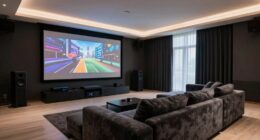
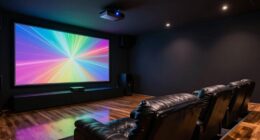
Short throw and long throw screens differ mainly in how close your projector is positioned to the screen. With a short throw, your projector sits close, reducing shadows and glare, making it ideal for small spaces. Long throw projectors sit farther back, suitable for larger rooms but requiring more space. Your choice affects installation, image sharpness, and room setup. Keep exploring to find out which option fits best with your space and setup needs.
Key Takeaways
- Short throw screens are designed for projectors placed close to the screen, producing large images in small spaces.
- Long throw screens require more distance between the projector and screen for optimal image quality.
- Short throw setups reduce shadows and glare, ideal for compact rooms; long throw setups are better for larger spaces.
- Short throw projectors and screens demand precise installation and calibration; long throw options are generally easier to set up.
- The choice depends on room size, space constraints, and installation preferences, highlighting clear differences in setup and application.

When choosing a projection screen for your home theater or classroom, understanding the difference between short throw and long throw screens is vital. The key factors to contemplate are projection distance and installation complexity. Short throw screens are designed to work with projectors placed close to the screen, often just a few feet away, making them ideal for small spaces where space is limited. Long throw screens, on the other hand, require a greater projection distance, meaning the projector needs to be positioned farther back from the screen to produce a clear image. Knowing this helps you determine the right setup based on your room size and how much space you can allocate to projector placement. Additionally, considering reliable setup guidance can help ensure your system performs optimally and safely. Projection distance plays a significant role in your choice. Short throw projectors can project large images from very close distances, which reduces shadows cast by viewers and minimizes glare. This is especially helpful if you have limited space or want to keep the projector out of the way. Conversely, long throw projectors need a larger area behind the projector to achieve the same image size, which can be a challenge in smaller rooms. The projection distance not only affects image size but also impacts the overall viewing experience, as shorter distances tend to produce sharper, more stable images with less potential for distortion. Installation complexity is another important factor. Short throw screens and projectors typically require more precise alignment because their lenses are specialized to project at close range. If the projector isn’t positioned correctly, you might notice keystone distortion or focusing issues. Installing a short throw setup often involves more careful calibration and sometimes custom mounts to guarantee ideal image quality. Long throw projectors tend to be simpler to install because they are more forgiving with positioning. They can be placed on a shelf or mounted on a ceiling farther from the screen, and their lenses are designed to accommodate larger projection distances, making setup more straightforward for beginners. Ultimately, your decision hinges on your space constraints and how much effort you’re willing to put into installation. Short throw screens are excellent for small rooms and clutter-free setups, but they demand precise placement and calibration. Long throw screens offer more flexibility and easier installation but need a larger area behind the projector. By understanding these distinctions, you can select the right screen and projector combination that fits your environment and viewing needs, ensuring you get the best experience without unnecessary hassle.

NothingProjector ALR Screen for Ultra Short Throw Projector, 95% Ambient Ceiling Light Rejecting, 120 inch, 4K/8K UHD, Active 3D, Fixed Frame 16:9, Wall Mount Anti Daylight UST, Black Series NothPJ
Fixed Frame 4K Ultra HD: This high-performance screen is tailor-made for HD and 4K Ultra Short Throw content….
As an affiliate, we earn on qualifying purchases.
As an affiliate, we earn on qualifying purchases.
Frequently Asked Questions
Can a Short Throw Screen Be Used Outdoors Effectively?
Yes, you can use a short throw screen outdoors effectively if it has good outdoor durability and weather resistance. Look for screens made with weatherproof materials that withstand sun, rain, and humidity. Proper installation and placement away from direct sunlight or moisture help maintain image quality. While they’re not specifically designed for outdoor use, with the right features, a short throw screen can perform well outside.
Do Long Throw Screens Require Special Mounting Equipment?
Long throw screens typically do require special mounting hardware, much like a ship needs sturdy anchors. You’ll likely need ceiling brackets and robust mounting hardware to secure the projector at the correct distance and angle. Make sure your ceiling brackets are compatible with your setup and can support the weight of the projector. Proper mounting guarantees a clear, stable image and prevents accidental falls, keeping your viewing experience smooth and safe.
What Is the Lifespan Difference Between Short and Long Throw Screens?
You’ll find that short throw screens tend to have a slightly shorter lifespan compared to long throw screens due to their exposure to more frequent projector maintenance and potential heat buildup. The durability of the screen material also plays a role; higher-quality materials last longer regardless of throw type. Proper cleaning and handling help extend your screen’s life, but overall, long throw screens often offer a bit more longevity.
Are There Differences in Resolution Options for Each Screen Type?
You’ll find that both short throw and long throw screens offer a variety of resolution options, from standard HD to 4K, to suit your needs. The key difference lies in image clarity, which depends on the resolution chosen. Higher resolutions enhance sharpness and detail, whether you’re using a short throw or long throw screen. So, your choice of resolution impacts your viewing experience, regardless of the screen type.
How Do Ambient Light Conditions Affect Each Screen Type’s Performance?
Ambient light critically impacts both short throw and long throw screens. In bright rooms, glare reduction becomes essential, especially for short throw screens, which are more susceptible to ambient light interference. You should use blackout curtains or adjust lighting to minimize glare. Long throw screens perform better in well-lit environments, but reducing ambient light always improves image clarity and contrast, ensuring an ideal viewing experience regardless of the screen type.

100" ALR Motorized Floor Rising Projector Screen for Long/Standard Throw Projector,Movie Screen for Home Theater,Motorized Projector Screen 4K/8K Ultra HD, Active 3D
Professional-Grade ALR Technology: Features advanced Ambient Light Rejecting (ALR) screen surface, specifically designed to combat ambient room light….
As an affiliate, we earn on qualifying purchases.
As an affiliate, we earn on qualifying purchases.
Conclusion
In the battle between short throw and long throw screens, you’re the captain steering your home theater ship. Think of short throw screens as the close-up magician, saving space while delivering stunning visuals, while long throw screens are the grand stage performers, perfect for larger rooms. By understanding their differences, you can choose the right one to turn your space into a cinematic paradise. Remember, the right screen is your ticket to a picture-perfect escape—your personal magic wand.

Mdbebbron 120 inch Projector Screen 16:9 Foldable Anti-Crease Portable Projector Movies Screens for Home Theater Outdoor Indoor Support Double Sided Projection
CONVENIENT TO STORAGE AND CARRY : Compact one-piece,lightweight and folding design. You can fold the projector screen in…
As an affiliate, we earn on qualifying purchases.
As an affiliate, we earn on qualifying purchases.

Cmple – Aluminum Short Throw Projector Wall Mount, Tilt & 360 Degree Swivel Wall Projector Bracket Mount with Telescopic Slide for LCD LED Projectors – Max 22lbs (Silver/Black)
PROJECTOR MOUNT is an aluminum short throw wall mount for most projectors up to 10kgs/22Ibs. Solid ball-joint structure…
As an affiliate, we earn on qualifying purchases.
As an affiliate, we earn on qualifying purchases.