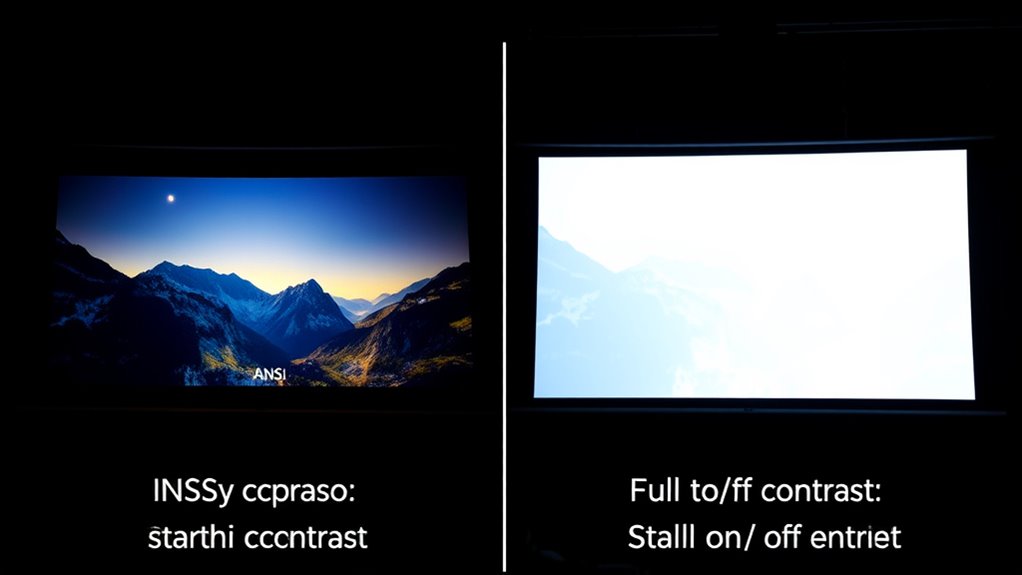
Understanding the difference between ANSI and full on/off contrast helps you choose the right projector for your environment. ANSI contrast measures brightness differences under ambient light, making it more relevant for typical rooms with some lighting. Full on/off contrast shows maximum possible contrast in dark conditions. If you’re unsure which matters most for your space, keep exploring—knowing more will help you pick the best projector for your needs.
Key Takeaways
- ANSI contrast measures brightness difference in a multi-section grid, reflecting performance under ambient light conditions.
- Full on/off contrast indicates maximum potential contrast in complete darkness, serving as a performance benchmark.
- ANSI contrast is more relevant for environments with ambient lighting, while full on/off suits dark room viewing.
- High ANSI contrast improves color accuracy and image vibrancy in lit spaces, unlike full on/off which shows maximum contrast in ideal conditions.
- Choosing between them depends on your environment; ANSI is better for lit rooms, full on/off for dark, controlled settings.
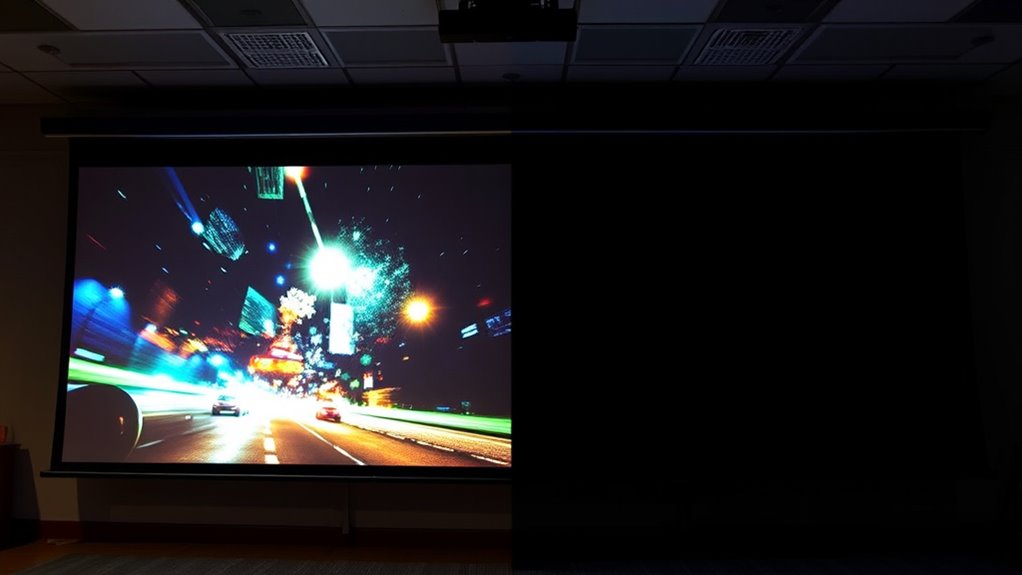
Contrast is a fundamental principle that shapes how we perceive and interpret visual and sensory information. When you’re choosing a projector, understanding how contrast impacts your viewing experience becomes essential. One key aspect is how different contrast measurements, like ANSI contrast and full on/off contrast, influence image quality. These measurements are especially relevant when considering color accuracy and ambient lighting conditions in your environment.
Understanding ANSI and full on/off contrast helps optimize image quality in various lighting environments.
ANSI contrast measures the difference in brightness between the brightest white and the darkest black in a grid of different sections. It offers a practical view of how a projector performs in real-world settings, where ambient lighting often affects the perceived contrast. If your room isn’t pitch dark, ANSI contrast gives you a better idea of how vibrant and detailed your images will appear. It’s especially useful for environments with some ambient lighting, as it reflects the projector’s ability to produce clear images despite light interference.
On the other hand, full on/off contrast focuses on the difference in brightness between a completely black screen and a fully illuminated white screen. This measurement is more idealized, representing the maximum potential contrast a projector can achieve in perfect conditions—usually in a dark room with no ambient lighting. While it provides a benchmark for the projector’s capabilities, it can be misleading if you plan to use your projector in a well-lit space.
Color accuracy plays a significant role here. A projector with high contrast, whether measured by ANSI or full on/off, can deliver more vivid and lifelike colors, but only if the contrast is maintained across different lighting conditions. In rooms with ambient lighting, a projector with a high ANSI contrast ratio is likely to produce more accurate and consistent colors because it can better handle light interference. Conversely, a projector that only excels in full on/off contrast may struggle to deliver true-to-life colors when ambient light is present, leading to washed-out or dull images.
Ultimately, your choice depends on your environment and how you plan to use the projector. If you often watch in a dark room, the full on/off contrast ratio might suffice. But if your space has ambient lighting or windows, prioritizing ANSI contrast will help you achieve better color accuracy and overall image quality. Remember, contrast isn’t just a number—it directly impacts your viewing experience, especially when considering ambient lighting and how well your projector reproduces colors in different conditions.

HAPPRUN 2500 ANSI Lumens Outdoor Projector with Built-in Streaming Apps, 4K Decoding Resolution, Dolby Audio, WiFi 6 and Bluetooth 5.2 for Indoor and Outdoor Home Theater
[ Built-in Streaming System ] – No extra equipment needed. This smart projector gives you direct access to…
As an affiliate, we earn on qualifying purchases.
As an affiliate, we earn on qualifying purchases.
Frequently Asked Questions
How Does Ambient Light Affect Contrast Performance?
Ambient lighting considerably impacts your projector’s contrast performance. Bright rooms reduce contrast durability by washing out dark details, making images appear less vivid. To maintain ideal contrast, you should control ambient lighting, use blackout curtains, or choose projectors with higher contrast ratios suited for well-lit environments. This ensures your images stay sharp, detailed, and vibrant, even when ambient light is unavoidable.
Can Contrast Settings Be Adjusted for Different Viewing Environments?
Think of contrast settings like a dimmer switch for your projector’s picture. You can tweak these settings to match your environment, especially if you adjust for room lighting or reflectivity. For ideal results, use color calibration and consider your screen’s reflectivity; these help you fine-tune contrast for different viewing spaces. So, yes, adjusting contrast settings makes your viewing experience better, no matter where you’re watching.
What Is the Impact of Contrast on Color Accuracy?
Contrast profoundly impacts color accuracy by influencing color fidelity during display calibration. When contrast is too high or low, colors may appear washed out or overly saturated, reducing overall image quality. Adjusting contrast helps you achieve better display calibration, ensuring true-to-life colors. This enhances your viewing experience, making images more vibrant and accurate. Proper contrast settings are essential for maintaining realistic colors and ideal visual performance in any projection environment.
Are Higher Contrast Ratios Always Better for Image Quality?
Higher contrast ratios often improve image quality by enhancing black levels and making details pop, but they’re not always better. Excessive contrast can cause contrast enhancement issues, leading to loss of detail in bright or dark areas. You should consider the projector’s black level performance and how well it maintains contrast in your environment. Balance is key; a high contrast ratio won’t guarantee better quality if black levels are poor.
How Do Projectors Maintain Contrast Over Extended Use?
To maintain contrast over extended use, you should regularly perform screen calibration to guarantee ideal image quality. Many projectors feature dynamic adjustment settings that automatically adapt brightness and contrast based on the content and ambient light. These adjustments help prevent image degradation over time, preserving contrast. Additionally, keeping your projector clean and avoiding prolonged use at high brightness levels can extend its lifespan, ensuring consistent performance.

Official Licensed Google TV Smart Projector, HAPPRUN 4K UHD Home Theater with Dolby Sound, Wi-Fi & Bluetooth, Built-in Streaming Apps, Compatible with Games Consoles & Smartphone, Indoor & Outdoor Use
[ Built-in Official Licensed Google TV ] – Without additional equipment, the smart projector can directly access Netflix,…
As an affiliate, we earn on qualifying purchases.
As an affiliate, we earn on qualifying purchases.
Conclusion
Now that you understand the difference between ANSI and full on/off contrast, you’re better equipped to choose the right projector for your needs. Remember, contrast is the heartbeat of image quality—without it, your display could be as dull as a blackout. By grasping these concepts, you’ll guarantee your projector delivers vivid, enthralling visuals that truly pop. So go ahead, pick the perfect contrast ratio and make your viewing experience unforgettable—your eyes will thank you!
Northern Galaxy Light Aurora Projector with 33 Light Effects, LED Star Projector for Bedroom Nebula Lamp, Remote Control, White Noises, Bluetooth Speaker for Parties
🏡【𝐔𝐩𝐠𝐫𝐚𝐝𝐞𝐝 𝟑-𝐢𝐧-𝟏 𝐆𝐚𝐥𝐚𝐱𝐲 𝐏𝐫𝐨𝐣𝐞𝐜𝐭𝐨𝐫】Watch the splendid aurora views without chasing around or hiking far away, turning your home…
As an affiliate, we earn on qualifying purchases.
As an affiliate, we earn on qualifying purchases.
![[3500 ANSI/ Official Apps/65W Audio] Outdoor 4K Projector with WiFi and Bluetooth, Auto Focus, Auto Keystone Smart Projector Support DoIby Audio, 2026 Upgrade GO2 Short Throw Projector with 360°Stand](https://m.media-amazon.com/images/I/41-laeqxhwL._SL500_.jpg)
[3500 ANSI/ Official Apps/65W Audio] Outdoor 4K Projector with WiFi and Bluetooth, Auto Focus, Auto Keystone Smart Projector Support DoIby Audio, 2026 Upgrade GO2 Short Throw Projector with 360°Stand
Highest 3500 ANSI Lumens & 360°Rotatable Stand– With upgrade 3500 ANSI lumens brightness, the GO2 outdoor projector offers…
As an affiliate, we earn on qualifying purchases.
As an affiliate, we earn on qualifying purchases.