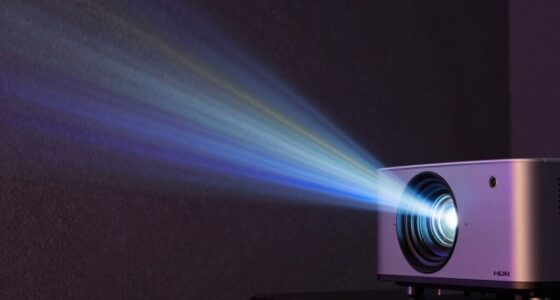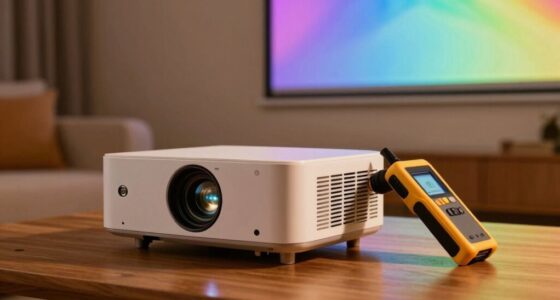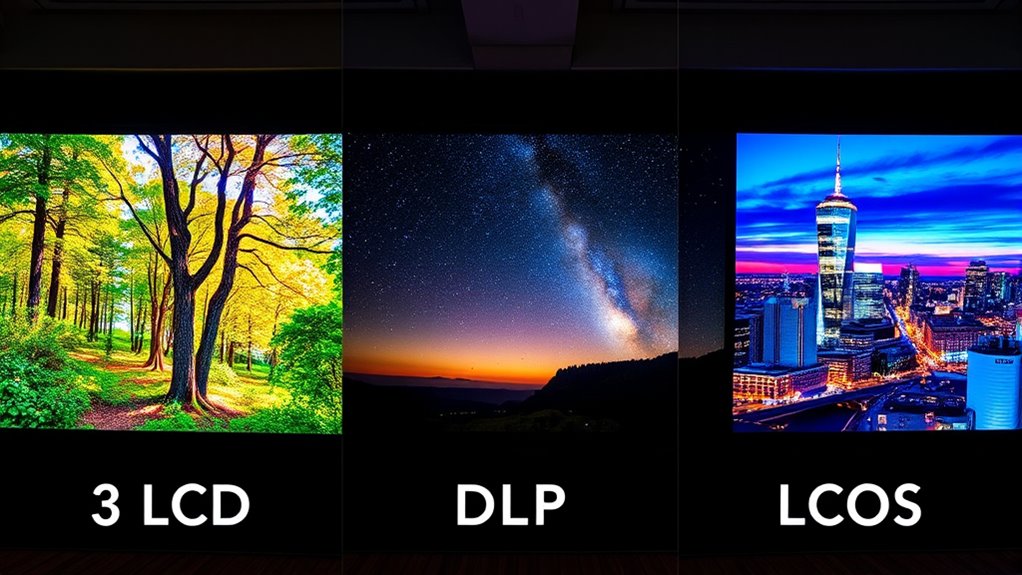

If you’re choosing between 3LCD, DLP, and LCOS projectors for better color and contrast, 3LCD models excel in color accuracy with true-to-life hues, making them great for presentations and movies. DLP projectors deliver superior contrast with deep blacks and bright whites, ideal for cinematic effects and dark rooms. LCOS offers a combination of rich colors and high contrast, providing a balanced, immersive experience. Keep exploring to discover which technology fits your viewing needs best.

Get business pricing on your home office setup
- Business-only prices and quantity discounts
- Tax-exempt purchasing
- Multiple users, one account, clear invoices
Key Takeaways
- 3LCD projectors provide superior color accuracy and vibrant, true-to-life colors due to their three-panel design.
- DLP excels in contrast, delivering deep blacks and bright whites for more dynamic images.
- LCOS offers a balance, delivering high contrast with rich, natural colors and minimal visual artifacts.
- 3LCDs are generally brighter, suitable for well-lit environments, while DLP and LCOS excel in darker settings.
- Cost and maintenance vary, with 3LCD being more affordable and easier to maintain compared to the more complex LCOS technology.
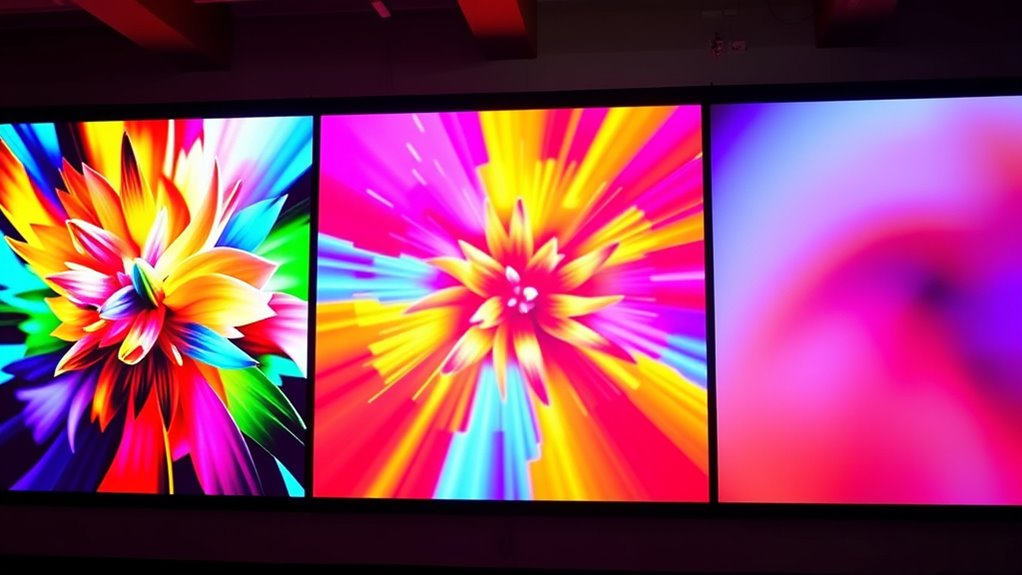
When choosing a projector, understanding the differences between 3LCD, DLP, and LCOS technologies is essential, as each offers unique advantages and drawbacks. These projection technologies influence not only the overall image quality but also how accurately colors are reproduced and how well contrast levels are maintained. If you’re aiming for sharp, vibrant visuals, knowing how these technologies handle color accuracy and contrast can help you make an informed decision.
3LCD projectors are known for their excellent color accuracy. They use three separate LCD panels to generate red, green, and blue light, which combine to produce bright, vivid images. This setup allows for smooth color blending and minimizes the “rainbow effect” sometimes seen in other technologies. Because of their design, 3LCDs tend to deliver consistent, true-to-life colors, making them ideal if you prioritize accurate color representation, whether for presentations, movies, or gaming. Additionally, they typically produce high brightness levels, which helps in well-lit environments, but this can sometimes come at the expense of contrast depth.
DLP technology, on the other hand, relies on tiny mirrors mounted on a chip that tilt to reflect light through a color wheel. This method results in fast image processing and often crisper details. DLP projectors generally excel with contrast, providing deep blacks and bright whites, which adds depth to the image. However, because DLP uses a color wheel, it can sometimes produce a “rainbow effect,” especially in fast-moving scenes or for viewers sensitive to color separation. When it comes to projection technology, DLP devices may struggle slightly with color accuracy compared to 3LCD models, but they excel in delivering high contrast ratios that make images pop, especially in darker rooms.
Furthermore, brightness levels are typically higher in 3LCD projectors, making them more suitable for environments with ambient light, whereas DLP and LCOS models often focus on maximizing contrast for cinematic quality. LCOS (Liquid Crystal on Silicon) combines elements of 3LCD and DLP, offering a reflective chip that produces high-quality images with excellent contrast and color fidelity. This technology tends to deliver smooth, sharp images with rich, natural colors and deep blacks, making it a favorite for home theater enthusiasts. Because LCOS technology minimizes the “rainbow effect” and maintains high contrast, it provides a more seamless viewing experience, especially in darker environments. However, LCOS projectors often come at a higher price point and may require more maintenance.
Frequently Asked Questions
How Do These Technologies Compare in Terms of Energy Efficiency?
You’ll find that LCD projectors generally have lower power consumption, making them more energy-efficient and offering better energy savings over time. DLP and LCOS projectors tend to consume more power, especially during brighter displays or extended use. If energy efficiency is your priority, opting for LCD technology helps reduce power consumption, ultimately leading to more significant energy savings and a more eco-friendly setup.
Which Projector Type Offers the Lowest Maintenance Requirements?
You’ll find that DLP projectors generally offer the lowest maintenance requirements, with lower repair frequency and minimal upkeep. Unlike LCD and LCOS models, DLPs have fewer delicate parts, reducing repair costs over time. Their sealed designs prevent dust buildup, meaning you spend less on cleaning and repairs. If you want a projector that stays reliable longer and demands less maintenance effort, DLP is your best choice for convenience and durability.
How Do They Perform in Different Ambient Lighting Conditions?
In various ambient lighting conditions, your viewing environment greatly impacts projector performance. LCD projectors excel in well-lit rooms because they handle ambient light better, maintaining vibrant images. DLP projectors perform well in darker settings, offering high contrast and sharp images. LCOS projectors provide balanced performance across different lighting conditions, delivering good color and contrast whether the room is bright or dim. Your choice depends on your typical ambient light levels and viewing environment.
Are There Significant Differences in Projector Lifespan?
Projector longevity largely depends on durability and maintenance. DLP projectors often boast longer lifespans because of their sealed DMD chips, reducing dust and damage risks. LCD projectors may face quicker deterioration due to filter and panel wear, leading to higher replacement costs. You’ll find that with proper care, DLP can deliver durability and economic efficiency, while LCDs might require more frequent replacements, impacting your long-term investment and overall projector performance.
Which Technology Is Most Suitable for 4K Resolution Projection?
You should choose DLP technology for 4K resolution projection if you want the best balance of color accuracy and image sharpness. DLP projectors typically deliver sharper images with vibrant colors, making them ideal for high-resolution content. While LCD and LCOS may also support 4K, DLP’s fast pixel response and better contrast make it a superior choice for immersive, detailed 4K viewing experiences.
Conclusion
When choosing between 3LCD, DLP, and LCOS, consider which aspect matters most to you. Did you know that 3LCD projectors typically offer 30% higher brightness and more vivid colors? If you prioritize color accuracy and brightness, 3LCD might be your best bet. However, for better contrast and deeper blacks, DLP and LCOS excel. Ultimately, pick the technology that aligns with your viewing needs for the best experience.
Fall Picks
fall essentials
As an affiliate, we earn on qualifying purchases.