
Playing on a big screen like a projector can boost immersion and make your gaming more exciting, but it also demands more from your perception and reactions. The larger visuals challenge your spatial awareness and can cause you to miss peripheral cues or misjudge distances, sometimes slowing your responses. While this might seem to hinder your performance, adjusting your setup and learning to adapt can turn these challenges into advantages. Keep going to discover how you can optimize your big-screen experience.
Key Takeaways
- Larger screens increase immersion, which can boost focus but also cause distraction or overwhelm if not properly adapted.
- The expanded field of view demands greater cognitive effort, potentially impacting reaction times and accuracy.
- Enhanced visual engagement can improve motivation and strategic thinking, positively influencing gameplay.
- Difficulties with depth perception and peripheral cues may lead to misjudgments and reduced performance.
- Proper calibration and breaks help players adapt to big screens, minimizing negative effects and enhancing gaming experience.

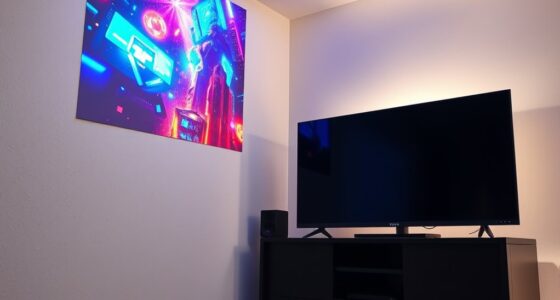
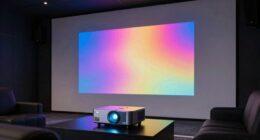
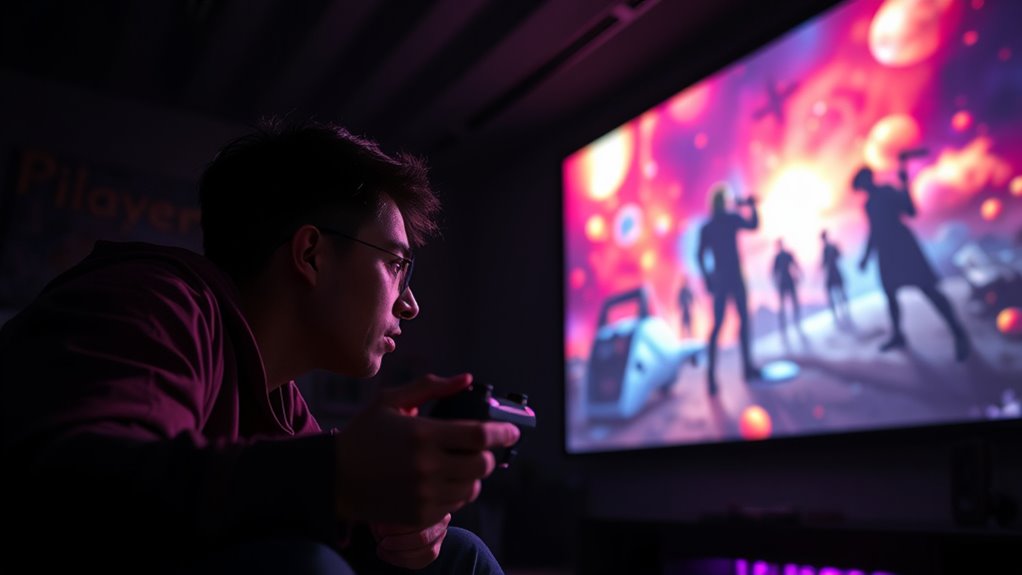
Big-screen gaming offers more than just larger visuals; it immerses you deeply into virtual worlds, engaging your senses and emotions in ways that smaller screens often can’t match. When you switch to a projector or large display, your sense of visual immersion intensifies. The expansive screen surrounds you, making you feel like you’re truly inside the game environment rather than just observing it. This heightened sense of presence can amplify your emotional responses, from excitement to tension, because your brain treats the experience as more real. However, this immersive environment also demands more from your spatial awareness. With a bigger display, your field of view widens, and you need to process a larger amount of visual information simultaneously. This can be both a thrill and a challenge, especially in fast-paced games where quick reactions matter. Your brain works harder to interpret spatial cues, track moving objects, and anticipate enemy movements, which can sometimes lead to increased cognitive load.
While this enhanced visual immersion makes gaming feel more engaging, it can also influence your performance. You might find yourself more absorbed, but that same absorption could cause you to miss peripheral cues or underestimate distances, especially if you’re not accustomed to the scale. Larger screens can distort your depth perception slightly, making it harder to judge how far away objects are or how close enemies are to your position. This is where spatial awareness becomes critical; if you don’t adapt your perception, your gameplay could suffer. Some gamers report feeling overwhelmed or disoriented when shifting from smaller screens to big projections, which can lead to decreased accuracy or slower reaction times.
On the flip side, the immersive environment can sharpen your focus, boosting your overall awareness of the game world. When you feel more involved, you’re often more motivated to stay alert, which can improve your strategic thinking. To optimize performance on a big screen, you might need to adjust your seating position, calibration, or settings. It’s also helpful to take breaks to prevent fatigue caused by the increased visual and cognitive load. Essentially, a projector elevates the gaming experience through enhanced visual immersion and expanded spatial awareness, but it requires a period of adaptation. If you embrace the challenge and learn to navigate the larger visual scope, you’ll likely find that your gameplay becomes more engaging and satisfying rather than worse.
gaming projector with low latency
As an affiliate, we earn on qualifying purchases.
As an affiliate, we earn on qualifying purchases.
Frequently Asked Questions
Does Screen Size Impact a Player’s Reaction Time?
Yes, screen size can impact your reaction time. When you play on a larger screen, your peripheral vision is more engaged, which can help you notice events faster. However, if the screen is too big or your setup isn’t ideal, it might slow your reaction time because you have to move your eyes or head more. Overall, the right screen size can enhance your responsiveness, but it depends on your comfort and setup.
How Does Immersive Gaming Affect Player Stress Levels?
Immersive gaming increases your emotional immersion, which can elevate your stress levels. The heightened cognitive load demands more mental effort, potentially causing feelings of anxiety or tension. While immersion boosts enjoyment, it also intensifies emotional responses, making you more susceptible to stress during challenging moments. Managing pacing and taking breaks helps balance emotional immersion, keeping stress levels in check and enhancing your overall gaming experience.
Can Projector Brightness Influence Gaming Performance?
Yes, projector brightness can influence your gaming performance. Higher perceived brightness helps you see details clearly, improving your reaction time and accuracy. However, if the brightness is too intense, it can cause visual fatigue, making it harder to focus over extended periods. Finding a balance guarantees you stay immersed without straining your eyes, ultimately enhancing your overall gaming experience.
Do Visual Distractions Differ Between TV and Projector Setups?
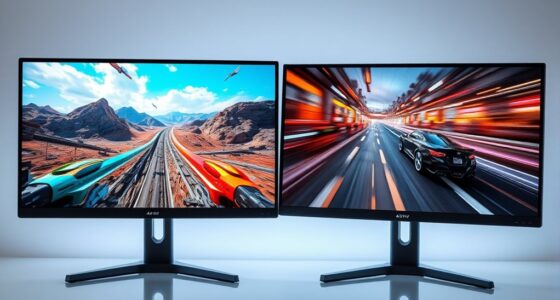
Visual distractions differ between TV and projector setups because each affects your visual focus and ambient lighting differently. With a TV, your focus stays on a fixed screen, and ambient lighting minimizes glare. In contrast, a projector’s larger image can draw your eyes away more easily, and ambient lighting may cause reflections or washout. You need to manage both visual focus and ambient lighting to reduce distractions and improve your gaming experience.
Is There a Psychological Difference in Playing Alone Versus With Others on a Big Screen?
Playing alone versus with others on a big screen impacts your performance through social facilitation and competitive anxiety. When you’re alone, you might feel less pressure, leading to relaxed focus. With others, social facilitation can boost motivation, but competitive anxiety might increase, potentially impairing your play. Recognizing these psychological effects helps you manage your mindset, whether you’re aiming for fun or competition.
gaming projector calibration tools
As an affiliate, we earn on qualifying purchases.
As an affiliate, we earn on qualifying purchases.
Conclusion
Imagine stepping into a grand theater, your game sprawling across the wall like a living painting. That’s the power of big-screen gaming—you’re immersed, but sometimes overwhelmed. Studies show your focus can waver, just like trying to read a map in a storm. So, while a projector pulls you into a world of wonder, it might also make you lose your grip. Embrace the spectacle, but remember, clarity often leads to victory.
large screen gaming setup
As an affiliate, we earn on qualifying purchases.
As an affiliate, we earn on qualifying purchases.
gaming projector screen size
As an affiliate, we earn on qualifying purchases.
As an affiliate, we earn on qualifying purchases.