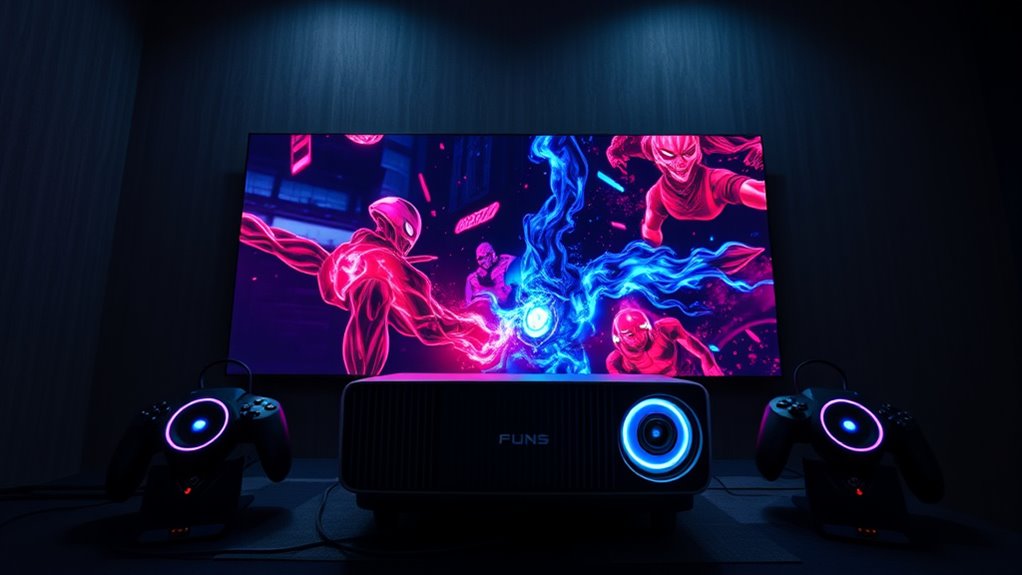

Deciding if you need an 8K projector for future consoles depends on your gaming setup and goals. Right now, 8K gaming is still in its early stages, requiring powerful hardware and optimized software to run smoothly. Investing in an 8K projector now might be expensive and may not deliver a noticeable upgrade over 4K for most players. If you want to understand how hardware, software, and future consoles impact 8K gaming, you’ll find more useful insights ahead.
Key Takeaways
- Future consoles may support 8K output, but optimal performance at high frame rates is not yet guaranteed.
- An 8K projector enhances visual fidelity but may be overkill given current hardware limitations.
- Software optimization and game development for 8K are still in early stages, affecting real-world benefits.
- Investing in an 8K projector now is more aligned with long-term gaming goals than immediate needs.
- Most gamers can enjoy excellent visuals with current 4K displays until 8K technology matures further.
As gaming technology advances, the push towards 8K resolution has sparked both excitement and concern among gamers and industry experts alike. You might be wondering whether investing in an 8K projector is worth it for future consoles or if you should wait until the technology matures. The resolution debate is at the heart of this, with many questioning if 8K’s benefits justify the hefty hardware expectations. While developers and hardware manufacturers are pushing hard for these ultra-high resolutions, it’s essential to understand what that really means for you as a gamer.
Right now, 8K gaming is still in its infancy, and the leap from 4K isn’t as straightforward as it might seem. You’ll need a powerful graphics card, a compatible display, and a system that can handle the massive data load without sacrificing performance. That’s where hardware expectations come into play. As of now, most gaming setups aren’t built to effortlessly support 8K at high frame rates, meaning you could face issues like lag, lower frame rates, or the need for significant upgrades. This creates a tension between the desire for the best visual fidelity and the practical limits of current hardware.
Most gaming setups struggle with effortless 8K support at high frame rates, risking lag and performance issues.
The resolution debate is also about whether the visual gains are worth the cost. At 8K, tiny details become more visible, and textures appear sharper. But, to truly enjoy these benefits, you need a large screen and close viewing distance, which isn’t always feasible for most gamers. Many experts argue that for the average player, 4K remains more than enough, especially since current hardware struggles to deliver smooth gameplay at 8K. The concern is that chasing 8K now could lead to overspending on equipment that might become outdated quickly once newer, more efficient hardware hits the market.
You also need to consider what future consoles will support. While some companies have announced plans for 8K-capable hardware, the actual gaming experience at this resolution might be limited by software optimization and available hardware. The hardware expectations for future consoles aim for 8K readiness, but that doesn’t guarantee all games will run at high quality or frame rates. As a result, it’s wise to question whether jumping into 8K now aligns with your gaming goals or if you should wait for more mature technology.
Furthermore, understanding display technology is crucial, as the type of projector or monitor you choose can significantly impact your visual experience at 8K resolution. The hardware expectations for future consoles continue to evolve, but the current limitations suggest that investing in 8K should be a carefully considered decision. The resolution debate continues, but one thing’s clear: 8K gaming isn’t here to replace 4K overnight. Instead, it’s a glimpse into a future where visual detail might become even more breathtaking — but only if your hardware can handle the challenge.
8K gaming projector
As an affiliate, we earn on qualifying purchases.
As an affiliate, we earn on qualifying purchases.
Frequently Asked Questions
Will Future Consoles Natively Support 8K Gaming?
Future consoles are likely to natively support 8K gaming, enhancing hardware compatibility and visual fidelity. As technology advances, developers focus on pushing resolutions higher to meet consumer expectations for sharper, more detailed graphics. While not every game will run at 8K immediately, upcoming consoles are designed to handle 8K outputs, ensuring you can enjoy increasingly immersive visuals. However, you’ll need compatible hardware to truly leverage these higher resolutions.
How Much Does an 8K Projector Typically Cost?
An 8K projector can cost anywhere from $10,000 to over $50,000, making it a significant investment. Pricing considerations include brand, features, and resolution quality, while market availability varies as these projectors are still emerging. You might feel like you’re chasing a unicorn, but if you’re after cutting-edge visuals, be prepared to pay a hefty price for the latest tech that turns your space into a cinematic universe.
Is 8K Gaming Worth the Current Investment?
Whether 8K gaming is worth the current investment depends on your cost-benefit analysis. If you value sharp visual clarity and future-proofing, it might be worth it. However, consider that current consoles and content may not fully capitalize on 8K resolution yet. If you’re a serious enthusiast, the upgrade could enhance your experience, but if you’re budget-conscious, waiting for better technology and prices could be smarter.
What Are the Latency Differences Between 4K and 8K Setups?
When comparing latency between 4K and 8K setups, you’ll notice that 8K generally has higher bandwidth requirements, which can lead to increased latency if your hardware isn’t optimized. The resolution comparison shows that 8K demands more processing power, potentially causing slight delays. To minimize latency, guarantee your system supports high-speed connections and low-latency technology, so gameplay remains smooth and responsive despite the higher resolution.
Can Existing Hardware Be Upgraded to Support 8K Gaming?
You can’t easily upgrade existing hardware to support 8K gaming due to hardware limitations. Most current GPUs and consoles are designed for 4K, and upgrading involves replacing major components like graphics cards or monitors. Some upgrade options include investing in a more powerful GPU that can handle 8K output or upgrading your display to an 8K-compatible model. However, verify compatibility and performance specs before making any upgrades to ensure smooth gaming.

Alienware 34 Curved Gaming Monitor – AW3425DWM – 34-inch WQHD 180Hz 1ms Display, 1500R, AMD FreeSync Premium, VESA AdaptiveSync.
Bring virtual worlds to life with WQHD quality: Explore your games' vast, detailed landscapes with WQHD resolution and…
As an affiliate, we earn on qualifying purchases.
As an affiliate, we earn on qualifying purchases.
Conclusion
So, as you stand at the crossroads of gaming’s future, ask yourself if chasing 8K is like reaching for a shimmering mirage or planting seeds for tomorrow’s forest. While the tech promises breathtaking visuals, today’s consoles and content still paint a picture in 4K. Whether you embrace the 8K dream or enjoy the now, remember—your gaming journey is a voyage, and the next horizon might just be a leap, not a giant step.
gaming graphics card for 8K
As an affiliate, we earn on qualifying purchases.
As an affiliate, we earn on qualifying purchases.
8K compatible gaming monitor
As an affiliate, we earn on qualifying purchases.
As an affiliate, we earn on qualifying purchases.