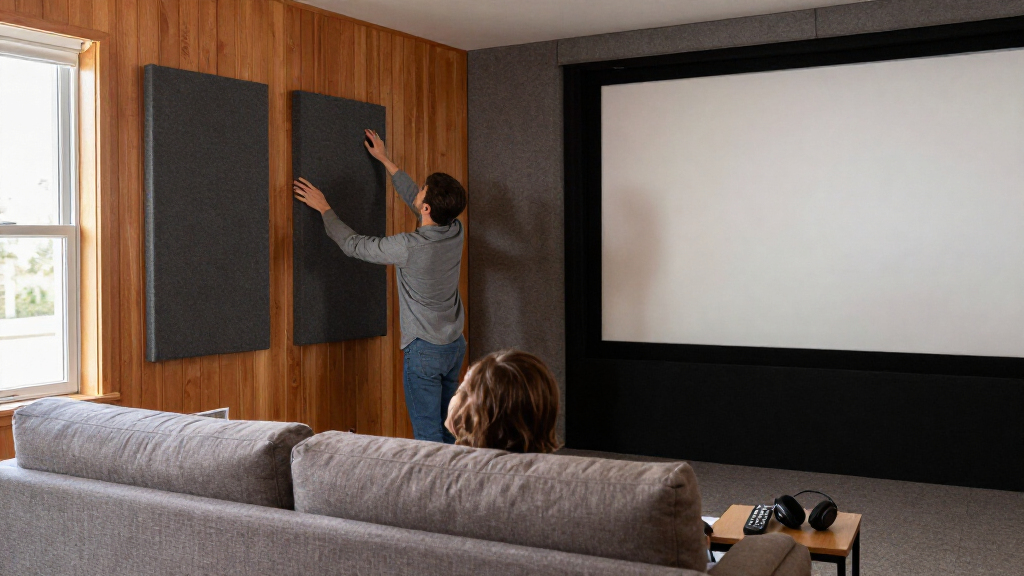
Acoustic panels for home theaters can reduce distracting reflections and make dialogue easier to follow, but they do not block sound from traveling through walls. My best overall pick is the Olanglab 2-inch fiberglass panels, which offer substantial thickness for treating reflections; the NeatiEase wood slat panels stand out for a finished, decorative look, while the Focusound 52-pack suits buyers who want many small pieces for flexible placement. The main tradeoffs are absorption versus appearance, broad coverage versus targeted treatment, and easy installation versus a more durable wall finish. Foam is lightweight and simple to place, while thicker fiberglass and wood-slat products can bring different acoustic and visual benefits. Read on for the full comparison, selection criteria, and room-planning advice.

Get business pricing on your home office setup
- Business-only prices and quantity discounts
- Tax-exempt purchasing
- Multiple users, one account, clear invoices
Complete the kit
Key Takeaways
- Thickness separates the more substantial absorbers: the Olanglab 2-inch fiberglass panels offer more depth than the listed 0.4-inch and 1-inch foam choices, though thickness alone does not establish a product’s full acoustic performance.
- Large panels simplify coverage: 47.2-by-23.6-inch wood and fabric-covered options can treat broad wall areas with fewer pieces than 12-inch squares, but demand more deliberate placement.
- Decorative wood slats and absorption solve different priorities: NeatiEase and similar slat panels are the visual-forward choices; buyers should not assume their appearance or soundproofing claims mean they replace dedicated absorbers or construction work.
- Small foam packs favor flexible layouts: Focusound’s 52 pieces and adhesive supply make it easier to experiment with many small treatment spots, but the 1-inch thickness and visible foam finish may not suit every theater.
- The lineup includes multiple panel types, not interchangeable fixes: fiberglass, foam, and wood-slat products differ in coverage, finish, and intended use, so room goals and mounting plans matter more than pack count alone.


| acoustic panels for home theater | Material | Color | Thickness |
|---|---|---|---|
| NeatiEase Wood Slat Wall Panel | — | Black | — |
| Soon Global Acoustic Wall Pane | Polyester fiber | — | — |
| 4 Pack Acoustic Foam Panels | High-density polyurethane foam | Black | — |
| Art3d 4-Pack High-Density Wedg | High-density polyurethane | Black foam | — |
| Focusound 52 Pack Acoustic Foa | High-density foam | — | 1 inch |
| 12 Pack Self-Adhesive Acoustic | Polyester fiber | Black | — |
| Olanglab Fiberglass Acoustic W | Fiberglass | Black | 1.6 inches |
| TONOR Wood Wall Panels for Int | — | — | — |
| 24 Pack 2” Thick Pyramid Acous | Acoustic foam | — | 2 inches |
| Self-Adhesive Soundproof Foam | High-density PU foam | Black | 3 inches |
| 12in Acoustic Panels for Walls | 100% polyester | — | 25% thicker than traditional panels, according to the product data |
| 6 Pack Acoustic Panels | Polyester fiber with wood-looking veneer | Walnut | 0.4 inches |
| 4 Pack Acoustic Panels 23.6"x1 | Fiberglass fiber with 100% polyester fabric wrap | Black | 2 inches |
| Acoustic Wall Panels | MDF wood slats and high-density polyester acoustic felt | Marble | 0.75 inches |
| Olanglab Sound Absorbing Acous | Fiberglass core with fabric cover | Light gray | 2 inches |
More Details on Our Top Picks
NeatiEase Wood Slat Wall Panels, 4-Piece 96″ x 12.6″, Soundproof & Noise Cancelling, Acoustic Wall Panels (Black)
NeatiEase pairs acoustic treatment with a full-height wood-slat finish, making it a stronger fit for a dedicated theater where the walls are part of the room design. Its four 96-inch panels cover 34 square feet, giving you more continuous vertical coverage than the smaller, individually placed Focusound foam tiles. The MDF-and-polyester-fiber construction is intended to reduce reflections, but the listing supplies no measured absorption figures, and these panels should not be treated as soundproofing that blocks noise between rooms. Installation also takes more effort than Soon Global’s peel-and-stick panels: expect to plan placement and use tools. I’d choose NeatiEase for a polished, architectural wall; buyers seeking flexible, low-commitment coverage or treatment for a large room may prefer a different format.
Pros:- Four tall panels provide 34 square feet of coverage.
- Slatted black finish gives a theater wall a more decorative look than exposed foam.
- MDF and high-density polyester fiber combine a rigid visual surface with an acoustic backing.
- Can be mounted vertically or horizontally on walls or ceilings.
Cons:- Installation requires tools and more planning than peel-and-stick options such as Soon Global Arcadian Vortex.
- Only black is listed, limiting coordination with lighter theater interiors.
- No measured acoustic rating is provided, and the product should not be assumed to block sound through walls.
Best for: Home theater owners who want tall, coordinated black slat panels to serve as both wall treatment and a prominent design feature.
Not ideal for: Renters or buyers seeking quick, tool-free installation, broad color choice, or documented acoustic performance.
- Pack count:4 panels
- Panel size:96 x 12.6 inches
- Total coverage:34 sq. ft.
- Materials:MDF and high-density polyester fiber
- Color:Black
- Form:Rectangular sheets
- Mounting orientation:Horizontal or vertical
Our verdict“Choose NeatiEase if you want substantial slatted wall coverage and a designed-in theater look, rather than the simplest installation.”
Soon Global Acoustic Wall Panels, Arcadian Vortex
Arcadian Vortex is the easiest fit for a theater owner who wants a finished-looking treatment without a tool-heavy install. The six polyester-fiber squares use peel-and-stick mounting, unlike the larger NeatiEase slat panels, which call for more involved installation. Each panel measures 23.62 inches square, so it is easier to arrange around a screen, door, or existing wall features; the tradeoff is that the set covers less area than a broad wall treatment. Its continuous-grain finish also reads more like decor than the black wedge foam of Art3d. Adhesive compatibility is the main uncertainty: the product is for interior use, and some wall surfaces may not hold the panels reliably. I’d pick it for targeted echo control and appearance, not for sound isolation or a whole-room treatment plan.
Pros:- Peel-and-stick installation avoids the tools and mounting effort associated with NeatiEase slat panels.
- Six square panels allow flexible placement around theater fixtures.
- Polyester-fiber construction is designed for sound absorption.
- Continuous-grain finish offers a more decorative look than exposed wedge foam.
Cons:- Adhesive may not suit every wall surface and can limit placement flexibility.
- The set’s stated coverage is modest for a full theater wall.
- No acoustic rating or evidence of sound transmission blocking is supplied.
Best for: Theater owners who want a decorative, modular acoustic treatment and have clean, compatible interior wall surfaces.
Not ideal for: Buyers treating a large room, mounting to unsuitable or delicate walls, or seeking a documented sound-blocking solution.
- Panel count:6
- Panel dimensions:23.62 x 23.62 inches
- Coverage per panel:558 sq. in.
- Total stated coverage:3,348 sq. in.
- Material:Polyester fiber
- Installation:Peel-and-stick, tool-free
- Finish:Continuous-grain with linear grooves
Our verdict“Choose Arcadian Vortex for convenient, decorative treatment of selected wall areas, provided your wall surface can support the adhesive.”
4 Pack Acoustic Foam Panels, 48″x24″x2″ – High Density Soundproof Foam Wall Panels for Noise Reduction, Studio Walls, Home Theater & Office
These four 48-by-24-inch foam panels suit buyers who want broad, simple shapes rather than a wall of small tiles. At two inches thick, the high-density polyurethane is intended to reduce room reflections, which can help tame an overly live theater; it does not establish that sound will be blocked from reaching neighboring rooms. Compared with Focusound’s 52 one-inch squares, this set uses fewer, much larger panels and may take less time to lay out, but it gives you less flexibility around screens and doorways. The black finish is functional rather than decorative, and no acoustic performance rating is listed to guide placement or predict results. Fire-retardant material is a useful stated feature, though buyers wanting a more finished wall appearance may prefer NeatiEase’s wood-slat design.
Pros:- Two-inch thickness gives the panels more depth than Focusound’s one-inch tiles.
- Large 48-by-24-inch format covers open wall sections with fewer pieces.
- High-density polyurethane is described as flame retardant.
- Suitable for wall or ceiling installation according to the product information.
Cons:- Large panels are less adaptable around screens, doors, and narrow wall sections than smaller tiles.
- Black foam has a utilitarian look compared with NeatiEase’s slatted finish.
- No specific acoustic performance rating is provided, and sound isolation is not established.
Best for: Theater owners prioritizing large, two-inch-thick foam sections for reflection control on open wall areas.
Not ideal for: Buyers who need decor-forward panels, highly flexible coverage around obstacles, or published acoustic performance data.
- Panel count:4
- Panel size:48 x 24 x 2 inches
- Material:High-density polyurethane foam
- Color:Black
- Item weight:6.8 lb.
- Package dimensions:12.8 x 10.98 x 7.68 inches
- Stated material feature:Flame retardant
Our verdict“Pick this set for straightforward coverage of broad wall areas with two-inch foam, not for a decorative or highly adjustable layout.”
Art3d 4-Pack High-Density Wedge Design Acoustic Foam Panels, 48 x 24 x 2 in
Art3d’s clearest advantage is the included double-sided tape, which makes it a more ready-to-mount choice than the large-format foam set from B0H299B8KQ. Both offer four black polyurethane panels measuring 48 by 24 by 2 inches, so the main distinction is installation support and the wedge profile, not a different coverage scale. The wedge design is intended to absorb sound and reduce echo in a home theater, while the recyclable, non-toxic material claims may appeal to buyers attentive to composition. The format still suits open wall stretches better than tight spaces, and the listing warns it may not fit large or highly noisy rooms. I’d treat it as a focused room-acoustics option, not a substitute for sound isolation or a complete theater-wide treatment plan.
Pros:- Included double-sided tape simplifies mounting compared with foam panels that require separate adhesive.
- Wedge profile is designed to absorb sound and reduce echo.
- Four large panels suit open sections of theater walls.
- Product information describes the polyurethane as recyclable and non-toxic.
Cons:- Black foam may look less integrated in a finished theater than NeatiEase wood-slat panels.
- Four large panels offer limited flexibility for narrow or irregular wall areas.
- The listing cautions against use in large or highly noisy spaces and provides no measured acoustic rating.
Best for: Home theater owners who want large wedge-profile foam panels and prefer a set that includes mounting tape.
Not ideal for: Buyers covering a large or very noisy room, arranging treatment around many obstacles, or seeking a decor-led wall finish.
- Panel count:4
- Panel dimensions:48 x 24 x 2 inches
- Material:High-density polyurethane
- Color:Black foam
- Package includes:4 panels and double-sided tape
- Item weight:8.07 lb.
- Design:Wedge
Our verdict“Choose Art3d for large foam panels with mounting tape included, while keeping expectations focused on echo reduction in a limited area.”
Focusound 52 Pack Acoustic Foam Panels 1″ x 12″ x 12″ Soundproofing Noise Cancelling Wedge Panels with 300PCS Double-Side Adhesive
Focusound gives you the most layout flexibility in this group: 52 one-foot squares are easier to distribute around a screen, speakers, or room corners than Art3d’s four broad panels. The triangular grooves are intended to absorb sound, and the included 300 adhesive pieces support a tile-by-tile installation. That small format also means more placement work and more visible seams; its one-inch thickness is less substantial than the two-inch foam offered by Art3d and the B0H299B8KQ set. The black foam has a studio-oriented appearance rather than the finished-wall feel of NeatiEase’s slats. The listing describes the panels as fire-resistant and non-toxic, but gives no acoustic rating. I’d choose Focusound for targeted, adjustable coverage—not as a soundproofing barrier or the quickest path to treating an entire theater.
Pros:- 52 small tiles allow more precise placement than Art3d’s four large panels.
- Triangular grooves are designed for sound absorption.
- Includes 300 pieces of double-sided adhesive for installation.
- Product information describes the foam as fire-resistant and non-toxic.
Cons:- At one inch thick, the panels are thinner than the two-inch Art3d and B0H299B8KQ options.
- Installing many small tiles takes careful layout and creates more seams.
- Foam durability may be a concern, and no measured acoustic rating is supplied.
Best for: Theater owners who need small, easy-to-arrange foam tiles for targeted treatment around screens, speakers, or wall features.
Not ideal for: Buyers wanting thick panels, a seamless decorative finish, minimal installation effort, or reliable sound blocking between rooms.
- Panel quantity:52
- Panel dimensions:12 x 12 x 1 inch
- Material:High-density foam
- Thickness:1 inch
- Profile:Triangular-groove wedge
- Adhesive included:300 double-sided adhesive pieces
- Stated material feature:Fire-resistant
Our verdict“Choose Focusound if flexible tile-by-tile placement matters more than thickness, a polished appearance, or fast installation.”
12 Pack Self-Adhesive Acoustic Panels, 12″ x 12″ x 0.4″ High-Density Soundproof Foam for Walls, Black
For a home theater that needs a small, easy-to-place treatment, these 12-inch peel-and-stick panels offer a less involved install than the Olanglab fiberglass panels, which are thicker and require more care when handling. Their polyester-fiber construction is intended to reduce echo and improve room acoustics, while the thin profile keeps them unobtrusive on a wall. The main limitation is coverage: the recommended treatment is 20–30% of wall area, so one pack may only be a starting point, especially in a larger theater. At 0.4 inches thick, they are better suited to modest echo control than to solving severe room reflections. Choose them for a small, straightforward DIY project; look elsewhere if you need substantial panel depth or broad coverage.
Pros:- Peel-and-stick backing makes placement a simple DIY task.
- Polyester-fiber panels are designed to reduce echo and improve room acoustics.
- Compact 12-inch squares can be arranged around an existing room layout.
- Black finish can blend into a dark theater space.
Cons:- At 0.4 inches thick, they offer less depth than the 1.6-inch Olanglab fiberglass panels.
- A 12-panel pack may not cover enough wall area for a larger theater.
- Only black is listed, limiting decor choices.
Best for: Home theater owners treating a small wall area who want lightweight panels and a peel-and-stick installation.
Not ideal for: Owners of large or highly reflective theaters who need deeper panels or broad coverage from a single pack.
- Material:Polyester fiber
- Panel size:12 x 12 x 0.4 inches
- Quantity:12 panels
- Color:Black
- Item weight:3.5 pounds
- Package dimensions:12.48 x 12.01 x 4.09 inches
Our verdict“Pick these for a small theater treatment that prioritizes quick adhesive installation over thickness and coverage.”
Olanglab Fiberglass Acoustic Wall Panels 4 Pack, 11.8” x 23.6” Sound Panels, Fabric Wrapped Soundproof Panels for Walls (Black)
The Olanglab panels stand out for buyers who want a defined, thicker treatment rather than the very thin 12-pack polyester panels. Each 1.6-inch fiberglass panel has a listed NRC of 0.9, making this a stronger candidate for absorbing room reflections than the 0.4-inch option. Four panels are a focused solution, though—not a full-room package—so placement matters, and larger theaters may need more. Adhesive is included, but fiberglass calls for careful handling during installation, and the black fabric covering may show wear or staining over time. Compared with the 24-pack pyramid foam, this set trades broader panel count for a fiberglass construction and a clearly stated absorption rating. It suits targeted treatment better than shoppers seeking an extensive, low-effort wall makeover.
Pros:- Listed NRC of 0.9 provides a useful absorption rating for comparison.
- At 1.6 inches thick, the panels have more depth than the 12-pack polyester option.
- Adhesive is included for installation.
- Fabric-wrapped black finish suits a dark theater aesthetic.
Cons:- Four panels provide limited coverage for a larger home theater.
- Fiberglass requires careful handling during installation.
- Fabric covering may stain or wear, and only black is listed.
Best for: Home theater owners targeting a few reflection points who want thicker fiberglass panels and a stated absorption rating.
Not ideal for: Anyone seeking broad wall coverage from one package or unwilling to handle fiberglass carefully during installation.
- Material:Fiberglass
- Panel dimensions:11.8 x 23.6 inches
- Thickness:1.6 inches
- Pack quantity:4 panels
- Coverage:1,118.72 square inches
- NRC:0.9
- Color:Black
Our verdict“Choose this set for targeted reflection control when you want thicker fiberglass panels and can work around its limited panel count.”
TONOR Wood Wall Panels for Interior Wall Decor – 4 Pack 47.2″ x 23.6″
TONOR is the decor-led pick in this group: its walnut veneer finish gives a home theater a warmer, more furniture-like look than the black foam or fabric-wrapped Olanglab panels. Four large panels cover about 31 square feet, making them more suited to a broad visual wall treatment than the small-square 12-pack. The listed construction combines polyester fiber, MDF, and solid wood veneer, and the panels are described as providing sound damping; the product data does not give an NRC figure for direct absorption comparisons. They can be cut to fit and installed with adhesive or screws, but wall preparation matters, and larger layouts may need extra hardware. I’d choose these when appearance and usable coverage matter more than a published acoustic rating.
Pros:- Walnut veneer offers a more furniture-like appearance than black foam panels.
- Four panels cover approximately 31 square feet.
- Panels can be cut and customized for different wall layouts.
- Installation can use adhesive or screws.
Cons:- No NRC or other quantified absorption rating is provided in the supplied specs.
- Wall preparation is needed for reliable adhesion.
- Larger installations may require additional hardware, and the finish options are limited.
Best for: Theater owners who want substantial wall coverage with a warm walnut finish that complements living-room decor.
Not ideal for: Buyers who need a quantified absorption rating, a foam-style treatment, or a ready-to-install solution without wall preparation.
- Materials:High-density polyester fiber, medium-density fiberboard, solid wood veneer
- Panel dimensions:47.2 x 23.6 inches
- Weight:6.17 pounds
- Coverage:Approximately 31 square feet for 4 panels
- Number of panels:4
- Color/finish:Walnut
Our verdict“Choose TONOR when you want broad, walnut-finished wall treatment and decor matters more than a published acoustic rating.”
24 Pack 2” Thick Pyramid Acoustic Foam Panels for Walls
With 24 pyramid-profile panels at 2 inches thick, this set gives home theater owners more pieces to arrange than the four-panel Olanglab fiberglass pack. That flexibility can help spread treatment across multiple wall or ceiling areas, while the shaped foam is intended to reduce echo and reverberation. The product description also lists flame-retardant material, a useful specification for buyers comparing foam options. However, the supplied data does not state total coverage or an NRC value, so it is harder to estimate how much of a room one pack will treat or compare absorption directly with Olanglab’s rated panels. Installation accessories are not included, adding a separate task. These panels suit buyers who want a customizable foam layout, not anyone expecting sound isolation between rooms.
Pros:- Twenty-four panels allow more placement options than a four-panel set.
- Two-inch thickness provides more panel depth than the 0.4-inch polyester squares.
- Pyramid design is intended to absorb sound and reduce echo.
- Flame-retardant material is listed in the product description.
Cons:- Foam treatment is not a substitute for sound isolation between rooms.
- No total coverage or NRC figure is provided in the supplied specs.
- Adhesive or tape is not included.
Best for: DIY home theater owners who want multiple 2-inch foam pieces to arrange across walls or ceilings for echo reduction.
Not ideal for: Buyers seeking sound isolation, a stated NRC rating, known total coverage, or included mounting accessories.
- Quantity:24 panels
- Thickness:2 inches
- Design:Pyramid
- Material:Acoustic foam
- Listed features:Sound absorption, flame retardant
- Installation accessories:Not included
Our verdict“Pick this set for a flexible foam layout aimed at reducing room echo, but not for sound isolation or quantified coverage planning.”
Self-Adhesive Soundproof Foam Panels for Walls, High Density Acoustic Panel, 36 Pack
For buyers who want a larger wall treatment in one package, this set combines 36 panels with a listed 36-square-foot coverage area—far more coverage information than the 24-pack pyramid foam provides. Its 3-inch thickness also exceeds the 2-inch pyramid panels, while the self-adhesive backing avoids sourcing separate tape or adhesive. The product is described as reducing echo and reverberation, but the supplied specs do not include an NRC figure, so its absorption cannot be directly ranked against Olanglab’s fiberglass panels with a stated NRC of 0.9. Adhesive performance may vary by wall surface, and black is the only listed color. This is the more practical pick for broad foam treatment; skip it if you need decor variety or verified absorption measurements.
Pros:- 36 panels provide a larger package quantity than the 24-pack pyramid set.
- Listed coverage of 36 square feet helps with layout planning.
- Three-inch thickness gives each panel more depth than the 2-inch pyramid foam.
- Self-adhesive backing removes the need to source separate mounting adhesive.
Cons:- Adhesive performance can vary across wall surfaces.
- No NRC value is provided in the supplied specs for direct absorption comparisons.
- Only black is listed, and larger rooms may still need additional panels.
Best for: Home theater owners treating a larger wall area who want thick foam panels and an adhesive-backed installation.
Not ideal for: Buyers who need a quantified NRC rating, multiple finish options, or reliable adhesion on an unprepared wall surface.
- Material:High-density PU foam
- Panel dimensions:12 x 12 x 3 inches
- Thickness:3 inches
- Pack size:36 panels
- Coverage:36 square feet
- Weight:10.83 pounds
- Color:Black
Our verdict“Choose this set for broad, thick foam coverage with built-in adhesive, provided you do not need an NRC rating or finish variety.”
12in Acoustic Panels for Walls, High Density Soundproof Wall Panels
These 12-inch polyester panels suit home theater owners who want to treat specific reflection points without committing to a uniform wall design. Their self-adhesive backing and mix-and-match shapes make it easier to arrange panels around a screen, shelves, or existing decor than with the large Olanglab 24 x 48-inch panels. The stated higher density and thickness are intended to improve absorption compared with traditional panels, which can help tame room echo; they are not a substitute for sound isolation or bass trapping. The tradeoff is coverage: eight small panels may leave a theater under-treated, and the product notes that fuller coverage is needed for better results. I would also check the wall surface before relying on adhesive, since adhesion can vary and removal may not be damage-free on every finish.
Pros:- Small panels allow flexible placement and DIY patterns
- Self-adhesive backing can simplify installation
- Polyester construction is described as odorless and flame-retardant
- Higher stated density and thickness target echo reduction
Cons:- Eight panels may provide limited coverage in a larger theater
- Adhesive may not hold reliably on every wall surface
- Acoustic absorption does not block sound transmission between rooms
Best for: Home theater owners who want to build a custom arrangement of smaller panels around screens, doors, or shelves
Not ideal for: Buyers treating a large, echo-prone room with a single pack, or anyone who needs guaranteed adhesion on textured or delicate walls
- Material:100% polyester
- Panel size:12 inches
- Pack size:8 panels
- Thickness:25% thicker than traditional panels, according to the product data
- Density:35% denser than traditional panels, according to the product data
- Color options:Multiple colors available
- Warranty:30 days
Our verdict“Choose this set for a customizable small-area treatment, but plan on additional panels if your theater needs broad wall coverage.”
6 Pack Acoustic Panels, 47.2″ x 23.6″ Sound Proof Panels, Walnut Color
The walnut-look finish makes these panels a decor-led choice for a theater where exposed acoustic treatment should feel more like wall cladding than studio foam. At 47.2 by 23.6 inches, each panel covers more area than the 12-inch polyester tiles in this roundup, so the six-piece set can create a more continuous visual treatment with fewer seams. The surface is a veneer over polyester fiber, not real wood, and the stated 0.4-inch thickness is comparatively slim. That makes this a different proposition from the 2-inch fiberglass panels: it favors appearance and broad, light-duty wall treatment over a thick absorber for controlling room reflections. Plan around the limited walnut color and the need for multiple sets if you want to cover several theater walls.
Pros:- Large panels cover more wall area per piece than small tiles
- Walnut-look surface can blend acoustic treatment into a finished room
- Lightweight and flexible panels can be cut for custom fitting
- Multiple installation methods offer placement flexibility
Cons:- 0.4-inch thickness is less substantial than the 2-inch fiberglass options
- Veneer is not real wood
- Walnut is the only listed color and larger rooms may need more than one set
Best for: Theater owners who want large, cuttable panels with a warm walnut appearance and modest wall coverage
Not ideal for: Buyers seeking thick, dedicated absorption for reflection control, real wood construction, or a broad choice of finishes
- Pack size:6 panels
- Panel dimensions:47.2 x 23.6 inches
- Thickness:0.4 inches
- Material:Polyester fiber with wood-looking veneer
- Color:Walnut
- Item weight:22.1 pounds
- Package dimensions:48.03 x 24.21 x 2.56 inches
Our verdict“Pick these when a walnut-style finish and large-format coverage matter more than the deeper absorption offered by 2-inch panels.”
4 Pack Acoustic Panels 23.6″x11.8″ Soundproof Fiberglass Panel, Black
These compact 2-inch panels prioritize absorption over decorative wall coverage, making them a more targeted home theater option than the thin walnut-look polyester panels. Their small 23.6 by 11.8-inch format can suit narrow spaces or specific reflection points, while included mounting brackets offer a more secure placement approach than adhesive-backed tiles. The fiberglass core is described as effective for echo reduction, but the listing provides no STC rating; I would not treat that claim as proof of soundproofing between rooms. Compared with Olanglab’s 24 by 48-inch fiberglass panels, this four-pack is easier to fit into constrained areas but covers much less wall in each panel. Handling and placement need care: fiberglass calls for cautious installation, and the black-only finish may not suit every theater scheme.
Pros:- Two-inch thickness is suited to absorbing room reflections
- Included brackets support removable, flexible placement
- Compact dimensions fit narrower wall sections
- Fabric-wrapped construction provides a finished surface
Cons:- Four panels cover less area than the larger Olanglab panels
- No STC rating is provided to support sound-isolation claims
- Fiberglass requires careful handling during installation
Best for: Home theater owners targeting a few narrow reflection zones who want 2-inch panels and bracket mounting
Not ideal for: Buyers who need large-area coverage, a documented sound-isolation rating, or a wide choice of finishes
- Quantity:4 panels
- Dimensions:23.6 x 11.8 inches
- Thickness:2 inches
- Material:Fiberglass fiber with 100% polyester fabric wrap
- Color:Black
- Mounting:Wall mounting brackets included
- Application:Sound absorption, echo reduction, and noise control
Our verdict“Choose this set for targeted reflection control in tight spaces, not for covering broad theater walls or blocking sound from leaving the room.”
Acoustic Wall Panels, 4 Pack 47.2″ x 23.6″ Noise Dampening Wood Slat Panels
These slat panels are the decor-first pick for a home theater where a warm, architectural wall matters as much as reducing reflections. The MDF slats sit over high-density polyester felt, pairing a finished surface with an absorptive backing; that construction is more visually integrated than the black fabric-wrapped fiberglass panels from Olanglab. Each panel is large, though the stated 38.4-pound weight means mounting is a bigger job than placing small self-adhesive tiles. The 0.75-inch thickness also makes these a different tool from 2-inch fiberglass absorbers: they can contribute to room treatment, but buyers seeking thicker, more targeted absorption may prefer the Olanglab option. Installation materials are not included, and no warranty is listed, so budget time for secure mounting and verify the finish before ordering a full set.
Pros:- Wood-slat appearance can make acoustic treatment part of the room design
- High-density polyester felt provides an absorptive backing
- Large panels can create a continuous feature wall
- Customizable format supports tailored installation
Cons:- Adhesive and nails are not included
- At 38.4 pounds, each panel needs secure mounting
- No warranty is listed and the 0.75-inch thickness is below the 2-inch fiberglass options
Best for: Theater owners planning a visible feature wall who want slat styling combined with an acoustic felt backing
Not ideal for: Renters needing quick, light installation or buyers focused on maximum absorption from thick fabric-wrapped panels
- Panel size:47.2 x 23.6 inches
- Thickness:0.75 inches
- Material:MDF wood slats and high-density polyester acoustic felt
- Surface area:15.5 sq. ft. per panel
- Weight:38.4 pounds
- Color:Marble
- Pack size:4 panels
Our verdict“Choose these for a substantial slat-style feature wall, but favor thicker fiberglass panels if absorption is your main priority.”
Olanglab Sound Absorbing Acoustic Wall Panels 2 Pack, 2” 24”x48” Fiberglass Sound Dampening Panels, Light Gray
Olanglab’s large 2-inch fiberglass panels are the strongest fit here for broad, practical reflection control: each 24 by 48-inch panel covers more wall than the compact black fiberglass set, while retaining the same listed thickness. The product cites an absorption coefficient of up to 0.95, a useful indicator for buyers comparing absorption claims, though it does not mean the panels block sound from passing through walls. Included impaling clips make installation more purpose-built than the adhesive approach of the 12-inch polyester panels. The two-panel pack still limits total coverage, and at 23 pounds the set needs suitable support and careful handling. Light gray is restrained rather than decorative, so this choice suits buyers who prioritize coverage and function over the slat-wall look of the MDF option.
Pros:- Large 24 x 48-inch format covers more wall per panel than compact absorbers
- Two-inch fiberglass core is designed for sound absorption
- Impaling clips are included for mounting
- Light gray fabric cover offers a subdued finish
Cons:- Two-panel pack may not cover enough area for a larger theater
- The 23-pound weight calls for sturdy mounting
- Fiberglass requires careful handling and does not provide sound isolation
Best for: Home theater owners who want large, 2-inch fiberglass absorbers for primary reflection areas and have sturdy walls for mounting
Not ideal for: Buyers who need a full-room treatment from one pack, want lightweight self-adhesive panels, or need sound isolation rather than absorption
- Material:Fiberglass core with fabric cover
- Thickness:2 inches
- Panel size:24 x 48 inches
- Pack size:2 panels
- Color:Light gray
- Item weight:23 pounds
- Package dimensions:49.1 x 25.2 x 4.6 inches
- Absorption coefficient:Up to 0.95, according to the product data
Our verdict“Choose these for substantial absorbers over key reflection areas, provided you can mount the heavy panels securely and add coverage as needed.”
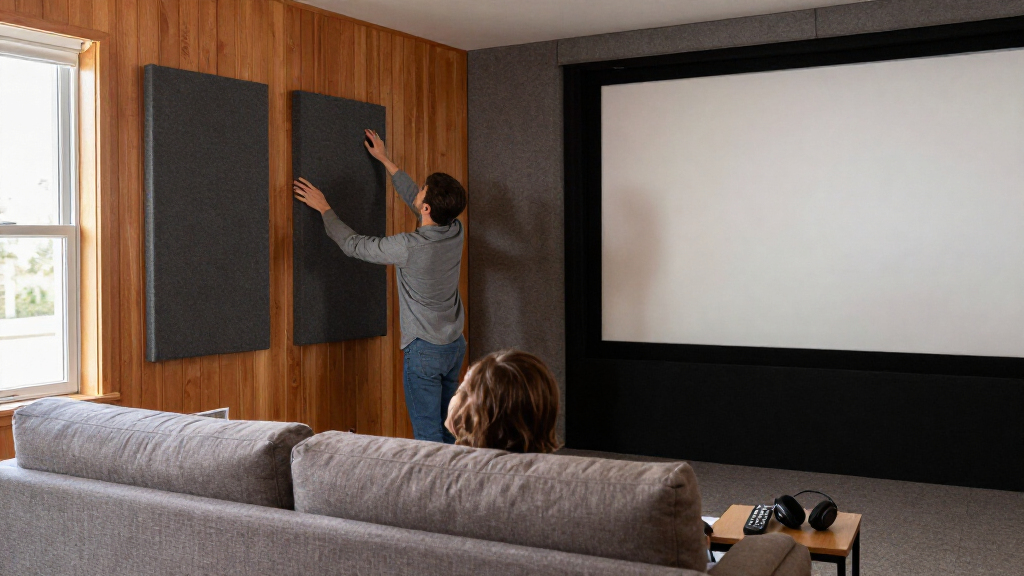
How We Picked
I ranked these 15 options for home-theater use by how well their stated format and materials fit common room needs: controlling reflections, treating enough wall area, and integrating with a viewing space. I gave weight to panel thickness and dimensions, material type, supplied adhesive or self-adhesive backing, and whether a product appears suited to broad coverage or targeted placement. I also separated sound absorption from sound isolation: a wall panel may reduce reflections inside the room, but product wording such as “soundproof” does not establish that it will stop sound passing through walls.
The order reflects a balance of acoustic-treatment potential, practical coverage, installation demands, and finish, rather than a claim that one material works best in every room. Thicker fiberglass options rank well for buyers prioritizing absorption, while large wood-slat panels earn a distinct place for buyers who need a more finished wall treatment. Foam kits rank higher when they offer useful flexibility or coverage for smaller budgets and spaces, but thin panels and limited product details keep them from leading the roundup. Where the supplied product information does not specify a performance rating or mounting details, I avoid treating those points as proven advantages.
Factors to Consider When Choosing Acoustic Panels For Home Theaters
Choosing panels starts with the room’s acoustic problem, not the product’s soundproofing language. I would decide what needs improvement, map the surfaces involved, then match panel material and installation method to the room’s use and appearance.
Separate Echo Control From Sound Isolation
Panels are generally used to absorb sound reflections within a room, which can help reduce flutter echo and make dialogue less smeared. They do not usually add the mass, sealed construction, or structural separation needed to keep subwoofer bass or loud sound from traveling to a neighboring room. If the main complaint is noise escaping through a shared wall, look at door gaps, wall construction, and other sound-isolation measures before buying decorative foam. A common mistake is choosing a panel labeled “soundproof” and expecting it to contain bass. Treating reflections and containing sound are different projects, and a theater may need separate solutions for each.
Plan Coverage Around Listening Positions
More panels are not automatically better; placement and the surfaces they cover affect the result. Start by identifying strong reflection areas on the side walls and, where appropriate, the wall behind the seating position. A first-reflection point is where sound from a speaker can bounce toward a listener, so treating selected zones can be more useful than covering every wall with thin material. Large panels can cover a broad area with fewer seams, while small squares allow a more adjustable pattern. Avoid blocking vents, access panels, speakers, or screen sightlines while laying out the treatment.
Match Material and Thickness to the Problem
Foam, fiberglass, and wood-slat products bring different combinations of absorption, finish, and installation requirements. Thicker absorbers are generally a more sensible place to start for meaningful reflection control than very thin decorative foam, but the exact result depends on construction and frequency performance. Foam can be light and easy to arrange; fabric-wrapped fiberglass offers a more finished face and a substantial panel format; slat panels emphasize a built-in architectural look. Do not infer bass absorption from a panel’s size or material name alone. If low-frequency buildup is your main issue, seek documented frequency data and room-specific bass treatment rather than relying on thin wall panels.
Check Mounting, Surface, and Long-Term Placement
Adhesive-backed products are convenient, but adhesive compatibility depends on the wall finish and the panel’s weight. Test a discreet area first, especially on painted drywall, wallpaper, or a surface that may be damaged when panels come down. Larger panels may need mounting hardware or a stable backing, and the product listing should clarify what is included. Adhesive can also limit repositioning, so use temporary placement methods or paper templates while planning a layout. If you rent or expect to rearrange the room, removable mounting options may matter more than shaving time off installation.
Balance Coverage With the Room’s Appearance
A theater is a living space as well as a listening room, so visible finish can affect how much treatment you are willing to install. Wood slats and fabric-wrapped panels can look more intentional than exposed foam, but a decorative surface does not automatically mean stronger absorption. Small foam tiles can be easier to fit around corners and equipment, though a patchwork layout may feel visually busy. Think about how the wall looks with the screen off and the room lights on, not only during a movie. When appearance is a priority, compare the full installed layout rather than judging one sample panel.
Buy to the Room, Not the Pack Count
Pack sizes can make one product appear to offer more value, but panel dimensions and usable coverage tell a clearer story. Calculate the area of the treatment zones you plan to cover and compare it with the panels’ stated dimensions, allowing for spacing and obstacles. Small pieces can be useful for custom layouts but may require more alignment and create more visible seams. Larger panels reduce piece count yet can be harder to handle and position alone. A phased approach—starting with the most reflective areas, then adding treatment after listening—can help avoid buying a large kit that over-treats the room.
Frequently Asked Questions
Will acoustic panels stop theater sound from reaching the next room?
Usually, no. These panels are intended mainly to manage reflections inside the theater, not to isolate the room from adjoining spaces. Sound isolation commonly involves sealing air gaps and adding mass or structural separation, particularly for low-frequency effects that pass through walls and floors. If sound leakage is the concern, inspect doors, vents, and shared-wall construction before choosing panels. Treating the room acoustically can improve listening even when it does not prevent sound transfer.
Should I cover every wall with panels?
Not as a default. Targeted treatment at strong reflection points can improve clarity without making the room overly damped or covering every available surface. Start with the side-wall areas around the main seating position and listen before adding more. The right amount depends on room size, furnishings, speakers, and how reflective the existing surfaces are. A layout plan is more useful than choosing a kit solely because it contains many pieces.
Are thin self-adhesive foam tiles enough for a home theater?
They can be useful for light, targeted treatment or for experimenting with placement, but thin tiles should not be treated as a full-room solution. Their small size may also mean more seams and a less finished appearance than larger panels. For stronger reflection control, compare thickness, material, coverage, and any available acoustic performance information. If you choose adhesive tiles, check wall compatibility and plan for the possibility that removal could affect paint.
Are wood-slat panels a better choice than foam?
They are better for some priorities, not all. Wood-slat options in this roundup offer a more decorative, broad-panel format, while foam kits are lighter and often easier to arrange in small or irregular areas. A slatted appearance alone does not tell you how much sound a panel absorbs, so look for construction and performance details rather than assuming it will outperform foam. Choose slats when the finished wall matters strongly; choose foam when flexible placement and simpler handling are higher priorities. Either option may need to be combined with other treatment for a balanced room.
How do I choose between a large panel and a multi-piece kit?
Begin with the shape of the wall area you want to treat. Large panels can cover broad sections with fewer joints, but they may be awkward around doors, speakers, and equipment. Multi-piece kits provide layout flexibility and can fit around obstacles, though installation takes more measuring and repeated alignment. Compare total stated coverage rather than piece count, and check whether mounting supplies are included. If you are uncertain about placement, a smaller, adjustable layout can be a safer first step than committing to a large fixed arrangement.
Conclusion
For the broadest fit, I would start with the Olanglab 2-inch fiberglass panels as the best overall choice, especially when reflection control matters more than a decorative slat finish. For a more design-led theater wall, the NeatiEase wood slat panels are my best premium-style pick, while the Focusound 52-pack is the best value-style option for buyers who want many small pieces and flexible placement. Beginners who want straightforward, smaller-scale treatment can look at the self-adhesive foam panels, with the caveat that thin foam is not a substitute for isolation or substantial absorption. For a specific need—covering broader wall areas with a finished look—compare the larger wood-slat and fabric-wrapped panel formats, then check mounting requirements and actual coverage before choosing. Match the treatment to the room’s acoustic problem first; choose the finish and pack format second.
Halloween Picks
halloween
As an affiliate, we earn on qualifying purchases.