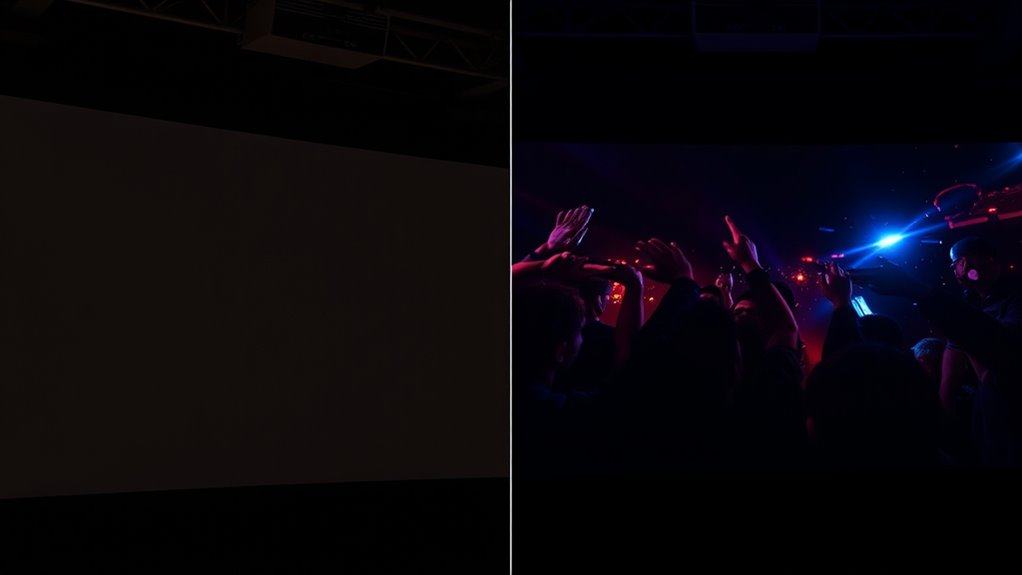
Contrast ratio is key to how well your projector distinguishes blacks from whites, affecting the overall picture quality. A high contrast ratio means deeper blacks, brighter whites, and more vivid images, making scenes look more realistic and immersive. It improves detail in shadows and enhances color accuracy, especially in well-lit environments. If you’re interested in achieving vibrant, sharp visuals, understanding why contrast really matters will help you make better choices — keep exploring to learn more.
Key Takeaways
- Contrast ratio measures how well a projector displays blacks versus whites, affecting image depth and realism.
- Higher contrast ratios enable better visibility in bright environments and improve shadow detail.
- They enhance color accuracy and vibrancy by distinguishing subtle luminance differences.
- A good contrast ratio contributes to sharper images with richer blacks and brighter highlights.
- Considering contrast ratio alongside brightness and color accuracy ensures optimal overall image quality.
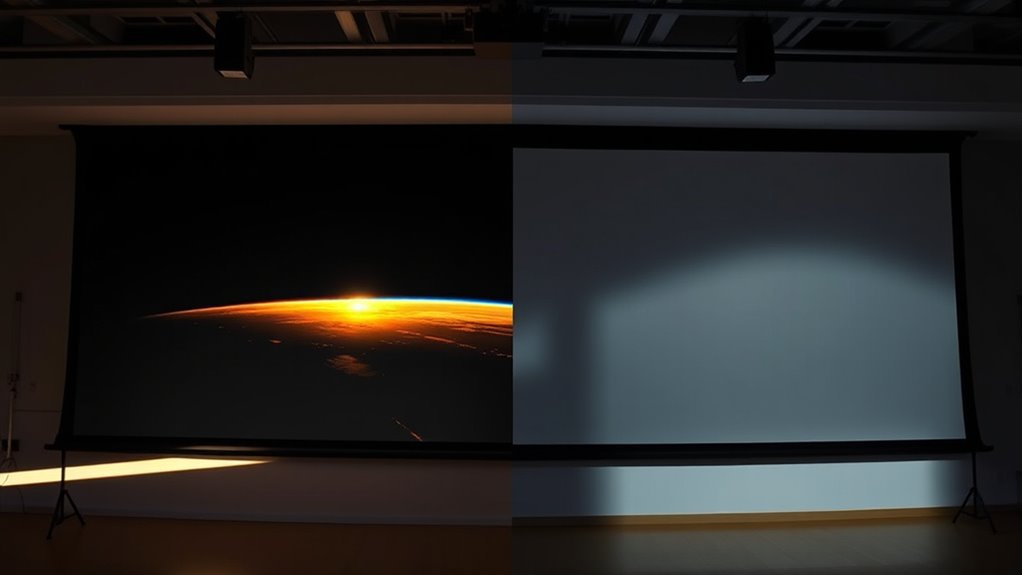
Contrast ratio is a key measurement that shows how well a display can distinguish between the darkest blacks and the brightest whites. When selecting a projector, understanding contrast ratio helps you anticipate how vibrant and realistic your images will appear. A higher contrast ratio means the projector can produce deeper blacks and brighter whites, which directly impacts brightness levels and color accuracy. If you’re watching movies or giving presentations, these factors matter because they influence how vivid and true-to-life the images look.
Understanding contrast ratio helps you choose a projector that delivers vibrant, true-to-life images with deep blacks and bright whites.
Brightness levels are essential because they determine how clearly you can see the picture in different lighting conditions. A projector with a high contrast ratio can better handle ambient light, making the picture appear more vibrant and detailed even in a well-lit room. When contrast is low, images tend to look washed out or dull, since the distinction between bright and dark areas isn’t sharp enough. This is especially noticeable in scenes with a lot of shadows or dark backgrounds. If you want your viewing experience to be immersive and crisp, aim for a projector with a high contrast ratio and sufficient brightness levels to match your environment.
Additionally, visual perception plays a vital role in how our eyes interpret differences in luminance and color, emphasizing why contrast ratio is so important for realistic images.
Color accuracy is another critical aspect that’s closely linked to contrast ratio. When a display has a high contrast ratio, it can reproduce colors more precisely because it can differentiate subtle variations in shading. This means your reds, greens, and blues will look more vivid and true to their source, without appearing oversaturated or washed out. Accurate color rendering enhances the realism of your images, whether you’re watching movies, playing games, or giving presentations. The combination of good contrast and accurate coloring ensures that your visuals are not only bright and lively but also true to life.
In essence, the contrast ratio influences both brightness levels and color accuracy, shaping how vibrant, detailed, and realistic your images appear. A high contrast ratio allows for better differentiation between light and dark areas, giving you richer blacks and more luminous whites. This balance makes your viewing experience more engaging and visually pleasing, especially in environments where controlling ambient light isn’t possible. When shopping for a projector, pay attention to the contrast ratio, but also consider how it interacts with brightness levels and color accuracy. Together, these elements determine how well your projector can deliver sharp, lively images that bring your content to life.

ONOAYO Outdoor-Projector-4K with AI Auto Focus,50WDolby Audio,Built-in Apps
- Built-in Streaming Apps: Compatible with Netflix, YouTube, Prime Video
- Smart TV OS 2.0: Faster performance with AI-driven algorithms
- Quick Boot & Response: Instant startup and app switching
As an affiliate, we earn on qualifying purchases.
As an affiliate, we earn on qualifying purchases.
Frequently Asked Questions
How Does Ambient Light Affect Contrast Ratio Performance?
Ambient light reduces your projector’s contrast ratio performance by washing out the image, making darks appear less deep. When there’s too much ambient light, your contrast perception suffers because the bright surroundings diminish the difference between light and dark areas on the screen. To get the best contrast ratio, you should control ambient light by dimming lights or using a darker room, ensuring your projector’s contrast is more vivid and accurate.
What Is the Ideal Contrast Ratio for Home Theater Projectors?
You should aim for a contrast ratio of at least 10,000:1 for your home theater projector to guarantee vibrant images. Many contrast ratio myths suggest higher ratios always mean better quality, but projector brightness also plays a vital role. A balanced contrast ratio enhances depth and clarity, especially in darker scenes. Don’t fall for myths—focus on a good mix of contrast and brightness for the best cinematic experience.
Can Contrast Ratio Improve With Projector Calibration?
Yes, you can improve contrast ratio with projector calibration. Using calibration techniques like adjusting brightness, contrast, and gamma settings helps optimize contrast enhancement. Properly calibrating your projector minimizes ambient light interference and enhances blacks, making images more vivid. This process allows you to achieve a better contrast ratio, delivering sharper details and richer colors, ultimately improving your overall viewing experience. Regular calibration ensures your projector performs at its best over time.
How Does Contrast Ratio Impact Color Accuracy?
A higher contrast ratio enhances color accuracy by increasing color vibrancy and display depth, making images look more realistic and vivid. When contrast is strong, dark areas are richer, and bright colors pop, giving you a more immersive viewing experience. This improved contrast helps your projector produce sharper, more precise colors, ensuring you see true-to-life visuals with better detail, especially in scenes with subtle shading or complex color schemes.
Is a Higher Contrast Ratio Always Better for Projection Quality?
A higher contrast ratio isn’t always better for projection quality because it mainly affects image depth and how vivid the picture appears. If your projector has excellent projection brightness, a slightly lower contrast ratio might still deliver sharp, colorful images. Focus on balancing contrast ratio with brightness to ensure your projections are clear, vibrant, and visually engaging without compromising overall image quality.
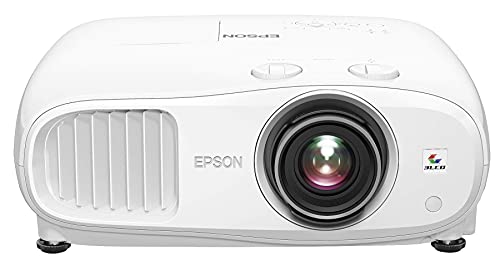
Epson Home Cinema 3800 4K PRO-UHD 3-Chip 3LCD Projector with HDR Technology
- Projection Technology: 4K PRO-UHD with advanced image processing
- Color Accuracy: True 3-chip 3LCD design for vibrant colors
- Resolution Processing: 4K pixel-shifting for detailed images
As an affiliate, we earn on qualifying purchases.
As an affiliate, we earn on qualifying purchases.
Conclusion
Understanding contrast ratio is your secret weapon for stunning visuals. When you choose a projector with the right contrast, it’s like turning your room into a cinematic universe where every detail pops with jaw-dropping clarity. Don’t settle for dull, lifeless images—think of contrast as the magic that transforms a simple picture into a vivid masterpiece. Master this concept, and you’ll never settle for less than breathtaking visuals again. Your audience will be wowed every time!

【360°Adjustable Stand & Native 1080P】Thinnest 1.81" Smart Mini Projector with WiFi and Bluetooth, Auto Focus & Keystone Portable Outdoor Projector, VOPLLS 4K Support Home Movie Projector(Deep black)
- Sleek and Portable Design: Compact, lightweight, stylish projector
- Fast Auto Focus & Keystone Correction: Auto focus in 5 seconds, 6D keystone correction
- 360° Adjustable Stand: Tool-free, rotatable stand for versatile projection
As an affiliate, we earn on qualifying purchases.
As an affiliate, we earn on qualifying purchases.

Rossetta 3D Projector with 60 Scenes, Galaxy Star Projector for Room Decor
- 4-in-1 Design: 3D projector, ambient light, night light, Bluetooth speaker
- Immersive 3D Visuals: Rich color saturation with deep spatial depth
- 60 Scenes & 12 Themes: High-definition projections for various moods
As an affiliate, we earn on qualifying purchases.
As an affiliate, we earn on qualifying purchases.