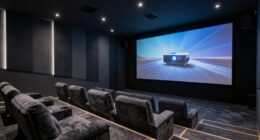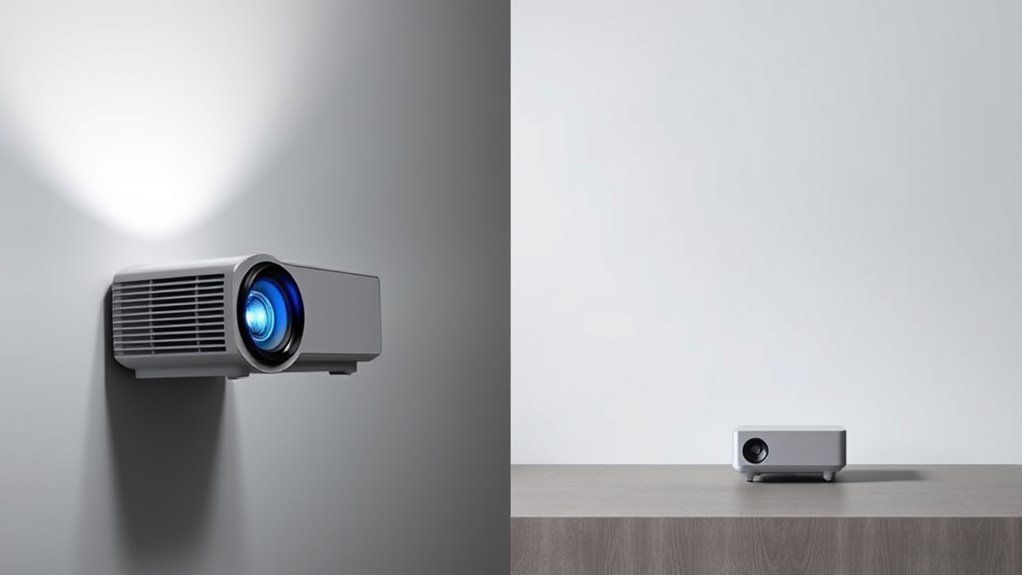
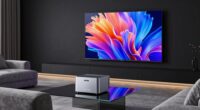
Ultra-short throw projectors sit just inches from the wall or screen, making them ideal for small spaces and quick setups. Short throw models need a few feet of distance to project a large image, requiring more room to position properly. This placement difference affects space use, installation effort, and performance. If you want to know how these differences impact your setup, keep exploring how each option fits your specific room.
Key Takeaways
- UST projectors sit inches from the wall, while short throw models require several feet of distance.
- UST models simplify setup by needing minimal space behind the device, unlike short throw projectors.
- Placement of UST projectors allows for larger images in small rooms; short throw projectors need more room for similar sizes.
- UST projectors are ideal for cramped spaces, whereas short throw projectors need dedicated area planning.
- Proper placement impacts image quality and performance for both ultra-short and short throw projectors.
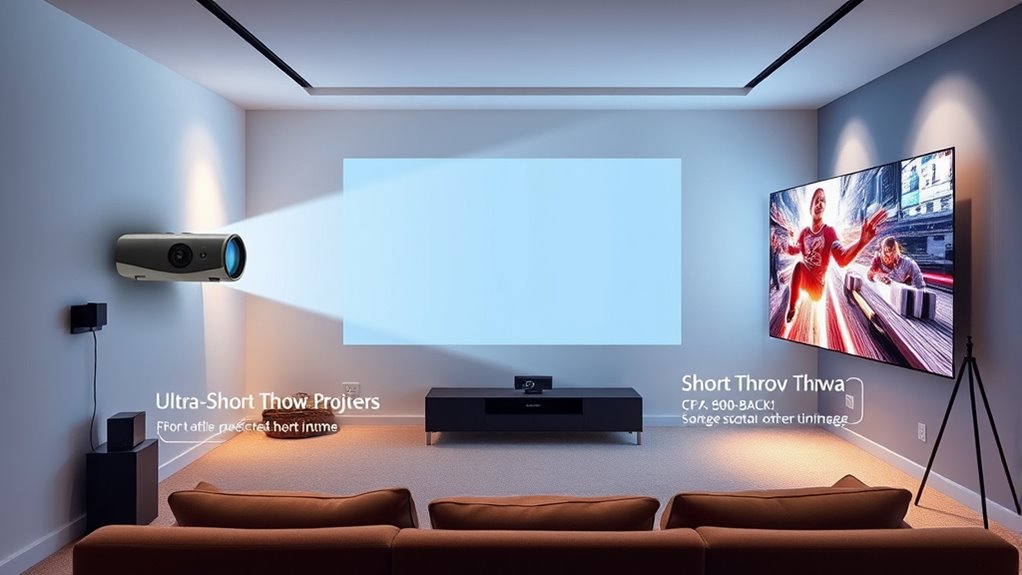
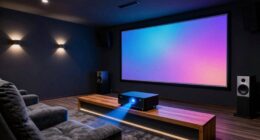
When choosing a projector, understanding the placement differences between ultra-short throw and short throw models is vital. Your decision will profoundly impact the screen size you can achieve and how complex the installation process will be. Ultra-short throw projectors are designed to sit very close to the wall or screen, often just inches away, which allows for larger images without requiring a long throw distance. This proximity means you can project a sizable screen even in tight spaces, making them ideal for smaller rooms or setups where space is limited. In contrast, short throw projectors need a bit more distance from the wall—typically a few feet—to produce a comparable screen size. This additional space provides a larger projection area but requires more room to set up properly.
The placement of ultra-short throw projectors minimizes the amount of space needed behind the device, which simplifies installation in cramped environments. You can place it on a low table right near the wall, reducing the need for complicated mounting setups or extensive wiring. This makes ultra-short throw models particularly attractive for home theaters or classrooms where space is at a premium. On the other hand, short throw projectors will require a dedicated area at a specific distance from the screen, which can involve more planning and effort during installation. You might need to mount it securely on a ceiling or place it on a sturdy stand, and this can increase the installation complexity, especially if adjustments are needed for ideal image quality. Additionally, the performance capabilities of these projectors can vary depending on their placement, so understanding their technical specifications is crucial to achieving optimal results.
Screen size plays a vital role when choosing between the two. Ultra-short throw projectors excel at producing large images from extremely close distances, which can be a game-changer if you want a cinema-like experience in a small room. Short throw models can still generate sizable screens but require more space to do so, meaning you’ll need to consider your room dimensions carefully. If your room is small and you want a big screen, ultra-short throw is usually the better choice because it offers impressive screen sizes with minimal installation hassle. Conversely, if you have a larger room or prefer a more flexible setup, a short throw projector might be preferable, even if it entails a slightly more complex installation process.

Philoent【Google TV Included】Smart Mini Projector, Ultra Short Throw for Big Screen in Small Room, Auto Keystone Portable Proyector with WiFi Bluetooth, Support 4K Movie – Home Theater Bedroom Outdoor
🥇【Instant Full Google TV Access – No Setup Needed】 Experience the complete Google TV ecosystem directly, with no…
As an affiliate, we earn on qualifying purchases.
As an affiliate, we earn on qualifying purchases.
Frequently Asked Questions
Can Ultra-Short Throw Projectors Be Used on Curved or Uneven Walls?
Yes, ultra-short throw projectors can work on curved or uneven walls, but wall surface and projector alignment are essential. You’ll want to make certain the projector is properly aligned to avoid distortion or shadows. Curved or uneven surfaces may affect image clarity, so consider using a flat, smooth wall for the best picture. Adjusting the projector’s position and settings helps optimize the image quality on challenging wall surfaces.
What Are the Maintenance Differences Between Ultra-Short and Short Throw Projectors?
You’ll find that ultra-short throw projectors generally require less maintenance than short throw models. You should regularly perform maintenance procedures like cleaning dust filters to prevent overheating and guarantee peak performance. Short throw projectors might need more frequent filter cleanings due to their placement and proximity to dust sources. Both types benefit from routine checks of lens cleanliness and occasional firmware updates, but ultra-short throw projectors often have simpler upkeep overall.
Do Placement Differences Affect Projector Lifespan or Durability?
Placement impact can influence projector longevity, but the effect varies. Did you know that improper placement might cause heat buildup or dust accumulation, reducing durability? For ultra-short throw and short throw projectors, correct positioning ensures ideal airflow and cooling, extending lifespan. Poor placement may lead to more wear and tear over time, so paying attention to your projector’s position helps maintain its performance and prolongs its durability.
How Does Room Size Influence Choosing Between Ultra-Short and Short Throw Projectors?
Room size influences your choice between ultra-short throw and short throw projectors because larger rooms often benefit from short throw models that need more space for placement. Small rooms are ideal for ultra-short throw projectors, which can sit very close to the wall. Also, consider wall material; smooth, flat surfaces improve image quality. So, measure your room size and wall type to select the best projector for your space.
Are There Specific Content Types Better Suited for Ultra-Short or Short Throw Projectors?
While some content types shine brighter on ultra-short throw projectors, their versatility makes them appropriate for a wide range of media. If you’re streaming movies or gaming, ultra-short throws offer a seamless experience with minimal setup. For presentations or detailed visuals, short throw projectors excel, providing crisp clarity. Overall, both projectors adapt well, but choosing based on content suitability ensures you get the best visual impact for your specific needs.
Philoent【Google TV Included】Smart Mini Projector, Ultra Short Throw for Big Screen in Small Room, Auto Keystone Portable Proyector with WiFi Bluetooth, Support 4K Movie – Home Theater Bedroom Outdoor
🥇【Instant Full Google TV Access – No Setup Needed】 Experience the complete Google TV ecosystem directly, with no…
As an affiliate, we earn on qualifying purchases.
As an affiliate, we earn on qualifying purchases.
Conclusion
Choosing between an ultra-short throw and a short throw is like selecting the right brush for a painting—you need the perfect tool to create your masterpiece. Ultra-short throws sit almost flush against the wall, ideal for tight spaces, while short throws give you more flexibility with placement. Understanding these differences helps you craft your perfect viewing experience, transforming your room into a personal cinema. With the right projector, your space becomes a canvas for unforgettable moments.

BAISHUN Projector Stand, Wall and Mini Ceiling Mount with 1/4-Inch Thread, 360-degree Rotation, Adjustable Tilt & Swivel, Foldable, Easy Setup Compatible with Most Projectors for Home, Office
Rock-Solid Stability: Heavy-duty metal construction, supports up to 4.4 lbs (2kg) with zero shaking, stays secure and steady…
As an affiliate, we earn on qualifying purchases.
As an affiliate, we earn on qualifying purchases.
projector screen for small room
As an affiliate, we earn on qualifying purchases.
As an affiliate, we earn on qualifying purchases.