Many new projector buyers believe that choosing a high-gain screen will automatically make their picture brighter and better. But that’s a misconception. Higher gain screens reflect more light, which can mean a brighter image, but they also focus light directionally—so viewers off to the side may see washed-out images. Factors like ambient light and room setup matter just as much. To truly understand what works best for your space, keep exploring the details ahead.
Key Takeaways
- Higher gain screens do not always produce clearer or better images; environmental factors and room lighting are crucial.
- Gain affects brightness and viewing angles but does not guarantee improved image quality in all settings.
- Overemphasizing gain can lead to poor viewing experiences in bright rooms or for off-center viewers.
- Proper screen choice depends on balancing gain with ambient light conditions, not just aiming for the highest gain.
- Misunderstanding gain’s role can cause buyers to overlook essential factors like room lighting and seating arrangements.
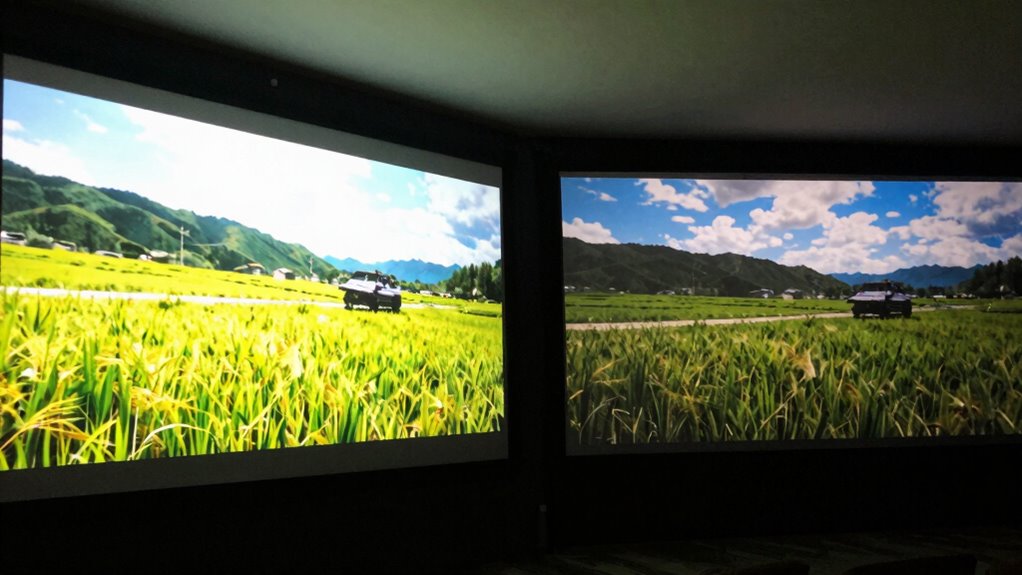
Have you ever wondered if screen gain really makes a difference in your viewing experience? Many new projector buyers hear about screen gain and assume it’s the key to better picture quality. But the truth is, understanding how screen gain interacts with your projection surface and ambient light can be more nuanced than simply choosing a high-gain screen. The idea that higher gain always equals a brighter, clearer image is a common misconception. In reality, the effectiveness of a projection surface’s gain depends heavily on your environment and how you plan to use your projector.
Screen gain impacts image quality more than you might think; matching it to your room and lighting is key.
A projection surface’s gain measures how much light it reflects compared to a standard matte white screen, which has a gain of 1.0. Higher gain screens, such as 2.0 or above, reflect more light and produce a brighter image, but they also tend to be more directional. That means if you’re not sitting directly in front of the screen, your picture can appear washed out or uneven. Conversely, lower gain screens, around 0.8 or less, spread light more evenly, offering a wider viewing angle but potentially sacrificing some brightness. This interplay becomes essential in rooms with ambient light, which can wash out images regardless of gain.
If you have a room with lots of ambient light, some might think a high-gain screen will solve all brightness issues. But in reality, adding more ambient light complicates things. Bright rooms require careful consideration of both the projection surface and ambient lighting conditions. A high-gain screen might seem like the solution, but it can cause glare and hot-spotting, making parts of the image overly bright while other areas appear dull. On the other hand, a matte or low-gain surface can help diffuse the light, reducing glare and providing a more uniform picture, especially when you can’t control the ambient light. Additionally, understanding the light reflectivity of your screen can help you make a more informed choice tailored to your specific space.
Choosing the right projection surface involves understanding the light environment of your room, which can significantly influence your overall viewing experience. It’s tempting to believe that simply increasing screen gain will improve your experience, but this overlooks the importance of matching your projection surface to your environment. Instead of fixating on gain alone, consider your room’s lighting, seating arrangement, and viewing angles. The visual comfort offered by a suitable screen gain, in conjunction with controlling ambient light, will give you a more satisfying viewing experience. Remember, the goal isn’t just a brighter picture but a clear, evenly lit image that suits your space. Properly managing ambient light and selecting an appropriate screen gain can significantly enhance your viewing quality. Being aware of the projection surface’s characteristics and how they interact with your room’s conditions can help you make better decisions for your setup.

Outdoor Projector Screen 80 Inch, 16:9, High Gain, Projector Screen with Stand, Wind-resistant Design for Portable Projection Screen Outdoor, With Ropes and Spikes, 4K Image for Home Theater, Camping.
High Gain Outdoor Projector Screen. The screen is rolled up and stored in storage tube, so that it…
As an affiliate, we earn on qualifying purchases.
As an affiliate, we earn on qualifying purchases.
Frequently Asked Questions
How Does Screen Gain Affect Image Brightness in Different Room Conditions?
Screen gain directly impacts image brightness depending on your room conditions. Higher gain screens reflect more light, making images brighter in controlled lighting, but may reduce viewing angles. Conversely, lower gain screens offer broader viewing angles but produce less brightness. Your choice of screen material influences this balance. In bright rooms, a higher gain screen boosts brightness, while in darker spaces, a lower gain screen guarantees even brightness across various viewing angles.
Is Higher Screen Gain Always Better for Projector Images?
Higher screen gain isn’t always better for projector images. It can make the image brighter, but it also narrows viewing angles, meaning you’ll lose picture quality if you’re off-center. Consider your screen material and room layout; a lower gain screen offers wider viewing angles and better color accuracy in large or multi-seat setups. Always match screen gain to your room conditions and viewing preferences for the best experience.
Can Screen Gain Influence Color Accuracy and Contrast?
Think of screen gain like a pair of glasses—higher gain can boost brightness but may distort color accuracy. Yes, it can influence color consistency and contrast enhancement; a high-gain screen might reflect light unevenly, causing color shifts. You risk losing detail in bright or dark areas. For balanced color and contrast, choose a screen with moderate gain, ensuring your images stay true and vibrant across the entire projection.
How Do Ambient Light Levels Interact With Screen Gain Choices?
Ambient light levels considerably impact your screen gain choice. In bright rooms, a high-gain screen boosts brightness and contrast, making images clearer, but it may cause viewing angle issues and highlight imperfections, which affects screen durability and installation challenges. Conversely, low-gain screens work better in darker environments, offering wider viewing angles. You need to balance ambient light with your screen’s gain to optimize image quality while considering installation ease and durability.
Are There Specific Projector Types Better Suited for High or Low Gain Screens?
You should choose a high gain screen if your projector has limited brightness or you’re in a well-lit room, as it amplifies the image, but keep in mind the narrow viewing angles. Low gain screens work better with projectors that have high lumen output, providing wider viewing angles and consistent brightness across different positions. Selecting the right screen material and considering your viewing angles guarantees the best image quality in your environment.

AAJK ALR Projector Screen, 4K Movie Projector Screen 16:9 HD Foldable Anti-Crease Portable Projector, Movies Screen for Home Theater Outdoor Indoor Support (120in Pro)
【Watch What You Want, When You Want!】 Remember when you could only really use your projector at night?…
As an affiliate, we earn on qualifying purchases.
As an affiliate, we earn on qualifying purchases.
Conclusion
Don’t let the screen gain myth fool you. Imagine you’re setting up a home theater, expecting a brighter picture by choosing a high-gain screen. But instead, the image becomes overly reflective and harsh, ruining your viewing experience. Remember, understanding that screen gain affects brightness and contrast—not just brightness alone—can save you from costly mistakes. By choosing the right gain for your space, you’ll enjoy crisp, vivid images without disappointment.
matte white projector screen
As an affiliate, we earn on qualifying purchases.
As an affiliate, we earn on qualifying purchases.
wide angle projector screen
As an affiliate, we earn on qualifying purchases.
As an affiliate, we earn on qualifying purchases.