
Place your surround speakers slightly behind and to the sides of your seating area, aiming for a 90 to 110-degree angle for the side surrounds and 135 to 150 degrees for rear surrounds. Keep them at or near ear level when seated, and avoid placing them too close to walls to prevent reflections. Angling speakers downward or toward the listening position helps create an immersive environment. To find out more tips for perfect placement, keep exploring these setup strategies.
Key Takeaways
- Position surround speakers slightly behind and to the sides of the seating area at a 90 to 110-degree angle.
- Mount wall speakers 1-2 feet above ear level, angling downward toward the listening position.
- Place rear surround speakers at 135 to 150 degrees behind and to the sides of the seating area.
- Keep speakers at ear level when seated and avoid placing them too close to walls to prevent reflections.
- Use calibration and test audio to fine-tune speaker angles and positions for optimal immersion.

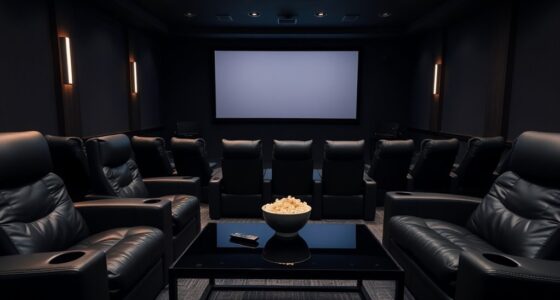
When setting up a projector for your home theater or presentation space, the speaker layout plays a vital role in delivering immersive sound. Your goal is to create a surround sound environment that makes you feel like you’re part of the action, and that starts with understanding surround sound placement. Proper placement of your surround speakers ensures that sound wraps around you seamlessly, without gaps or dead zones. To achieve this, focus on optimal speaker positioning, which involves careful placement relative to your seating area and screen.
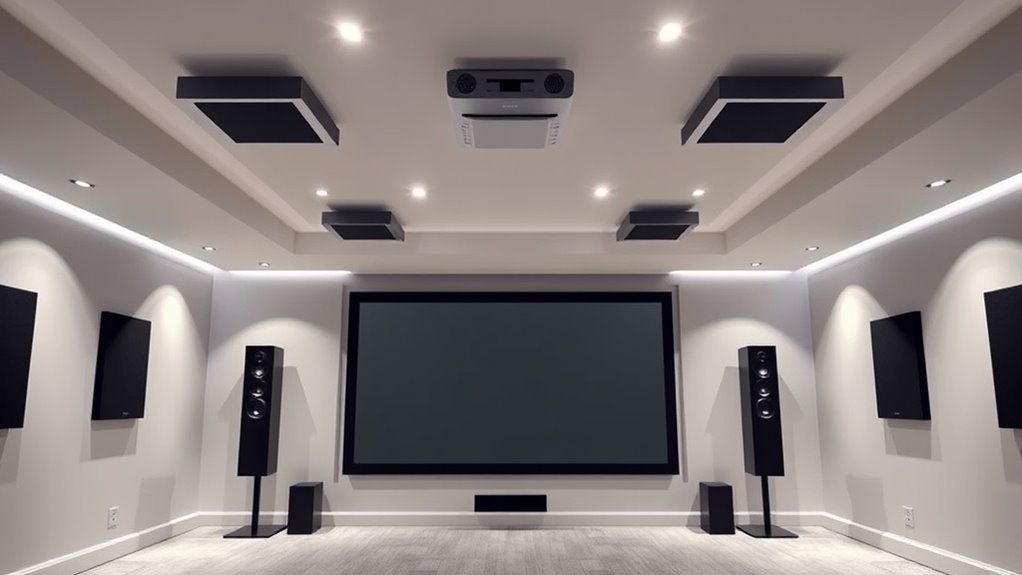
Begin by positioning your surround speakers slightly behind and to the sides of your seating area. Ideally, they should be at ear level when you’re seated, which helps in delivering clear, direct sound. If you’re using wall-mounted speakers, place them about 1 to 2 feet above ear level, angling them downward slightly toward the listening position. For floor-standing or in-ceiling speakers, aim to keep them at a similar height to maintain consistency in sound delivery. The key is to avoid placing surround speakers too close to the walls, as this can cause sound reflections that muddy audio clarity.
In terms of surround sound placement, the general guideline is to position the side surround speakers at a 90 to 110-degree angle relative to your main listening position. This placement creates an enveloping sound field that feels natural and immersive. Rear surrounds, if you have them, should be placed slightly behind and to the sides of your seating, around 135 to 150 degrees from your primary viewing spot. Keep in mind that the distance between speakers and your seating area should be balanced; too far apart, and the soundstage becomes disjointed, too close, and the sound may feel congested. Additionally, considering speaker calibration can help optimize sound quality after setup.
Adjustments after initial setup are crucial. Play some test audio and walk around your space to identify any dead spots or areas where sound seems weak. Fine-tune the angles and height of your surround speakers to fill those gaps. Remember, the goal of optimal speaker positioning is to create a seamless, three-dimensional sound environment that enhances your visual experience without drawing attention to the speakers themselves.
surround sound speaker wall mounts
As an affiliate, we earn on qualifying purchases.
As an affiliate, we earn on qualifying purchases.
Frequently Asked Questions
How Do Room Shape and Size Affect Speaker Placement?
Room shape and size critically impact your speaker placement because they influence room acoustics and sound distribution. Larger or irregularly shaped rooms may require more careful positioning to avoid sound distortion, while smaller spaces can cause sound reflections. You should calibrate your speakers accordingly, adjusting placement based on room dimensions, to optimize acoustics and guarantee balanced sound. Proper placement enhances your listening experience, making calibration easier and more effective.
What Are the Best Speaker Types for Different Room Layouts?
Wireless speakers often work best in open spaces, providing flexible placement without clutter. For wall-mounted options, go for compact, slim designs that blend seamlessly into your room’s decor, especially in smaller or irregularly shaped rooms. Larger rooms benefit from traditional bookshelf or floor-standing speakers for better sound distribution. Testing different types helps you find the ideal mix, ensuring immersive audio regardless of your room’s layout.
How Can I Optimize Sound for Irregular or Asymmetrical Rooms?
To optimize sound in irregular or asymmetrical rooms, start by addressing soundproofing challenges and minimizing furniture interference. Use flexible speaker placement, like wall mounts or adjustable stands, to find the best spots where sound is clear and balanced. Experiment with speaker angles and distances, ensuring they’re not blocked by furniture. Adding acoustic panels or rugs can also help absorb unwanted sound reflections, creating a more immersive experience.
What’s the Ideal Distance Between Surround Speakers and the Listening Area?
You should position your surround speakers about 1 to 2 meters (3 to 6 feet) from your listening area for ideal sound. During speaker calibration, guarantee they’re angled slightly toward you to minimize sound reflection and improve clarity. Keep the distance consistent on both sides to create a balanced soundstage, which enhances immersion. Proper placement reduces echo and reflection, giving you clearer, more accurate surround sound.
How Do Ceiling Height and Speaker Height Influence Placement?
Think of your room as a symphony, where ceiling height considerations set the stage. If ceilings soar, you should make speaker height adjustments to guarantee sound flows seamlessly. Position surround speakers slightly above ear level, aligning with the natural direction of sound. This creates an immersive experience, as the elevated placement complements the room’s vertical space, making audio feel like it’s enveloping you from all directions.
home theater surround speakers
As an affiliate, we earn on qualifying purchases.
As an affiliate, we earn on qualifying purchases.
Conclusion
Imagine your home theater as a symphony, each speaker playing its part perfectly. When you place your surround speakers thoughtfully, you create an immersive experience that transports you right into the action. I once set up a system where positioning the speakers just right made my living room feel like a private cinema. With the right layout, you’ll reveal that same magic—turning ordinary movie nights into unforgettable adventures.
in-ceiling surround speakers
As an affiliate, we earn on qualifying purchases.
As an affiliate, we earn on qualifying purchases.
projector speaker calibration kit
As an affiliate, we earn on qualifying purchases.
As an affiliate, we earn on qualifying purchases.