
8K projectors offer stunning clarity and detail that can elevate your viewing experiences, but your eyes might not fully notice the difference beyond a certain point. Modern technology has advanced to deliver ultra-realistic images, yet human visual limits mean some enhancements could be imperceptible. If you want to discover whether your eyes can truly keep up with this stunning leap, there’s more about what’s behind the technology waiting for you.
Key Takeaways
- Human eyes have limited ability to perceive the enhanced detail of 8K resolution, with diminishing perceptible benefits beyond a certain point.
- 8K projectors deliver ultra-sharp images, but require high-quality content and advanced processing hardware to realize their full potential.
- Technological advances in lenses and image processing are making 8K projection more realistic, immersive, and visually striking.
- The true benefit of 8K depends on viewing distance, screen size, and individual visual acuity.
- Future developments will continue to push visual realism, but individual perception and content quality remain critical factors.

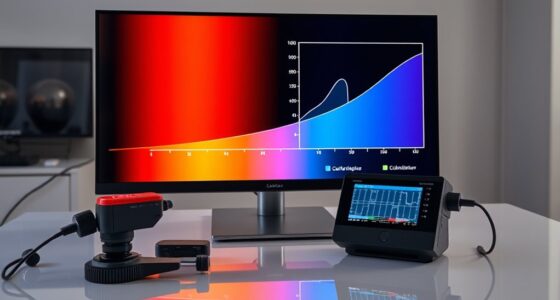
8K projectors represent the latest leap in display technology, delivering incredibly detailed and sharp images that bring movies, games, and presentations to life like never before. This breakthrough hinges on advancements in projection technology and an increase in display resolutions, pushing visual fidelity to unprecedented levels. When you consider 8K, you’re looking at a resolution of 7680 by 4320 pixels—four times the number of pixels found in 4K. This leap in resolution means every image appears more detailed, more realistic, and more immersive. For you, this translates into viewing experiences with virtually no visible pixelation, even up close. But it’s not just about adding more pixels; it’s about how projection technology handles this increased data. Higher resolution demands more powerful projectors capable of processing and projecting such detailed images without lag or loss of quality.
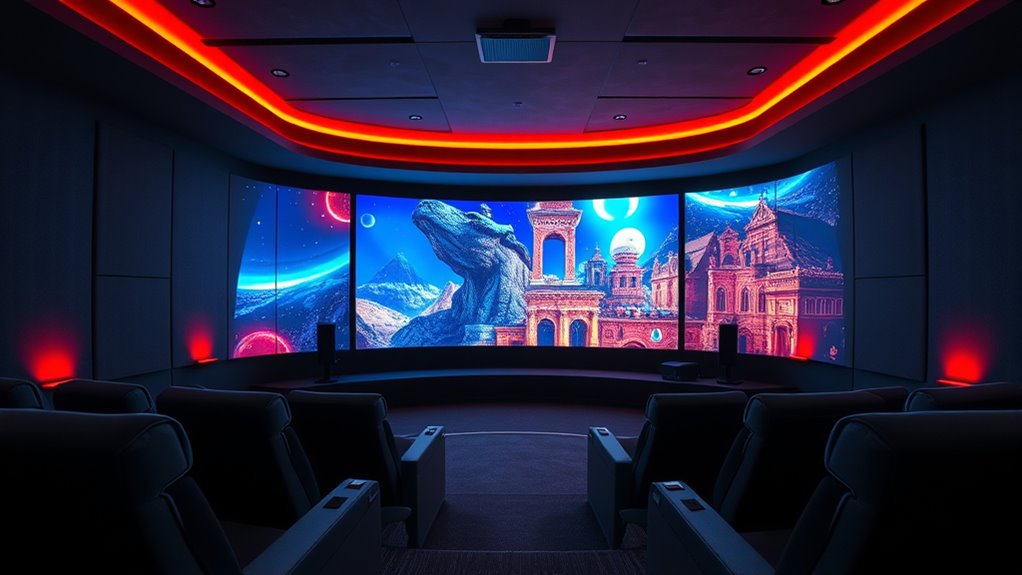
As you explore 8K projectors, you’ll notice that advancements in projection technology have become essential for harnessing this resolution. Modern projectors use sophisticated lenses, better light sources, and enhanced image processing algorithms to deliver crisp images at this high resolution. The display resolutions of 8K projectors are designed to maximize detail and minimize artifacts, ensuring that every scene, every frame, is rendered with precision. This means you can enjoy films with incredible clarity, whether you’re watching a blockbuster or a nature documentary. Gaming and virtual experiences also benefit from 8K, offering an ultra-realistic environment that pulls you deeper into the action. Additionally, the development of high-resolution content is crucial for fully appreciating the capabilities of 8K projection.
However, it’s worth questioning whether your eyes are ready for such a leap. While the technology exists and is rapidly improving, your visual acuity also plays a role. The human eye has limits, and at a certain point, increased resolution offers diminishing returns. Still, if you’re an enthusiast, a professional, or someone who demands the best possible image quality, 8K projectors can elevate your viewing experience considerably. They demand high-quality content and powerful processing hardware, but they reward patience with stunning visuals that make the most of the latest projection technology.
In essence, 8K projectors are not just about bigger numbers—they’re about pushing the boundaries of visual realism. As display resolutions continue to evolve, so will your ability to experience entertainment at a whole new level. Whether your eyes are ready depends on your expectations and your willingness to embrace cutting-edge technology. But one thing’s clear: the future of projection is incredibly bright, detailed, and immersive, and 8K projectors are leading the way there.
Frequently Asked Questions
How Does 8K Resolution Impact Gaming Performance?
8K resolution can enhance your gaming experience with sharper visuals and better color accuracy, but it also presents latency challenges. You might notice slower response times if your hardware struggles to process the high data load, affecting gameplay fluidity. To fully enjoy 8K gaming, guarantee your system is optimized for high performance, reducing latency and maximizing color accuracy for a truly immersive experience.
Are 8K Projectors Suitable for Outdoor Use?
Yes, 8K projectors can be suitable for outdoor use if they have good outdoor durability and weather resistance. You’ll want a model specifically designed to withstand elements like rain, dust, and temperature changes. Look for features such as sealed enclosures, weatherproof housing, and robust cooling systems. With these qualities, you can enjoy stunning 8K visuals outdoors without worry about weather damage or durability issues.
What Are the Energy Consumption Differences Between 4K and 8K Projectors?
Your eyes might think 8K projectors are a spectacle, but their power consumption is particularly higher than 4K models. 8K projectors typically use more energy, making them less energy-efficient overall. While 4K projectors balance quality and power use well, 8K units demand more electricity, which could lead to higher operational costs. If energy efficiency matters, stick with 4K unless you crave the ultimate ultra-high-definition experience.
How Does 8K Content Availability Compare to 4K?
You’ll find that 8K content availability is still limited compared to 4K due to content scarcity and production challenges. While 4K has become mainstream with plenty of movies, streaming, and gaming options, 8K content is emerging slowly. Studios face higher costs and technical hurdles, so expect a gradual increase. For now, you’ll mostly see 8K in high-end demos and some niche productions, not yet widespread for everyday viewing.
Can Existing Home Theater Setups Support 8K Projectors Seamlessly?
Your home theater setup can support 8K projectors, but it may require some equipment upgrades. Over 60% of existing systems lack the necessary HDMI 2.1 ports or powerful enough graphics cards. To guarantee seamless performance, check home compatibility first, then upgrade components like cables, receivers, or players if needed. Properly prepared, you’ll enjoy stunning 8K visuals without sacrificing quality or smoothness.
Conclusion
As you consider upgrading to 8K projectors, it’s tempting to believe your eyes are ready for the next leap. But the truth is, our eyes might not fully perceive the difference yet—our brains need time to adapt, and content isn’t always optimized for such high resolution. While the technology is impressive, don’t rush in just because it’s new. Wait, watch, and see if your eyes genuinely benefit before diving in headfirst.