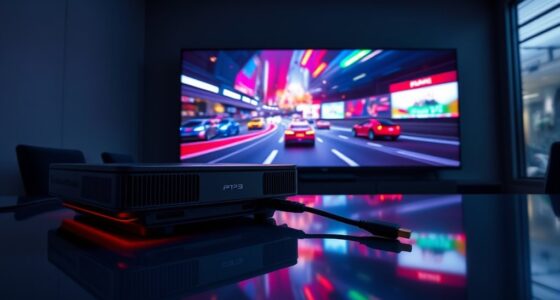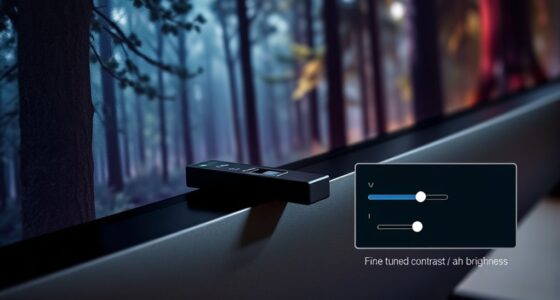

HDMI 2.1 plays a crucial role in next-gen gaming by supporting higher resolutions like 4K and 8K, and faster refresh rates for smoother gameplay. It reduces lag with features like Auto Low Latency Mode (ALLM) and eliminates screen tearing through Variable Refresh Rate (VRR). This guarantees you enjoy clearer visuals and a more responsive experience. Staying current with these innovations means your gaming setup is ready for the most immersive adventures ahead.
Key Takeaways
- HDMI 2.1 supports higher resolutions like 4K and 8K, enhancing visual clarity for next-gen gaming experiences.
- It enables VRR to reduce screen tearing and stuttering, ensuring smoother gameplay.
- HDMI 2.1 offers increased bandwidth for richer audio and advanced visual features, improving overall game immersion.
- It facilitates seamless connectivity with next-generation consoles and PCs, optimizing performance and responsiveness.
- HDMI 2.1 prepares the foundation for wireless and VR innovations, advancing future gaming and virtual reality experiences.
Understanding HDMI 2.1: The Fundamentals
Have you ever wondered what makes HDMI 2.1 a game-changer for next-gen gaming? It’s primarily about the improved audio quality that enhances your overall experience. HDMI 2.1 supports higher bandwidth, allowing for richer, more immersive sound through advanced audio formats. This means you’ll hear every detail clearly, whether you’re in a tense firefight or enjoying a cinematic cutscene. Additionally, the cable durability has been upgraded to handle the increased data transfer without wear and tear. The new cables are built tougher, so they last longer even with frequent plugging and unplugging. These fundamentals ensure that HDMI 2.1 not only boosts your gaming visuals but also provides a reliable, high-quality connection that endures the test of time. Practical tools help ensure you get the most out of your setup without the hype.
Enhancing Visuals With 4K and 8K Support
Wondering how HDMI 2.1 elevates your gaming visuals? It supports 4K and 8K resolutions, delivering sharper images with more detail. This enhancement means you experience richer color accuracy and smoother visuals. HDR enhancements further boost contrast and brightness, making colors pop and giving your games a more immersive look. To understand this better, here’s a quick comparison:
| Feature | 4K Support | 8K Support | HDR Enhancements |
|---|---|---|---|
| Resolution | Up to 3840×2160 | Up to 7680×4320 | Improves contrast, color depth |
| Color Accuracy | Improved | Remarkably | Enhanced brightness, contrast |
| Visual Clarity | Sharp details | Ultra-detailed | Vibrant, realistic colors |
These features work together to create stunning visuals, pulling you deeper into your gaming worlds.
The Impact of Variable Refresh Rate (VRR) on Gameplay
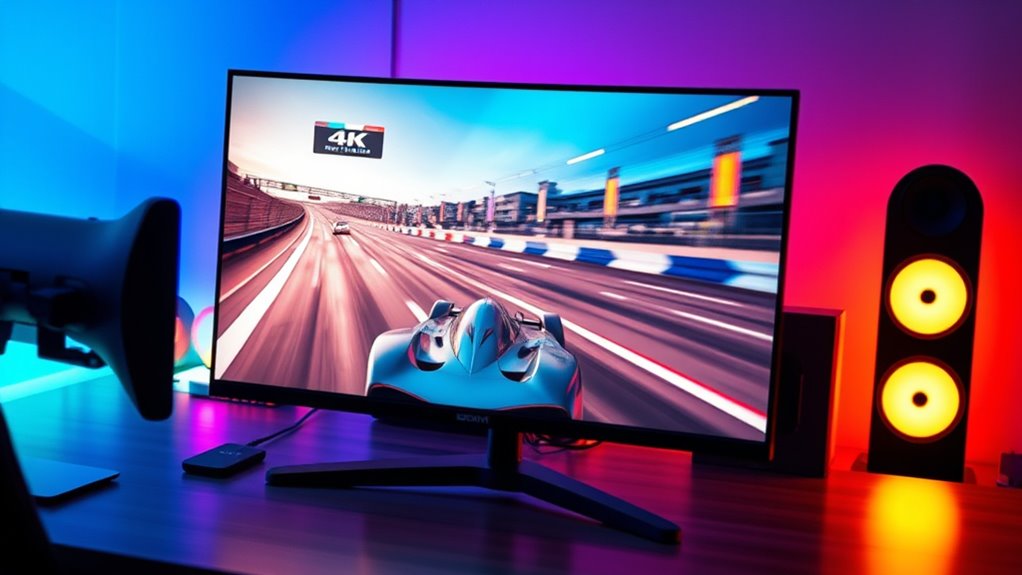
Ever notice how screen tearing or stuttering can ruin an otherwise smooth gaming experience? That’s where Variable Refresh Rate (VRR) makes a difference. VRR dynamically adjusts your display’s refresh rate to match your game’s frame rate, reducing issues like screen tearing and stuttering. Instead of waiting for a fixed refresh cycle, your screen updates in sync with each frame, ensuring fluid visuals even when the frame rate fluctuates. This smoothness not only enhances visual quality but also improves responsiveness, giving you a competitive edge. With HDMI 2.1 supporting VRR, you’ll experience more seamless gameplay, where graphics stay crisp and consistent, no matter how intense the action gets. Incorporating natural materials like wood and linen in your setup can further enhance the immersive experience. VRR truly transforms how you enjoy next-gen gaming, making every moment more immersive.
Reducing Latency With Auto Low Latency Mode (ALLM)
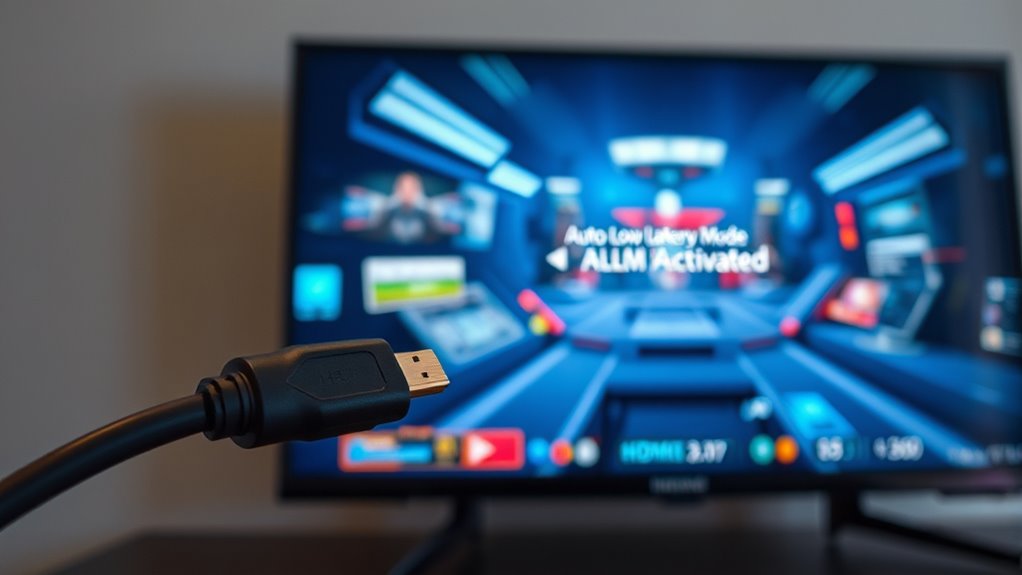
Auto Low Latency Mode (ALLM) automatically minimizes input lag by enabling your display to switch to a low-latency setting whenever you start a game or use a compatible device. This feature guarantees smoother gameplay, reducing delays between your actions and on-screen responses. With HDMI 2.1, ALLM also supports HDR enhancements, allowing your games to display richer visuals without sacrificing speed. Additionally, ALLM works alongside audio return to streamline your entertainment experience, minimizing latency for both video and sound. By automatically adjusting settings, you avoid manual changes and enjoy seamless transitions from browsing to gaming. Overall, ALLM helps you stay immersed in fast-paced games with minimal lag, making your gaming sessions more responsive and enjoyable. Incorporating merchant services into gaming setups can also facilitate easier payments for new hardware or subscriptions, enhancing your overall experience.
How HDMI 2.1 Enables Next-Gen Consoles and PCs
HDMI 2.1 transforms how next-generation consoles and PCs deliver gaming experiences by supporting higher resolutions, faster refresh rates, and advanced features. With this upgrade, you can enjoy ultra-smooth gameplay at 4K or even 8K, making visuals sharper and more detailed. The increased bandwidth allows for richer color profiles and immersive audio, elevating your gaming experience. HDMI licensing guarantees that your devices meet strict standards, promising top-tier performance and compatibility. This means your gaming accessories, like high-end monitors and sound systems, work seamlessly with your console or PC. By leveraging HDMI 2.1, developers and manufacturers can push the limits of graphics and performance, giving you a truly next-gen gaming experience that’s more immersive and responsive than ever before.
Compatibility and Cable Considerations for Optimal Performance
To achieve the best performance with HDMI 2.1, it’s vital to verify your cables and devices are fully compatible. Not all HDMI cables support the higher bandwidth and advanced features of HDMI 2.1, so choosing a cable with solid cable durability is essential. A durable cable ensures consistent connections and minimizes signal loss during intense gaming sessions. Check that your devices, such as consoles, TVs, and graphics cards, explicitly support HDMI 2.1 to unlock maximum performance. Using incompatible cables or devices can result in reduced resolution, lower refresh rates, or no signal at all. Investing in high-quality HDMI 2.1 cables and confirming device compatibility guarantees you get the most out of your next-gen gaming experience. Material durability is crucial to maintain long-term performance and prevent signal degradation over time.
Future Trends and Innovations in Gaming Connectivity
Wireless technology is rapidly advancing, making it easier for you to connect your devices without cables. These innovations will lead to smoother, more responsive gaming experiences. Additionally, enhanced VR capabilities will become more immersive and accessible as connectivity improves. Moreover, angel numbers can serve as spiritual guidance, inspiring gamers to embrace personal growth and transformation through their gaming journeys.
Wireless Integration Advances
As gaming technology evolves, wireless integration is poised to transform how you connect your devices, offering greater freedom and convenience. Imagine:
- Seamlessly switching between your console and mobile device without cables.
- Instantly syncing your controllers with multiple gaming systems.
- Effortlessly streaming high-quality audio and video without lag.
- Easily pairing accessories, like headsets, across different platforms.
These advances in wireless integration promote better device interoperability, reducing clutter and enhancing your gaming experience. You’ll no longer be limited by physical connections, allowing you to move freely and focus on gameplay. As wireless tech improves, expect faster data transfer, lower latency, and more reliable connections. This creates a future where your gaming setup is more flexible, responsive, and immersive, all driven by ongoing innovations in wireless integration, including advanced connectivity standards.
Enhanced VR Experiences
With wireless integration improving your gaming setup, the potential for enhanced VR experiences becomes even more exciting. HDMI 2.1 plays a key role by supporting higher bandwidth, reducing latency, and enabling ultra-high-definition visuals. This means your VR headsets can deliver sharper images with minimal lag, creating a more immersive environment. Improved connectivity guarantees smoother interactions with motion controllers, making movements feel more natural and responsive. Future innovations may include wireless VR headsets that seamlessly communicate with gaming consoles and PCs, eliminating cables and increasing freedom of movement. As technology advances, you’ll experience more realistic virtual worlds where your motions are instantly reflected, elevating the overall VR gaming experience to new levels of realism and engagement.
Frequently Asked Questions
Can HDMI 2.1 Support Multi-Monitor Gaming Setups Simultaneously?
Yes, HDMI 2.1 can support multi-monitor setups, enhancing your gaming performance. With its higher bandwidth, it allows you to connect multiple displays seamlessly, delivering high resolutions and refresh rates. This means you can enjoy smoother, more immersive gaming experiences across multiple screens. Just confirm your graphics card and monitors are compatible with HDMI 2.1 to maximize the benefits for your multi-monitor gaming setup.
How Does HDMI 2.1 Influence Audio Quality in Gaming?
HDMI 2.1 boosts your gaming experience by enhancing audio fidelity and sound synchronization. It transmits richer, clearer sound and reduces lag, making dialogues, sound effects, and music more immersive. With support for advanced audio formats, you get a more precise and synchronized audio experience that matches your gameplay. This improves your overall immersion, ensuring every sound detail aligns perfectly with visuals, heightening your enjoyment and competitive edge.
Are All HDMI Cables Compatible With HDMI 2.1 Features?
Not all HDMI cables support HDMI 2.1 features, so cable compatibility is crucial. You need to verify your cable is labeled as HDMI 2.1 or Ultra High-Speed to fully support the increased bandwidth and advanced features like 4K at 120Hz or 8K. Using incompatible cables can limit performance, so double-check the specifications before connecting your next-gen gaming setup to guarantee feature support and maximum performance.
What Are the Cost Differences Between HDMI 2.0 and HDMI 2.1 Cables?
They say “you get what you pay for,” and that’s true with HDMI cables. HDMI 2.1 cables usually cost more than HDMI 2.0 cables due to higher manufacturing costs and advanced features. The price comparison shows HDMI 2.1 cables can be 50% or more expensive, but they support higher bandwidth and better gaming performance. Investing a bit extra guarantees you’re prepared for next-gen gaming’s demands.
Does HDMI 2.1 Improve Online Gaming Latency Beyond Local Connections?
HDMI 2.1 doesn’t directly improve online gaming latency, but it enhances your experience by supporting higher refresh rates and increased color depth, which make visuals smoother and more vibrant. This means you’ll see less motion blur and richer colors, giving you a competitive edge. While it doesn’t reduce lag over the internet, HDMI 2.1 guarantees your local connections deliver the best possible picture quality for immersive gaming sessions.
Conclusion
As you plug into HDMI 2.1, imagine stepping into a world where every pixel is crystal clear, every moment seamless, and your gaming experience feels like an extension of your own reality. This technology acts as a bridge to the future, transforming your setup into a portal where visuals are sharper, latency is nearly invisible, and every game becomes an immersive adventure. Embrace HDMI 2.1, and access the true potential of your next-gen gaming journey.